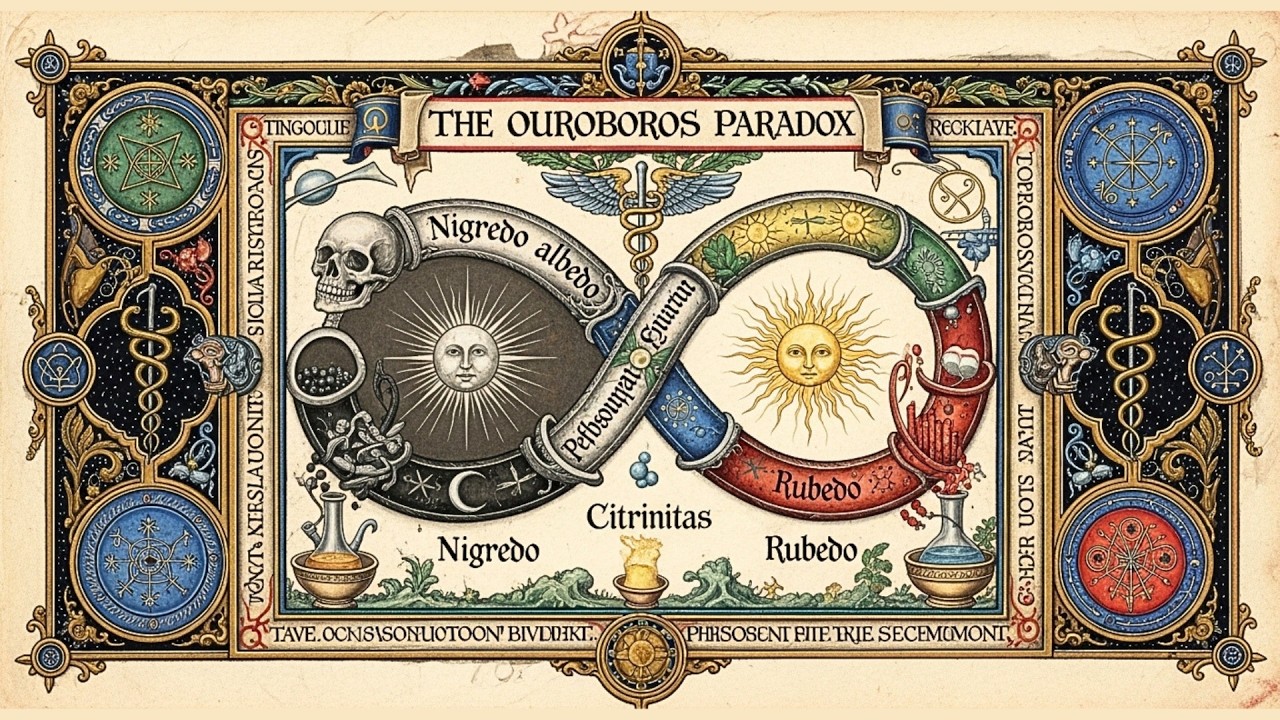
The Ouroboros Paradox — The Secret Psychic Cycle That Regenerates the Self
The Ouroboros — the ancient image of a serpent devouring its own tail — is perhaps the most misunderstood symbol in the Western esoteric tradition. Most people encounter it as a vague emblem of "eternity" or "infinity," a decorative motif on occult book covers. But for the alchemists, and later for Carl Jung, the Ouroboros represented something far more specific and far more psychologically dangerous: the paradox of self-regeneration through self-destruction.
The Prima Materia of the Psyche
In alchemical literature, the Ouroboros is associated with the Prima Materia — the chaotic, undifferentiated substance from which all transformation begins. The alchemists described it as "the thing that is everywhere and nowhere," the raw material that contains within itself both poison and cure.
Jung recognized this as a perfect description of the unconscious. The unconscious is precisely "the thing that is everywhere and nowhere" in our psychic life — it influences everything we do, yet we cannot directly perceive it. It contains our greatest fears and our greatest potential simultaneously.
The Kybalion
The seven Hermetic principles read closely, set beside the older sources, and applied.
About the book"The Ouroboros is a dramatic symbol for the integration and assimilation of the opposite, i.e., of the shadow. This process is at the same time a symbol of immortality, since it is said of the Ouroboros that he slays himself and brings himself to life, fertilizes himself and gives birth to himself."
The Cycle of Psychic Death and Rebirth
What makes the Ouroboros paradoxical — and what makes it so relevant to genuine inner work — is that it represents a process where the destroyer and the destroyed are the same entity. The serpent eats itself. The psyche dismantles itself. The ego must consume its own constructions in order to be reborn.
This is not metaphor. Anyone who has undergone a genuine psychological crisis — a dark night of the soul, a collapse of meaning, a shattering of identity — has experienced the Ouroboros cycle firsthand. The person you were had to die so the person you are becoming could emerge -- a process the alchemists called the death of the false self. And the instrument of that death was your own psyche turning against its former structures.
The Three Phases of the Ouroboros Cycle
Phase 1: The Devouring. Something in you begins to consume what you thought was solid. Your beliefs, your self-image, your certainties — they start dissolving. This corresponds to the alchemical Nigredo, the blackening that the Black Sun symbolizes. It feels like depression, confusion, or existential crisis. It is all of these things, and it is also the beginning of genuine transformation.
Phase 2: The Digestion. What was consumed is broken down into its essential elements. In psychological terms, this is the period where you sit with discomfort, uncertainty, and not-knowing. The old identity has been dissolved but the new one has not yet formed. This is the most difficult phase because there is nothing to hold onto.
Phase 3: The Regeneration. From the digested material, a new form emerges. Not a return to the old self, but a genuinely new configuration of the psyche. The serpent has completed its circuit. You are the same organism, but fundamentally reorganized.
Why Most People Get Stuck
The reason most people never complete the Ouroboros cycle is that they flee from Phase 1. The moment the devouring begins — the moment their certainties start cracking, their identity starts dissolving — they reach for anything that will stop the process. Distraction, denial, medication, new relationships, new jobs, new cities. Anything to avoid the terrifying sensation of being consumed by their own psyche.
But the Ouroboros cannot be escaped. It can only be delayed. And each delay makes the eventual cycle more violent, more disorienting, more difficult to navigate. The unlived transformation accumulates interest, like a debt to the unconscious that compounds over time.
The Alchemical Instruction
The alchemists had a specific instruction for working with the Ouroboros: "Do not interrupt the circulation." Let the process complete itself. Do not try to save the old form. Do not try to rush the new one. Sit in the fire of transformation and let it do its work.
This is not passivity. It requires enormous courage and enormous discipline. It requires the capacity to tolerate what Jung called the "tension of opposites" — the simultaneous experience of death and birth, destruction and creation, ending and beginning.
The Ouroboros teaches us that these are not sequential events but simultaneous ones. The end is contained in the beginning. The death is contained in the birth. The poison is the cure.
This is the paradox that regenerates the Self.
This essay is educational and historical. It describes how alchemical and psychological traditions have interpreted human experience. It is not medical or psychological advice, not a diagnosis, and not a substitute for care from a qualified mental health professional. If you are not sleeping, if you believe you have been given a special mission, if people close to you have expressed concern, or if you are hearing or seeing things others do not, please contact a licensed practitioner or a crisis line in your country today.
Go Deeper
This article is derived from our video teaching. For the complete exploration with visual symbolism and guided reflection, watch the full lesson on YouTube.
Watch on YouTube Get The Magnum Opus