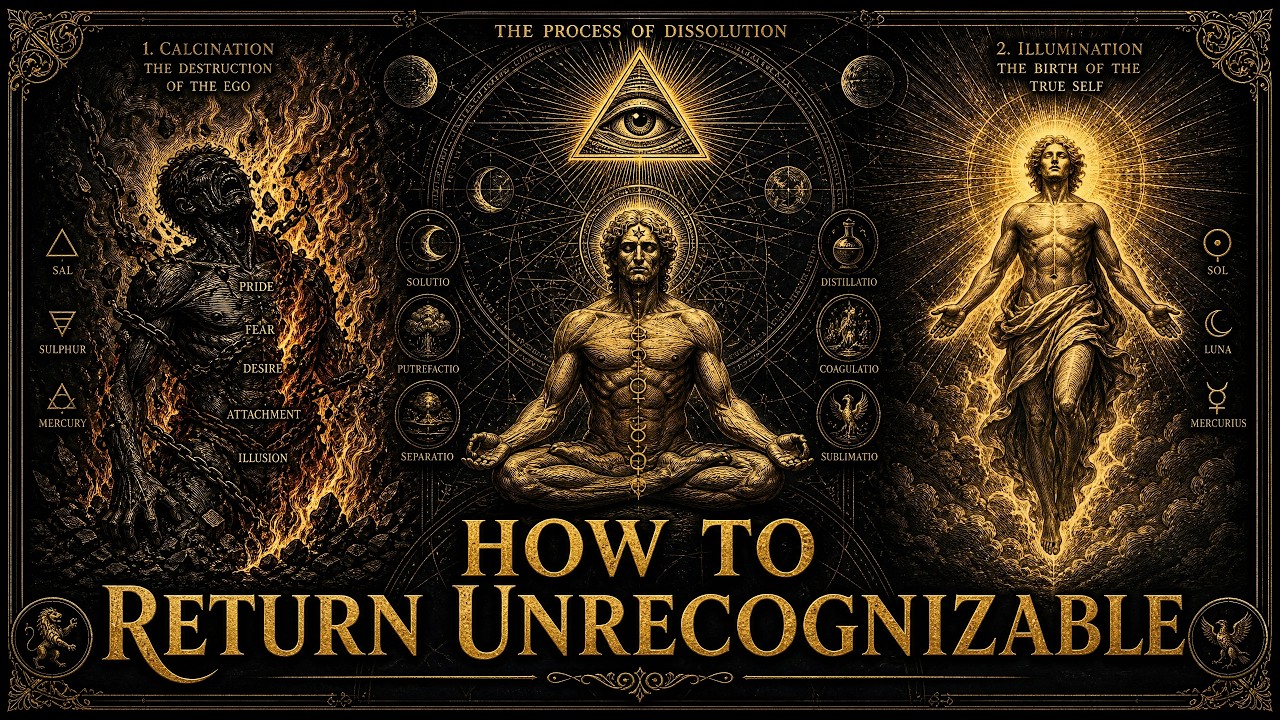
The Alchemical Art of Truly Disappearing — How to Return Unrecognizable
Have you ever felt like a stranger in your own life? That quiet dissonance between who the world sees and who you sense you are becoming is not a malfunction. It is an invitation. Throughout the ages, the great alchemists understood something that modern psychology is only now beginning to articulate: true transformation requires a period of radical withdrawal. Not escapism. Not avoidance. But a deliberate, conscious retreat from the stage of ordinary life so that the deeper work of dissolution and rebirth can unfold without interference. This is the alchemical art of disappearing -- and it is one of the most potent, most misunderstood practices in the Western esoteric tradition.
The idea of voluntary isolation as a vehicle for transformation appears across every initiatory tradition. The shaman retreats to the wilderness. The monk enters the cell. The mystic withdraws into silence. In alchemy, this phase corresponds to the Nigredo -- the blackening, the putrefaction, the necessary death of the old self. What distinguishes the alchemical approach from mere solitude is its intentionality. The alchemist does not simply leave the world; the alchemist enters the vessel. And within that sealed container, the raw matter of the psyche is subjected to fire, pressure, and time until something entirely new crystallizes.
The Sealed Vessel: Why Transformation Demands Containment
Carl Jung recognized that the alchemical vessel -- the vas hermeticum -- was a profound symbol for the therapeutic container. Just as the alchemist must seal the flask to prevent the volatile spirits from escaping, the individual undergoing deep psychological transformation must create boundaries around the process. When you disappear from the world's gaze, you are effectively sealing yourself within the alchemical retort. Every social interaction, every explanation you offer to others about your process, every attempt to maintain your old identity while simultaneously dissolving it -- these are cracks in the vessel. They allow the psychic heat to dissipate before the work is done.
The Alchemist’s Path
The whole sequence, stage by stage: how Jung read the alchemists and what each operation asks of a life.
About the bookThis is why the alchemists insisted on secrecy. It was never about elitism or exclusion. It was about the practical understanding that transformation, like a chemical reaction, requires specific conditions. Exposure to the wrong elements at the wrong time can ruin the entire operation. The person who announces their transformation on social media, who seeks validation for their withdrawal, who explains their inner process to people incapable of understanding it -- that person has broken the seal. The volatile mercury of the soul escapes, and the work must begin again from scratch.
"One does not become enlightened by imagining figures of light, but by making the darkness conscious." -- C.G. Jung
There is a specific quality to the darkness that envelops the one who truly disappears. It is not the comfortable darkness of rest or the passive darkness of depression. It is the active, purposeful darkness of the alchemical furnace -- the athanor -- where the heat is carefully regulated and the operator watches with unwavering attention. In this darkness, every unresolved wound, every unexamined belief, every borrowed identity rises to the surface like dross in molten metal. The temptation to flee this confrontation is enormous. But the alchemist understands that what rises must be seen, acknowledged, and ultimately consumed by the fire of conscious awareness.
The Death Before Death: Ego Dissolution and the Hermetic Rebirth
What actually happens during this period of disappearance? The alchemists described it as a death -- the mortificatio. The ego structure that has been built over a lifetime, layer by careful layer, begins to dismantle -- what we explore more deeply in the alchemical death of the false self. Not through violence, but through the patient application of truth. Every role you have played, every mask you have worn, every compromise you have made with your own authenticity -- all of it enters the crucible. And in the heat of genuine self-examination, these structures do not merely change. They die. This is not metaphorical. The person you were before the Great Work genuinely ceases to exist.
Jung described this process as the confrontation with the Shadow -- what the alchemists symbolized as the Black Sun and shadow dissolution -- the sum total of everything the conscious personality has rejected, denied, or refused to acknowledge. But the alchemical tradition goes further. It suggests that within the Shadow lies not only what you have repressed, but what you have not yet become. The gold is hidden in the lead. The philosopher's stone is buried in the most despised and rejected substance. When you disappear from the world, you are not running away from life. You are running toward the most essential, most terrifying encounter of your existence: the meeting with your own totality.
The return is what distinguishes the alchemist from the hermit. The alchemist always returns. But the person who returns is not the person who left. The old relationships may no longer fit. The old ambitions may feel hollow. The old fears may have lost their power entirely. People who knew you before will sense that something fundamental has shifted, but they will struggle to name it. You have not simply changed your habits or your appearance. You have undergone a transmutation at the level of your very substance. You have returned unrecognizable -- not because you have hidden yourself more skillfully, but because the self they once knew has been consumed in the fire and something new has taken its place.
Practicing the Art of Sacred Withdrawal
The practical application of this teaching does not require you to vanish into a cave for years, though some traditions have certainly embraced that path. What it requires is the willingness to create periods of genuine containment in your life -- intervals where you stop performing your identity for others and begin the honest labor of examining what remains when the performance ends. Reduce the noise. Limit the social input. Stop explaining yourself. Let the people around you wonder. Let them project. Let them forget you for a while. In that forgetting, in that blessed absence from the world's mirror, you may finally discover what the alchemists have always promised: that the true gold was never outside you, waiting to be found. It was inside you, waiting to be forged.
This essay is educational and historical. It describes how alchemical and psychological traditions have interpreted human experience. It is not medical or psychological advice, not a diagnosis, and not a substitute for care from a qualified mental health professional. If you are not sleeping, if you believe you have been given a special mission, if people close to you have expressed concern, or if you are hearing or seeing things others do not, please contact a licensed practitioner or a crisis line in your country today.
Go Deeper
Watch the complete teaching with visual symbolism and guided reflection on our YouTube channel.
Watch on YouTube Get Never React. Never Explain