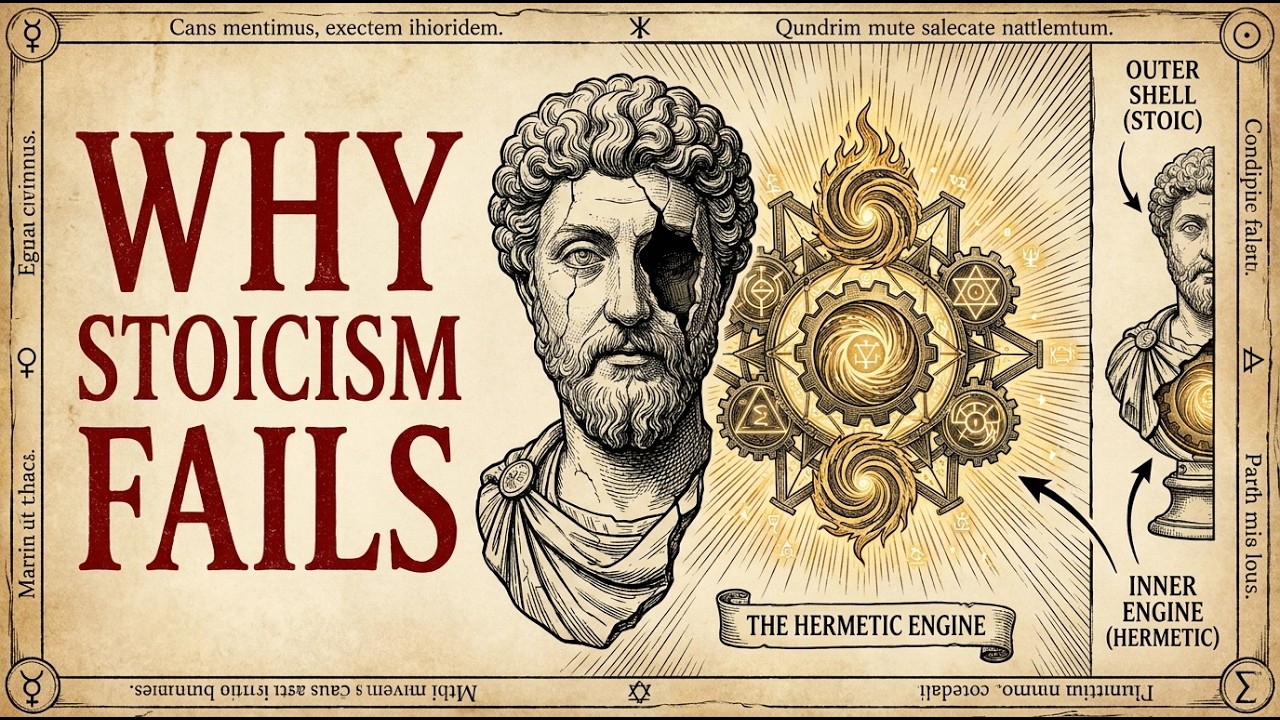
Why Stoicism Always Breaks Down — And the Tradition It Was Secretly Derived From
You read the books. You practiced the discipline. You told yourself the obstacle was the way. And for a while, it held — until something arrived that your philosophy had no shelf for, and the calm you had constructed so carefully revealed itself for what it always was: a wall, not a foundation. The grief came, or the betrayal, or the encounter with something so numinous and terrifying that no amount of rational reframing could contain it. And in that moment, Stoicism did what it always eventually does — it broke. Not because you failed to practice it correctly, but because the philosophy itself is structurally incomplete. It is a magnificent architecture built on a foundation it borrowed from somewhere else and then forgot to acknowledge.
This is not a dismissal of Stoicism. Marcus Aurelius, Epictetus, and Seneca produced some of the most penetrating psychological insights in the history of Western thought. Their emphasis on the governance of attention, the sovereignty of the inner life, and the discipline of perception remains profoundly valuable. But there is a fatal crack running through the Stoic edifice, and it becomes visible only under the weight of genuine existential pressure: Stoicism teaches you to endure. It does not teach you to transform. And endurance without transformation is just suffering with better posture.
The Hermetic Roots That Stoicism Forgot
The historical relationship between Stoicism and Hermeticism is far more intimate than most scholars acknowledge. Both traditions emerged from the philosophical ferment of the Hellenistic world. Both drew from Egyptian wisdom traditions. Both recognized the Logos — the divine rational principle — as the ordering intelligence of the cosmos. But where the Hermetic tradition preserved the transformative, alchemical dimension of this insight, Stoicism increasingly reduced it to an ethical framework. The fire of the Logos, which in Hermeticism was understood as the agent of genuine inner transmutation, became in Stoicism merely a metaphor for rational self-governance.
The Kybalion
The seven Hermetic principles read closely, set beside the older sources, and applied.
About the bookThis is not a minor philosophical difference. It is the difference between a teaching that changes what you are and a teaching that changes how you cope. The Hermetic tradition — and the spiritual alchemy that grew from it — understood that the human being is not a fixed entity that must learn to endure an indifferent universe. The human being is an alchemical substance, a living process, capable of genuine metamorphosis. The lead of unconscious suffering is not simply to be borne with dignity. It is to be transmuted into gold through a precise interior operation that Stoicism, in its mature form, had no language for and no method to achieve.
"The mind is not a vessel to be filled, but a fire to be kindled." — Plutarch, drawing on Hermetic-Platonic sources
Consider the Stoic approach to grief. You are told to accept what cannot be changed. You are counseled to recognize that your distress comes not from the event itself but from your judgment about the event. This is psychologically sophisticated — and up to a point, it is genuinely helpful. But notice what it does not do: it does not engage the grief as a transformative substance. It does not ask what the grief is trying to dissolve in you, what outgrown identity it is burning away, what deeper self is trying to emerge through the pain. It simply manages the symptom. The alchemical tradition, by contrast, recognizes grief as a form of nigredo — the necessary blackening, the putrefaction of the old self — and works with it as the raw material of a new becoming.
Endurance Without Transformation Shatters
The reason Stoicism eventually breaks down is structural, not circumstantial. A philosophy of emotional regulation can only hold as long as the emotions being regulated remain within manageable intensity. But life, eventually, sends something that exceeds the capacity of regulation. The death of a child. A confrontation with the numinous. An encounter with evil so profound that no rational reframing can domesticate it. In these moments, the Stoic discovers that the wall they built was load-bearing only up to a point — and the load has just exceeded that point.
What happens then is psychologically predictable: either collapse or dissociation. The Stoic who cannot endure any further either shatters into the grief and rage they have been holding at bay for years, or they retreat into an even more rigid numbness, cutting themselves off from the feeling dimension entirely. Neither outcome is transformation. Neither outcome produces gold. Both are simply different forms of the same failure — the failure of a system that was designed to manage emotional life rather than alchemize it.
The Path Beyond Endurance
The Hermetic tradition offers something Stoicism cannot: a technology of transmutation. Not the mere management of inner states, but their genuine conversion from one substance to another. The anger is not suppressed or reframed. It is worked with, in the sealed vessel of conscious attention — what the Hermetic tradition calls the silent observer — until its volatile fire separates from its destructive smoke and becomes the refined energy of will. The grief is not simply accepted. It is entered, fully and deliberately, as the alchemist enters the nigredo, knowing that the blackening is not the end but the necessary precondition for the whitening that follows.
Jung recognized this distinction clearly. His entire model of individuation — the integration of the shadow, the encounter with the anima and animus, the dissolution and reconstitution of the ego — is far more alchemical than Stoic. Jung did not advise his patients to simply endure their neuroses with philosophical detachment. He guided them into the underworld of their own psyches, into direct confrontation with the autonomous complexes and archetypal forces that no amount of rational governance can control. This is the path of genuine emotional transmutation rather than mere emotional management. He understood that the soul does not want to be managed. It wants to be transformed.
If Stoicism has brought you this far, honor it. It gave you discipline, it gave you the ability to withstand, it gave you the sovereignty of inner attention. But do not mistake the scaffolding for the building. The discipline of endurance was preparation — not the work itself. The real work begins where Stoicism ends: in the fire that does not merely test you but changes you, in the descent that does not merely challenge you but dissolves who you were so that who you truly are can finally emerge. This is the promise of the Hermetic tradition. This is the path that Stoicism was always pointing toward but could never quite name. The obstacle is not the way. The obstacle is the raw material. And the way is transmutation — the Hermetic secret that renders external circumstances powerless over the sovereign mind.
Works Named in This Essay
- Three Initiates, The Kybalion (1908).
- Marcus Aurelius, Meditations (2nd century).
- Epictetus, Discourses and Enchiridion (2nd century).
- Seneca, Letters to Lucilius (1st century).
This essay is educational and historical. It describes how alchemical and psychological traditions have interpreted human experience. It is not medical or psychological advice, not a diagnosis, and not a substitute for care from a qualified mental health professional. If you are not sleeping, if you believe you have been given a special mission, if people close to you have expressed concern, or if you are hearing or seeing things others do not, please contact a licensed practitioner or a crisis line in your country today.
Go Deeper
Watch the complete teaching with visual symbolism and guided reflection on our YouTube channel.
Watch on YouTube Get The Kybalion