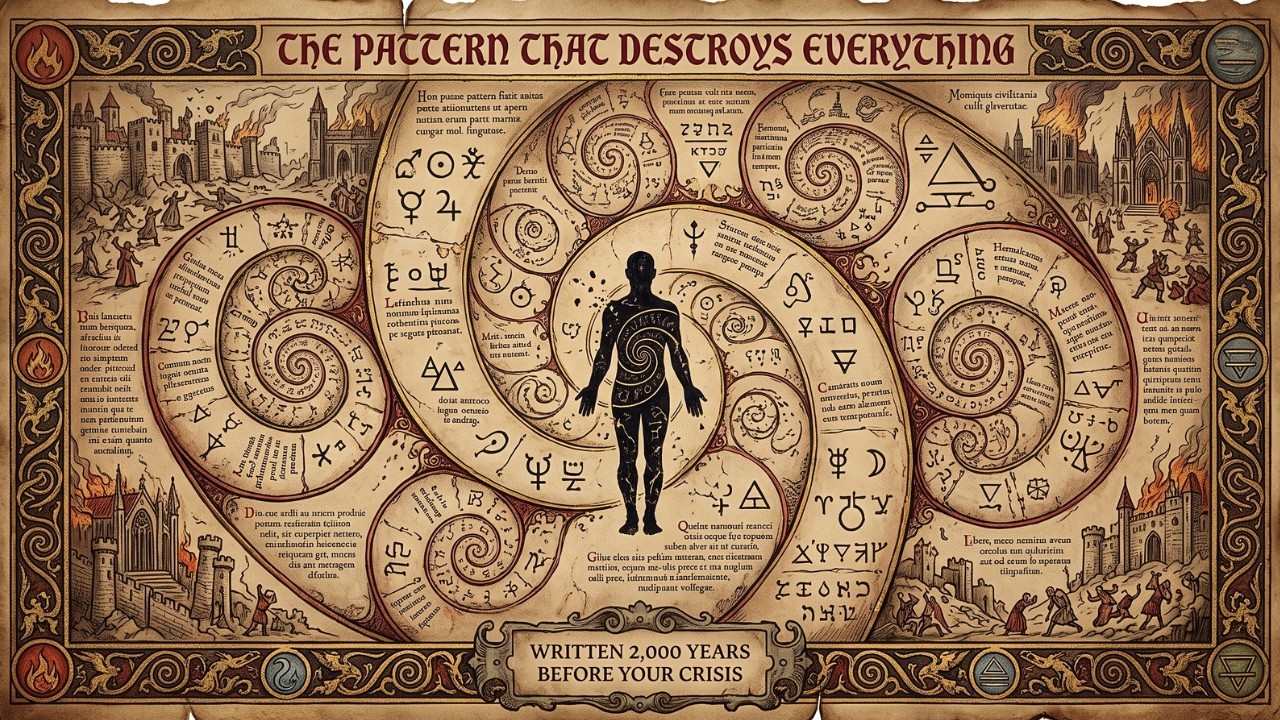
Every Personal Collapse Follows This Alchemical Pattern — Written 2,000 Years Ago
Every human life, no matter how meticulously engineered, possesses a hidden fault line. We watch individuals climb to the apex of professional, material, or intellectual success, only to witness an abrupt, catastrophic implosion that defies rational explanation. To the modern observer, these sudden downfalls are classified as behavioral anomalies, nervous breakdowns, or mere tactical failures. Yet, when we strip away the superficial noise of contemporary life, an unsettling consistency emerges. The architecture of human ruin is not random. It follows a precise, recurring geometry — a pattern so ancient, so universally consistent, that it points to an underlying law governing the human psyche.
Two thousand years ago, in the syncretic melting pot of Greco-Roman Egypt, the authors of the Hermetica — the foundational text attributed to Hermes Trismegistus — did not view human existence as a series of linear, material events. They understood reality as a manifestation of immutable metaphysical principles operating simultaneously across the macrocosm of the universe and the microcosm of the individual mind. What the modern world diagnoses as a psychological collapse, the ancient Hermetic masters recognized as something far more profound: a forced alchemical dissolution.
The Principle of Mentalism and the Architecture of Collapse
The opening axiom of The Kybalion states that "The All is Mind; the Universe is Mental." In this framework, physical matter, economic systems, and biological bodies are not independent primary realities — they are final, crystallized expressions of an underlying mental matrix. Any disruption observed in the physical world is merely a delayed reflection of a structural failure that has already occurred within the invisible mental architecture of the subject.
The Hermetica asserts that human beings are unique in their dual nature. We are simultaneously bound to the physical laws of the cosmos (Heimarmene, or fate) and endowed with a spark of the divine intellect (Nous). When an individual operates solely within the material domain, seeking to build permanence out of impermanent materials, they commit a fundamental epistemological error. They treat the reflection as the source. They build an identity predicated on external validation, wealth, social status, or rigid intellectual models — a false temple built upon sand.
Why Awakening Hurts
A psychological guide to spiritual breakdown: why the dark night hurts, what it is doing, and when it is something else.
About the bookThe Law of Polarity and the Mechanics of the Pendulum
The core diagnostic tool of the ancient texts lies in the law of polarity and the law of rhythm. The universe maintains its equilibrium through a continuous rhythmic swing between opposing poles. If an individual pushes excessively in one direction — accumulating wealth without spiritual alignment, cultivating an intellectual persona while repressing their shadow, or maintaining an artificial facade of total control — they create an extreme energetic deficit. The further the pendulum is swung by the human ego, the greater the kinetic energy stored within the opposite pole. The subsequent crash is not an external accident — it is the universe pulling the pendulum back to center.
Modern psychology looks at an executive who destroys his career in a single night of reckless behavior and calls it self-sabotage. The Hermetic philosopher looks at the same event and diagnoses it as a systemic release of repressed polar pressure. The individual's ego had created a highly pressurized, unsustainable state of artificial perfection. The psyche, seeking equilibrium at all costs, engineered its own destruction to shatter the illusion.
The architect of your collapse is never an external enemy, a bad economic cycle, or a treacherous associate. The architect is your own unexamined mind, which has constructed a life incompatible with the natural laws of the cosmos.
The Seven Stages of Alchemical Dissolution
The alchemists who inherited the esoteric core of the Hermetic texts masked this psychological reality behind physical metaphors. The sequence of the Magnum Opus — the Great Work — provides an exact step-by-step diagnostic manual for the breakdown and eventual reconstruction of the individual. Every personal collapse matches these stages with terrifying precision.
Calcination — the initial assault of reality upon the human ego, closely related to the experience of the Black Sun and shadow dissolution. When the fires of life intensify through unexpected loss, betrayal, or an internal crisis of meaning, the false certainties are turned to dust. The individual experiences a profound identity crisis as everything they thought they knew about themselves begins to incinerate.
Dissolution — the breaking of the mental floodgates. The individual is submerged in the contents of their own subconscious mind. They can no longer regulate their emotional responses. Wealth, status, and social obligations appear as meaningless props. The Hermetica describes this as a necessary submersion into the prima materia.
Separation — the first moment of conscious critical awareness. Sitting amidst the ruins, the individual performs a brutal intellectual autopsy: "What part of my life was genuinely true, and what part was merely an artificial construct?"
Conjunction — the marriage of opposites. The individual integrates their conscious ego with the contents of the subconscious mind. They acknowledge their shadow instead of pretending it does not exist, striving for wholeness rather than perfection.
Fermentation — arguably the darkest hour. The remnants of the old self die a slow, agonizing death. Yet within this rotting matter, the spiritual seed germinates. The density of the human ego must be completely broken down so that the subtle spiritual intellect can break through.
Distillation — purification through repeated testing. The individual is put back into the world and subjected to the same old temptations. The volatile, reactive elements of the personality are systematically boiled away until only pure essence remains.
Coagulation — the birth of the integrated sovereign individual. The person emerges not merely recovered, but entirely transfigured. They possess an unshakable internal gravity, no longer susceptible to the flattery of the world or the terror of its sudden changes. They have moved from lead to gold.
The Dark Night of the Soul
The transition between dissolution and fermentation presents an existential crisis so severe that it threatens the very survival of the individual. Many experience this phase as what we explore in transmuting depression through the Nigredo. The old self has definitively died, but the new self has not yet been born. Rational thought becomes a weapon the mind turns against itself. Every logical path leads back to despair.
The most insidious temptation is the desire to regress — to crawl back into the ruins of the old life and patch together the broken pieces of the false ego. But the ancient texts warn that regression is not only impossible, it is metaphysically dangerous. Once the alchemical fire has been lit, any attempt to abort the process halfway results in permanent psychological stagnation. One must instead honor the alchemical law of natural timing and allow the process to unfold at its own pace.
The pain is directly proportional to your resistance. The dark night demands nothing less than absolute surrender — not to external defeat, but a surrender of the ego's claim to absolute authority. Only when this total capitulation occurs does the downward trajectory halt. The serpent of the abyss transforms into the light of the true intellect.
The Emergence of the Sovereign Self
The individual who emerges from the alchemical crucible bears little resemblance to the person who entered it. Before the collapse, life was outer-directed, governed by the shifting expectations of society and the desperate need to control external variables. After integration, life becomes inner-directed, anchored in the immutable laws of the Nous.
Having faced the absolute dissolution of their identity and survived, the integrated individual develops a unique immunity to existential terror. They no longer fear failure, loss of status, or social rejection — because they have already visited those depths and discovered that the core of their being remained untouched. The things they lost during the collapse were not their true self, but merely structural baggage they had mistakenly identified with.
The scars of collapse remain, but they are no longer marks of shame. They are the precise lines where the lead was broken to let the gold shine through. True mastery is not the subjection of the external world to your fragile will, but the absolute surrender of your illusion of control to the immutable, eternal architecture of the sovereign mind within.
Works Named in This Essay
- Three Initiates, The Kybalion (1908).
This essay is educational and historical. It describes how alchemical and psychological traditions have interpreted human experience. It is not medical or psychological advice, not a diagnosis, and not a substitute for care from a qualified mental health professional. If you are not sleeping, if you believe you have been given a special mission, if people close to you have expressed concern, or if you are hearing or seeing things others do not, please contact a licensed practitioner or a crisis line in your country today.
Go Deeper
Watch the complete teaching with visual symbolism and guided reflection on our YouTube channel.
Watch on YouTube Get Why Awakening Hurts