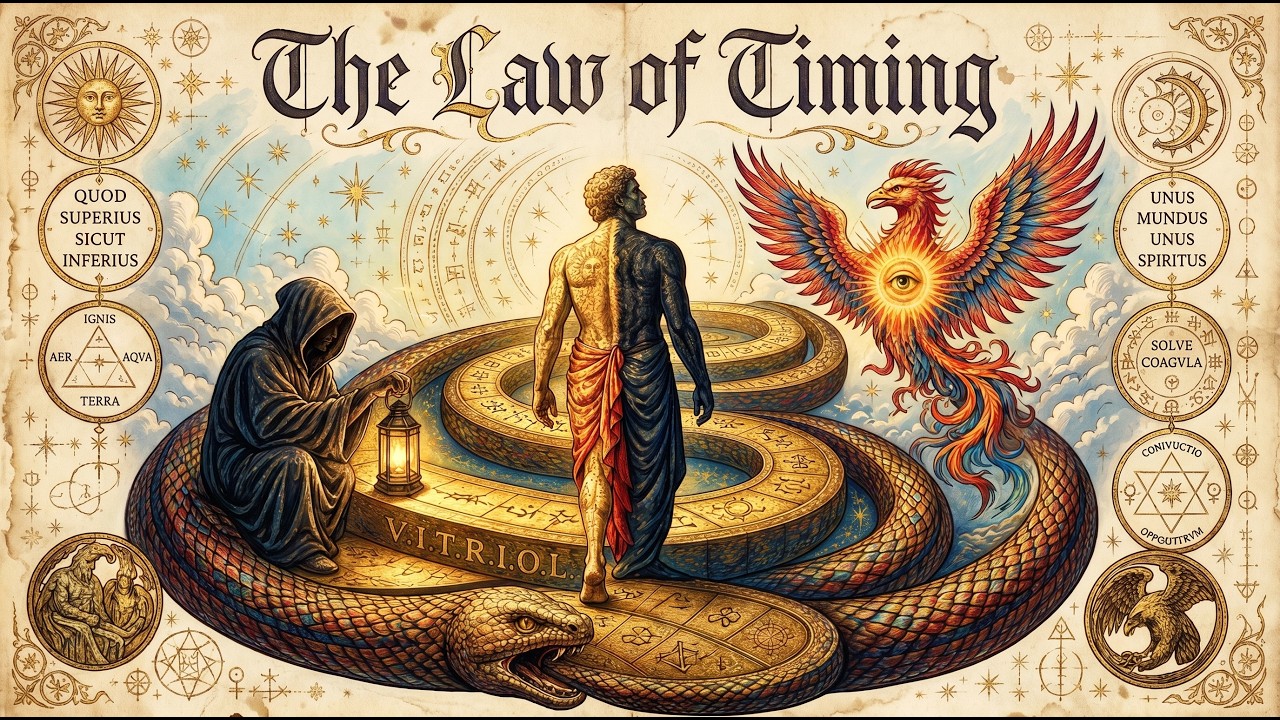
Never Force the Process. The Alchemical Law of Natural Timing — Jung + Hermeticism
Have you ever woken up and realized the architecture of your life no longer belongs to you? The ambitions, routines, and identity you once carefully built suddenly feel hollow, as if you are wearing the costume of a character you no longer play. Something within you has shifted — quietly, irrevocably — and now everything around you feels like it belongs to a version of you that has already died. This disorientation is not a crisis. It is the beginning of a genuine alchemical process. But here is where most people destroy what could become their greatest transformation: they try to force it. They try to rush the dissolution, accelerate the rebirth, skip the uncomfortable middle, and arrive at gold before the fire has done its patient, necessary work.
The alchemists had a term for this impatience: they called it the error of the puffer — the amateur who cranks up the heat, who forces the retort, who tries to compress into days what nature requires months or years to complete. And the result is always the same. The vessel shatters. The substance is ruined. The Work must begin again from nothing. This is not just a historical curiosity about medieval chemistry. It is a precise description of what happens to the human psyche when transformation is forced rather than allowed.
The Kairos: Jung and the Right Moment
Carl Jung drew deeply from both alchemical symbolism and ancient Greek philosophy, and one concept he returned to again and again was the distinction between chronos and kairos. Chronos is clock time — mechanical, linear, indifferent. It is the time of schedules, deadlines, and the ego's anxious demand that progress be measurable and constant. Kairos is something entirely different. It is the pregnant moment, the ripened instant when conditions have aligned and transformation becomes not just possible but inevitable. The kairos cannot be manufactured. It can only be prepared for and recognized.
The Nigredo Journal
Thirty days of guided shadow work, with a prompt and an alchemical reflection for each day of the descent.
About the bookJung observed in his clinical practice that the most profound psychological breakthroughs never arrived on schedule. They could not be forced by the analyst or willed into existence by the patient. They came when the unconscious was ready to release what it had been holding — when the dream delivered the symbol, when the crisis produced the insight, when the suffering had done its slow, invisible work of dissolving the old structure so that the new one could emerge. Every attempt to rush this process, Jung noted, either produced a superficial change that quickly collapsed, or worse, triggered a psychological inflation where the ego claimed a transformation it had not actually undergone.
"The right way to wholeness is made up of fateful detours and wrong turnings." — Carl Jung
This is deeply uncomfortable for the modern mind. We live in a civilization that worships speed, efficiency, and the illusion of control. We want our healing to be linear. We want our awakening to follow a timeline. We want to know how long the dark night will last and what the transformation will look like when it arrives. But the Hermetic tradition — and Jung after it — insists that this demand for control is itself part of the problem. The ego that wants to manage the transformation is the very structure that must be dissolved by it.
The Alchemical Stages Cannot Be Skipped
In classical alchemy, the Great Work unfolds through specific stages: the nigredo, or blackening, where the old form is destroyed; the albedo, or whitening, where purification begins; the citrinitas, or yellowing, where the first light of new consciousness dawns; and finally the rubedo, the reddening, the full realization of the Philosopher's Stone. Each stage has its own duration, its own quality, its own necessary suffering. And the alchemists were adamant: no stage can be skipped. No stage can be artificially shortened without catastrophic consequences to the entire operation.
The nigredo — the darkening — is where most people try to force the process. The dissolution of the old self is agonizing — and as we explore in depth elsewhere, every personal collapse follows this alchemical pattern. The loss of familiar identity, the collapse of relationships that were built on who you used to be, the raw exposure of wounds you thought you had healed — none of this is pleasant. The ego screams for relief. It demands a shortcut. It reaches for spiritual bypassing, for premature positivity, for any technique that promises to end the pain without actually completing the work that the pain is doing. But the fire cannot be rushed. The blackening must be complete before the whitening can begin. Skip the nigredo, and you carry its unfinished business into every subsequent stage, contaminating the gold with unprocessed lead.
Surrender Is Not Passivity
The alchemical law of natural timing does not demand passivity. It demands something far more difficult: active surrender. This means remaining fully present to the process — feeling what must be felt, facing what must be faced, holding the tension of opposites without resolving it prematurely — while simultaneously releasing the ego's compulsive need to control the outcome. It is the posture of the skilled alchemist who watches the fire, who tends the vessel, who observes the colors changing in the retort, but who does not reach in and try to pull the gold out before it has fully formed.
Jung called this holding the tension of opposites, and he considered it the single most important psychological capacity a human being could develop. The ability to be in the middle — between who you were and who you are becoming, between the death of the old and the birth of the new — without collapsing into either side. This is the crucible. This is the furnace. And the fire within it operates on its own sacred timing, responsive not to your impatience but to the deep intelligence of the soul itself. This is especially true during the midlife passage, when the second half of life demands an entirely new relationship with time and purpose.
Trust the process. Not blindly, not passively, but with the quiet confidence of someone who understands that the forces at work within you are older, wiser, and more powerful than your ego's desperate need for certainty. The gold will come. The transformation will complete itself. But only if you have the courage to let the fire burn at its own pace, in its own time, according to laws that were ancient before you were born.
This essay is educational and historical. It describes how alchemical and psychological traditions have interpreted human experience. It is not medical or psychological advice, not a diagnosis, and not a substitute for care from a qualified mental health professional. If you are not sleeping, if you believe you have been given a special mission, if people close to you have expressed concern, or if you are hearing or seeing things others do not, please contact a licensed practitioner or a crisis line in your country today.
Go Deeper
Watch the complete teaching with visual symbolism and guided reflection on our YouTube channel.
Watch on YouTube Get The Magnum Opus