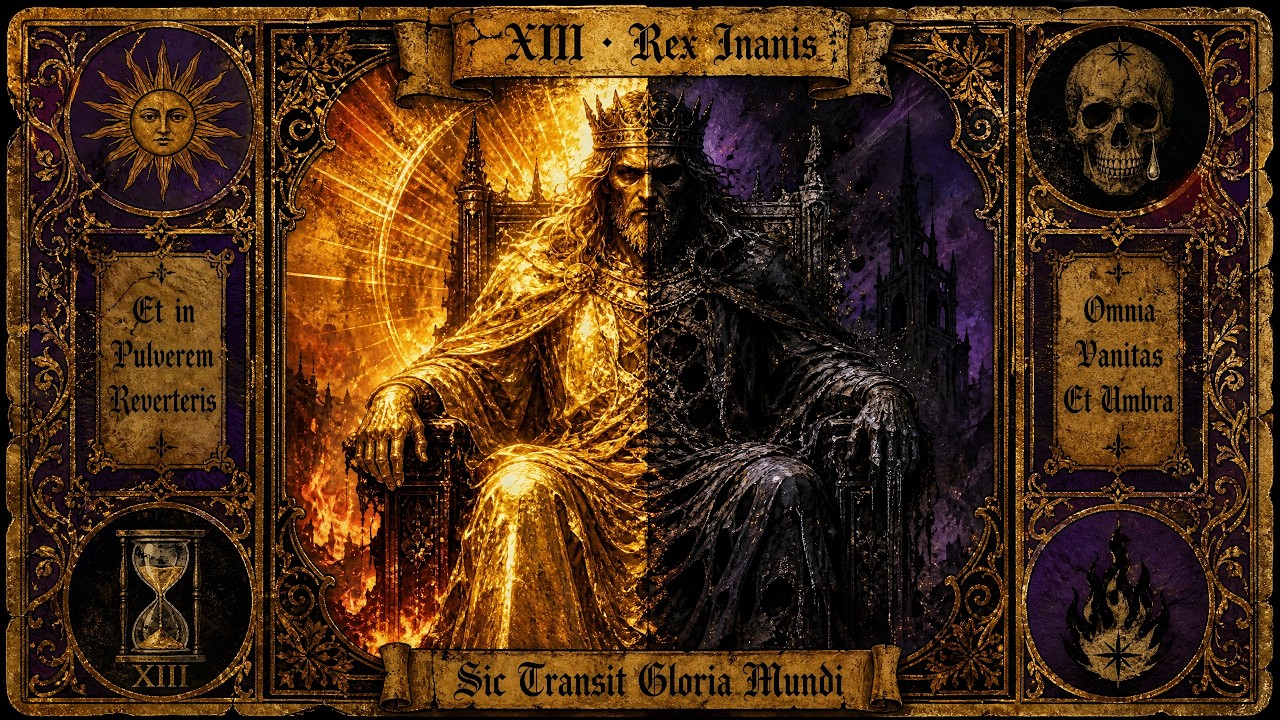
The Midlife Alchemy— How the Second Half of Life Demands a New Self
There comes a moment — usually somewhere between the ages of thirty-five and fifty — when the life you have so carefully constructed begins to feel like a prison. The career that once gave you purpose now drains you. The relationships that once defined you now feel like roles in someone else's play. The ambitions that once propelled you forward now ring hollow, like echoes in an empty cathedral. This is not depression. This is not failure. This is the call of the Self — the deeper, truer center of your being — demanding that you finally turn inward and begin the second great labor of your existence. Carl Jung understood this passage more profoundly than any psychologist before or since, and he recognized it for exactly what it is: an alchemical process.
Jung observed that the first half of life is devoted to the construction of the ego. You build an identity, a persona, a place in the world. You answer the questions that society demands of you: What will you do? Who will you marry? What will you achieve? These are necessary tasks, and there is no shame in having pursued them. The ego is not the enemy — it is the vessel. But it is not the destination. The vessel was built to carry something, and in the first half of life, most people never ask what that something is. They mistake the container for the contents.
The Noon of Life and the Reversal of Values
Jung used a powerful metaphor to describe this transition. He compared human life to the arc of the sun. In the morning, the sun rises — it expands, gains altitude, illuminates the external world. This is youth: outward, ambitious, conquering. But at noon, the sun begins its descent. It does not stop shining — in fact, its light often becomes richer, warmer, more golden. But its direction reverses. It moves now toward the horizon, toward the inner world, toward depth rather than height. The tragedy, Jung noted, is that most people try to live the afternoon of life according to the program of the morning. They keep climbing when the soul demands they descend.
The Magnum Opus
The complete map of the Great Work: four stages and twelve operations, with the psychology of each.
About the bookIn alchemical terms, this midlife reversal corresponds to the transition from the Albedo — the whitening, the purification of the ego — to the Rubedo, the reddening, the integration of the total personality. But this transition cannot happen without first passing through a second encounter with the Nigredo, the blackening. The carefully constructed identity must be dissolved, at least partially, so that the deeper Self can emerge. This is why midlife so often feels like a death. Because it is one. The person you were — the achiever, the provider, the performer — must die so that the person you truly are can finally be born. This is the same pattern that underlies every personal collapse in the alchemical tradition.
"Thoroughly unprepared, we take the step into the afternoon of life. Worse still, we take this step with the false presupposition that our truths and our ideals will serve us as hitherto." — Carl Jung
Individuation: The Central Task of the Second Half
Jung called this process individuation — the progressive integration of unconscious contents into conscious awareness, resulting in the realization of the Self as the true center of the psyche. In the first half of life, the ego occupies this center by default, simply because nothing else has been developed enough to challenge it. But the Self — that vast, transpersonal core that contains both light and shadow, masculine and feminine, order and chaos — has been waiting in the depths all along. The midlife crisis is its announcement. The suffering is its invitation.
Individuation in the second half of life demands confrontations that the ego would rather avoid. You must face your shadow — all the qualities, desires, and truths about yourself that you suppressed in order to build your acceptable persona. Those who complete this work of shadow integration discover a vitality that defies their age. You must reckon with the anima or animus — the contrasexual element within your psyche that carries the unlived dimensions of your soul. You must withdraw the projections you have cast upon the world — the idealized lovers, the demonized enemies, the gods and monsters that were always reflections of your own inner landscape. This is not comfortable work. It is the most demanding labor a human being can undertake. And it is the only work that ultimately matters.
The alchemists encoded this entire process in their symbolism. The coniunctio — the sacred marriage of opposites — is not a wedding between two people. It is the union of the conscious and unconscious within a single psyche. The Philosopher's Stone is not a substance you hold in your hand. It is the integrated personality — the Self realized, embodied, and expressed in the world. The alchemists knew, as Jung rediscovered, that the real gold is not found in any external mine. It is forged in the crucible of your own transformation.
Embracing the Descent
The great error of modern culture is to treat the midlife transition as a problem to be solved — with a new car, a new partner, a new career, a new distraction. But the Hermetic and Jungian traditions understand it as a sacred passage, a threshold crossing that separates the merely successful from the truly wise. The descent is not a fall. It is a pilgrimage — an alchemical death of the false self that clears the way for authenticity. And the darkness you encounter there is not empty — it is pregnant with everything you have not yet become.
If you are in the midst of this passage, know that what feels like dissolution is actually the beginning of your most profound work. The emptiness is not the absence of meaning — it is the clearing of space for a meaning so deep that your old life could not have contained it. The second half of life does not ask you to achieve more. It asks you to become more. And the Self that awaits you on the other side of this transformation is not a diminished version of who you were — it is the fullness of who you have always been, finally allowed to emerge from behind the mask.
This essay is educational and historical. It describes how alchemical and psychological traditions have interpreted human experience. It is not medical or psychological advice, not a diagnosis, and not a substitute for care from a qualified mental health professional. If you are not sleeping, if you believe you have been given a special mission, if people close to you have expressed concern, or if you are hearing or seeing things others do not, please contact a licensed practitioner or a crisis line in your country today.
Go Deeper
Watch the complete teaching with visual symbolism and guided reflection on our YouTube channel.
Watch on YouTube Get Jung & The Occult