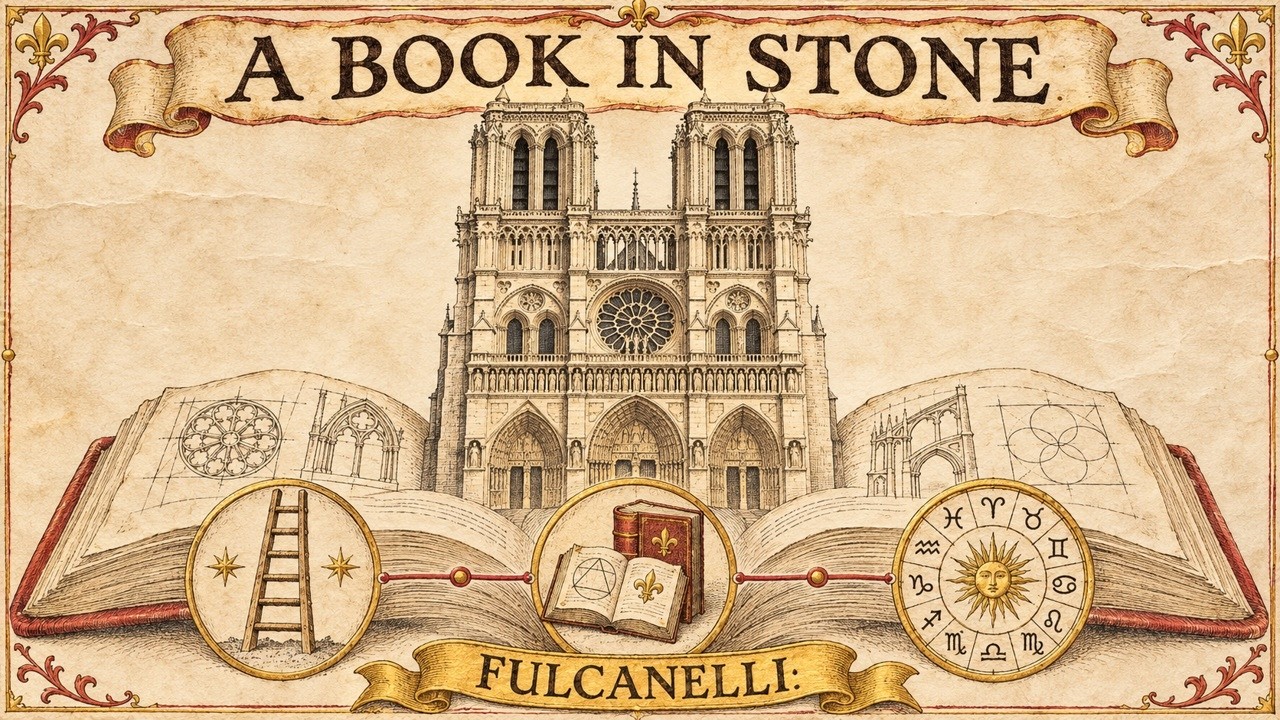
Fulcanelli: Reading Notre-Dame as a Book of Alchemy
In 1926, a writer using the name Fulcanelli published Le Mystère des Cathédrales. The book invited readers to approach Gothic architecture as a language of alchemy. Notre-Dame became a surface to read: figures, books, ladders, and the patient work of looking.
A powerful reading can change how an object appears. It can also make us forget to ask when the object was made, who supplied its meaning, and what the evidence actually establishes. Fulcanelli's book becomes more interesting when those questions stay open.
This essay follows three clues from the episode: the books and ladder, the age of the cathedral's sculpted figures, and the calendar at its entrance. Each asks us to distinguish an object, an author's interpretation, and our own response.
The Published Book and the Unresolved Name
The 1926 edition was issued by Jean Schemit. Its title announces an esoteric interpretation of the Hermetic symbols of the Great Work. That gives us a definite publication and a definite interpretive project. It does not resolve the identity behind the name on the cover.
Fulcanelli has attracted proposed identities, tales of encounters, and increasingly elaborate accounts of what an adept might have known. A proposal needs evidence appropriate to its claim. Association with publication, resemblance of ideas, and an exciting anecdote are not interchangeable kinds of proof.
For the purpose of reading the book, we can begin with what survives publicly: a text, its images, and its arguments. An unresolved attribution is a legitimate historical result. We do not need to supply a secret identity in order to examine the method.
First Clue: Books and a Ladder
Fulcanelli treats a seated figure, associated with books and a ladder, as an image of alchemy. The objects become part of a vocabulary: forms of knowledge, the relation between what is open and what remains closed, and an ascent that requires stages.
Keep the attribution in view. This is how Fulcanelli reads the figure. To establish that medieval makers intended precisely that system, a historian would need more than a compelling match between a later vocabulary and an earlier image.
A symbol can support more than one historically situated reading. The task is to explain why a particular reading is plausible, what evidence supports it, and where the argument depends on analogy. Saying that everything is symbolic would remove the very distinctions that make interpretation worth doing.
You may find a personal question in the contrast between an open and a closed book. Which subjects can you explain fluently but have scarcely practised? That question can be useful today. Its usefulness does not establish a medieval author's intention.
Second Clue: The Age of the Stone
Notre-Dame is not a single untouched moment preserved in stone. The building has been altered, repaired, damaged, and restored. The history published by Friends of Notre-Dame records the nineteenth-century restoration directed by Jean-Baptiste Lassus and Eugène Viollet-le-Duc.
That matters when an argument uses a carved figure as a witness to an ancient teaching. What we see today may be medieval work, a later replacement, a reconstruction, or an addition. Its date changes what it can establish.
The famous chimeras on the upper gallery are particularly useful reminders to check restoration history. They should not be treated as a single unexamined set of medieval witnesses. A modern photograph identifies a visible object. Further research is needed to identify the age and history of that particular object.
These questions do not make later work worthless. A nineteenth-century addition can tell us about nineteenth-century ideas of the medieval past. It can participate in Fulcanelli's twentieth-century reading. The value becomes more specific when we place it in time.
Third Clue: A Calendar at the Entrance
The cathedral's Portal of the Virgin brings the signs of the zodiac into a programme that also includes the labours of the months. The year appears through a relationship between a larger order and recurring human tasks.
An alchemical reader can recognise an affinity with operations that depend on time, sequence, and the conditions of matter. That affinity helps explain the attraction of the image. It does not, by itself, make the portal an encoded laboratory manual.
The distinction is practical. If you say that a carving depicts a particular sign, another reader can examine the carving. If you say that it encodes a particular operation, you owe that reader the steps in the argument. A conclusion should remain connected to the kind of evidence capable of supporting it.
The calendar can also correct a modern impatience. Repeated work belongs to a season and a material circumstance. You can take that as a philosophical prompt without claiming that the carving was designed to address contemporary habits.
V.I.T.R.I.O.L.
The Hermetic descent: visit the interior of the earth, and by rectifying, find the hidden stone.
Get this guide · $7Three Columns for Reading a Symbol
Choose one image from the episode or from a reliable collection record. On paper, make three columns: observation, source, and response. Keep the entries short enough that you can see when one category has slipped into another.
Observation
Describe what is visible before naming what it means. A seated figure holds two objects resembling books. A ladder appears beside the figure. Record the image's location and, where a reliable catalogue provides one, its date. If you cannot tell whether a detail is present, write that uncertainty down.
Source
Record whose claim you are considering. Fulcanelli interprets an image in a certain way in a publication dated 1926. A cathedral history dates a restoration. A collection record identifies an earlier photograph. Different sources may answer different questions without cancelling one another.
Response
Write what the image brings up for you. Perhaps the ladder recalls patience, or the book recalls an abandoned study. Give the response its proper status: it belongs to your encounter with the image. You can examine and act on it without presenting it as an archival discovery.
The exercise is simple, but it changes the pace of an interpretation. You begin to notice how often an evocative caption has been doing the looking on your behalf.
What a Serious Reading Requires
Start with the strongest version of an argument rather than its most extravagant retelling. Look at the original passage, identify its object, and ask what would count as supporting or challenging evidence. Where a source is unavailable, retain the uncertainty.
Pay attention to translation as well. A technical term can gather meanings across languages and centuries. A familiar English word may conceal a distinction that mattered to the author. Compare editions when a large claim depends on a small verbal detail.
Then examine your investment in the outcome. Do you want the cathedral to confirm a complete secret system? Do you want one mistake to make the whole subject disappear? Either wish can make you stop looking too soon. This inward question belongs beside the historical enquiry, with each retaining its own methods.
Where the Inward Reading Begins
The V.I.T.R.I.O.L. formula is another place where historical language invites inward interpretation. Its later psychological use asks what can be discovered through attention, separation, and rectification. We should identify that use as an interpretation rather than silently projecting it back onto every alchemical author.
Fulcanelli's invitation has a durable force: remain with a detail long enough for it to resist your first explanation. The resistance may reveal a different date, an overlooked restoration, a source you had misunderstood, or an assumption of your own.
The cathedral can sustain more history than a single theory contains. You leave with a better question when you can say what you saw, whose reading you followed, and what you still do not know.
Frequently Asked Questions
Who was Fulcanelli?
Fulcanelli is the name under which Le Mystère des Cathédrales was published in 1926. The identity behind the name remains disputed; this essay does not endorse a proposed identity.
Does Notre-Dame prove that medieval cathedrals were alchemical manuals?
No. Fulcanelli offers an alchemical interpretation of cathedral imagery. Establishing a medieval maker's intention requires additional historical evidence.
Why does restoration history matter?
A visible figure may be medieval, restored, replaced or added later. Its date affects what it can establish about the ideas of a particular period.
How can I study a symbol without confusing interpretation with fact?
Record three things separately: what you can observe, what a named source claims, and your own response. Each can be valuable without carrying the same evidential weight.
Sources
This essay is educational and historical. It describes how alchemical and psychological traditions have interpreted human experience. It is not medical or psychological advice, not a diagnosis, and not a substitute for care from a qualified mental health professional. If you are not sleeping, if you believe you have been given a special mission, if people close to you have expressed concern, or if you are hearing or seeing things others do not, please contact a licensed practitioner or a crisis line in your country today.
Go Deeper
Watch the complete teaching with visual symbolism and guided reflection on our YouTube channel.
Watch on YouTube Explore Ebooks