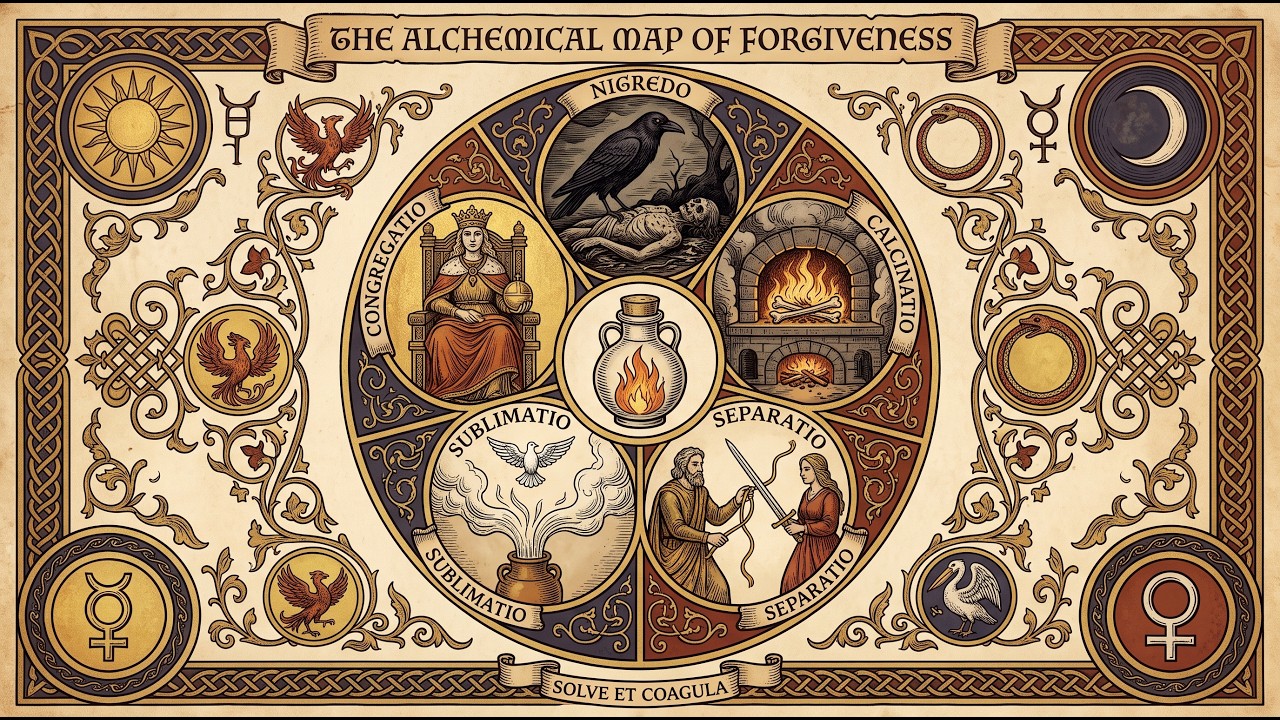
Never Forgive Someone Who Hasn't Earned It — The Hermetic Law
Human culture has long suffered under the weight of a comforting yet profoundly hazardous illusion: the myth that instantaneous forgiveness is the ultimate marker of spiritual maturity. From contemporary psychological self-help dogmas to watered-down spiritual practices, modern individuals are constantly exhorted to forgive immediately, to let go without delay, and to extend mercy before the ink of betrayal is even dry.
But what if this cultural rush to mercy is not a manifestation of high spiritual development, but rather a profound act of psychological cowardice? What if premature forgiveness is actually an alchemical catastrophe — a mechanism that freezes the soul in a permanent state of unresolved trauma, truncating the necessary evolutionary friction required for genuine individuation?
The Alchemical Vessel Must Remain Sealed
In the Hermetic tradition, the transformation of the soul is directly mapped onto the operations of speculative alchemy. The fundamental axiom of this science is that nothing can be elevated, purified, or transformed until it has been completely reduced to its primary components through intense structural stress.
The raw psychological material generated by trauma and injustice — righteous rage, acute grief, structural alienation — constitutes the foundational prima materia. This material must be deliberately contained within the sealed vessel of the conscious ego. It must not be discharged prematurely through impulsive external retaliation, nor should it be dissolved through an artificial act of immediate mercy.
When an individual grants premature forgiveness, they violate the core law of the alchemical vessel — the vas hermeticum. The vessel must remain perfectly sealed so that internal pressure can build, allowing the heat of conscious awareness to break down the complex painful experience into its constituent psychological truths. Premature mercy acts as a catastrophic leak in this vessel. It vents the necessary pressure, allowing the volatile elements to escape before they have been purified.
This phenomenon aligns precisely with what Carl Jung described as the suppression of the shadow. By refusing to look directly into the dark lineaments of the injury, the individual re-represses the shadow — guaranteeing its eventual destructive eruption in the form of neurosis, somatic illness, or repeated victimhood.
Resentment as Diagnostic Fire
Friedrich Nietzsche warned extensively against this specific form of moral degradation, identifying it as a symptom of ressentiment — a condition where the weak, unable to truly master or metabolize their suffering, rebrand their structural impotence as spiritual superiority. The individual who forgives too quickly does not do so because they possess an abundance of love, but because they lack the psychological stamina to inhabit the tension of their own profound injury.
Resentment, when properly understood, is not merely a negative emotion to be discarded. It is a vital diagnostic indicator. It signals that an existential boundary has been crossed and that a core component of the self has been compromised. To discard this indicator prematurely through a forced act of forgiveness is equivalent to disconnecting a fire alarm while the house is still burning.
The heat must be utilized, not denied. It must be directed inward to illuminate the precise structural vulnerabilities that allowed the violation to occur in the first place. Only when this rigorous internal audit is complete can the individual begin to contemplate a true, authentic transcendence of the event. This is the same principle behind the alchemical map of anger — rage as raw material, not as waste product.
The Nigredo: Allowing the Blackness to Be Absolute
The journey begins with the stage known as the Nigredo, or the blackening. This is the moment immediately following a profound betrayal. The ego's neatly ordered world is shattered, and the individual is plunged into a dark, chaotic state of shock, grief, and intense psychological fragmentation.
In this stage, the temptation to flee into premature forgiveness is at its absolute peak. The pain of the Nigredo is so acute, the sense of dissolution so terrifying, that the uninitiated ego will grasp at any passing illusion of peace — eagerly offering an unearned pardon simply to arrest the descent into darkness.
However, the path of the Hermetic school demands that the individual resist this premature escape. In the Nigredo, one must allow the blackness to be absolute. The conscious mind must stand as a vigilant guardian over the decaying remnants of its previous worldview, understanding that this decay is the indispensable prelude to any true resurrection. This is the same Black Sun dissolution that initiates every genuine transformation.
Calcinatio: The Containment of Righteous Rage
As the Nigredo completes its work of decomposition, the process transitions into Calcinatio — calcination. This is the application of intense dry heat to the raw material until it is reduced to a fine white ash.
When we are deeply wronged, a fierce destructive fire ignites within us. The common mistake is to either express this fire outwardly through vindictive retaliation — which wastes the energy in useless drama — or to extinguish it instantly through premature forgiveness. The alchemist does neither. The alchemist traps the fire inside the vessel of the self.
They allow the rage to burn, but they direct its flame inward, using it to incinerate their own dependencies, their own naive assumptions, and the hidden codependencies that may have left them vulnerable to exploitation. This stage demands a harsh truth: while you may be the innocent victim of an external injustice, you must never remain the passive victim of your own internal narrative.
The fire of containment burns away the toxic residues of self-pity and entitlement. It forces the individual to realize that no one is coming to save them, that the universe owes them no cosmic compensation, and that their healing is entirely their own sovereign responsibility. The raw reactive anger is progressively purified — transforming from a chaotic, externalized scream into a concentrated internal axis of pure intent and uncompromising self-awareness.
Separatio: The Art of Strategic Intolerance
Following the intense heat of calcination comes Separatio — separation. The individual takes the ashes left behind by the fire and subjects them to a rigorous process of cognitive differentiation. The primary task is to cleanly divide the valuable elements of the experience from the worthless, toxic dross.
This requires an objective, analytical dissection of the entire event. The individual must see the perpetrator precisely as they are — a flawed, limited, and perhaps malevolent actor operating within their own structural pathology. Concurrently, they must examine their own participation: where they ignored their intuition, where they compromised their boundaries out of a desire for validation, and what specific psychological illusions allowed the violation to occur.
This is the exact point where the danger of premature forgiveness becomes most apparent. When an individual forgives too early, they scramble the elements of this critical stage — merging victim and perpetrator back together in a premature, messy reconciliation, blending the gold of learned wisdom with the toxic lead of unexamined patterns.
Genuine Separatio requires a hard, unyielding line to be drawn. It demands the setting of absolute, non-negotiable boundaries. It is here that the individual learns the vital art of strategic intolerance — the understanding that certain behaviors are fundamentally unacceptable and must be met with permanent exclusion. This is not malice. It is an act of supreme self-preservation. The individual separates their destiny from the one who harmed them, ensuring the toxic cycle is broken forever — a death of the false self that accommodated abuse.
Sublimatio: Elevation Beyond the Personal
Once the elements have been separated, the journey enters Sublimatio — sublimation. The individual elevates the entire experience from the personal, ego-driven level to the universal, archetypal level. They no longer view their suffering merely as a random, unfair assault on their private ego. They begin to see it as a specific manifestation of the timeless human struggle between light and shadow, order and chaos, consciousness and unconsciousness.
They recognize that their betrayer was simply an actor playing a classic archetypal role in the grand drama of personal evolution — a necessary adversary whose enmity served to wake them from their dogmatic slumbers. By sublimating the experience, the individual detaches their identity from the trauma. They are no longer the person who was broken. They are the consciousness that witnessed the breaking and engineered the reconstruction.
It is at this precise stage — and only at this stage — that something resembling authentic forgiveness can begin to manifest. But this is not the forgiveness of modern sentimentality. It is a cold, objective recognition that the event has served its purpose in the evolutionary schema, accompanied by a complete lack of emotional charge toward the perpetrator.
The Dark Night: The Ultimate Test
There is a specific, treacherous region in the middle of this alchemical work where the individual is stripped of all comfort — both old and new. The old naive illusions have been incinerated by the fire, but the new integrated gold has not yet coalesced. In this desolate space, the individual stands utterly exposed.
It is during this acute crisis that the temptation to succumb to premature mercy returns with redoubled force. The existential weight of holding the tension becomes almost unbearable. The ego screams for relief, whispering that if you would just forgive, the agonizing isolation would end and you could return to the warm embrace of collective illusion.
This is the ultimate test of the alchemical worker. Most individuals fail here — breaking their vessels at the exact instant when the transformation is closest to completion. They collapse under the pressure, extending a false, desperate hand of mercy not out of love, but out of a total inability to endure the existential solitude of their own developing consciousness.
To survive this crisis, one must understand: the pain you feel is not merely the pain of the original injury. It is the death throes of your own dependency — the agonizing extraction of the desire for external validation, for parental protection from the universe, and for the illusion of an inherently fair world. If you abort the process now through hasty reconciliation, you preserve that soft, dependent tissue, guaranteeing you will be broken again by the exact same dynamics. The only path through is the alchemical law of natural timing — trusting that the fire knows its own duration.
The Rubedo: Sovereign Integration
When the fire has finally exhausted its fuel, a profound transformative silence descends upon the psyche. The individual who emerges is fundamentally unassailable. They have not merely recovered from an injury — they have used that injury to structurally re-engineer their entire being.
The primary characteristic of this integrated state is the absolute cessation of internal friction. The individual no longer carries the burning weight of unexamined resentment, nor the fragile burden of forced forgiveness. The perpetrator has been completely drained of their emotional power — stripped of their personal charge and reduced to a neutral, objective memory.
In this state, the individual's relationship with mercy undergoes a revolution. They understand that true mercy is not a universal right to be scattered indiscriminately. It is a sacred, highly valuable currency that must be strictly earned through demonstrated contrition, thorough restitution, and visible structural transformation. To extend mercy to someone who has not done this work is now seen for what it truly is — an act of cosmic injustice that degrades the value of mercy itself and actively subsidizes evil.
The sovereign self is equally comfortable with severity. They possess the capacity to execute permanent exclusions, to sever relationships with clinical precision, and to enforce boundaries with absolute force whenever their core territory is threatened. Their naive, childlike trust has been replaced by a mature, vigilant faith — a faith in their own capacity to navigate the dark currents of human nature without drowning. They walk through the world with a quiet, centered authority that can only be possessed by someone who has looked into the abyss and refused to blink.
He who forgives before the fire has finished its work performs an act of spiritual self-destruction, building a fragile sanctuary upon the unexploded mines of his own repressed shadow. True sovereignty is never born from the desperate evasion of suffering, but from the absolute, unyielding containment of the inner storm.
Trust the fire. Hold the vessel. And let the truth burn away all that is false.
Go Deeper
Watch the complete teaching with visual symbolism and guided reflection on our YouTube channel.
Watch on YouTube Explore Ebooks