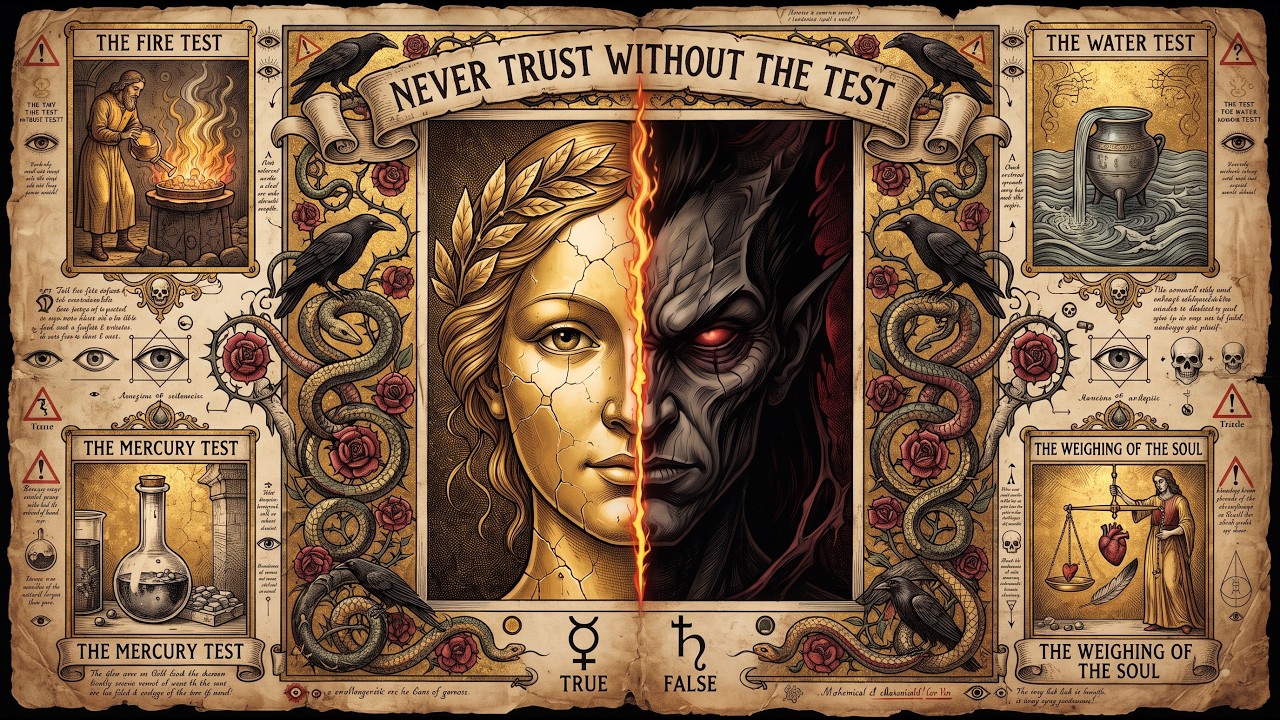
Never Trust Someone Until You See These 3 Alchemical Signs — The Hermetic Test of Character
The human face is the premier landscape of deception. Every individual carries a theater within themselves — a highly sophisticated psychological apparatus designed to project masks of virtue, competence, and benevolence while concealing the chaotic, unrefined prima materia of their true impulses.
Most individuals structure their trust on fragile superficial metrics: a warm disposition, shared ideological platitudes, or the socioeconomic validation of institutional standing. Yet history and esoteric philosophy demonstrate that these are the very materials from which the most destructive deceptions are forged.
The Hermetic tradition offers a different framework — one rooted in spiritual metallurgy. It asks a singular, uncompromising question: Has this individual's soul passed through the crucible of self-transformation? Or are they merely projecting a polished exterior over a volatile, uncalcined core?
The Doctrine of Volatility
At the core of alchemical philosophy lies the concept of the Magnum Opus — the Great Work. The lead to be transmuted was never a physical metal; it was the dense, heavy, unrefined ego of man. The gold was the realized, integrated, and incorruptible self.
The human being is born in a state of internal fragmentation — a loose constellation of competing drives, inherited traumas, social conditioning, and repressed shadows. In Hermetic terminology, this raw state is the prima materia. It is characterized by utter instability: it reacts violently to external stimuli, seeks immediate gratification, and is entirely incapable of sustained, self-sacrificing loyalty.
When you meet an individual who has not undergone the alchemical transformation, you are meeting a psychological entity composed entirely of prima materia. They may possess a brilliant intellect, a charming demeanor, and positions of significant authority. However, because their internal components have not been separated, purified, and recombined through intentional inner work, their character remains fundamentally volatile.
Their virtues are accidental — dependent entirely upon favorable conditions. Change the environment, introduce economic pressure or profound personal loss, and the unrefined character will instantly collapse back into its chaotic primal state. To trust a volatile entity is to build a fortress upon shifting sand.
The First Sign: The Nigredo — Familiarity with One's Own Darkness
The first phase of the Great Work is the Nigredo, the blackening — the encounter with the shadow, the confrontation with the darkest and most repressed aspects of one's own personality.
The first alchemical sign that you can trust someone is their deep familiarity with their own capacity for evil, paired with an absolute conscious restraint over it.
Most people believe that a trustworthy person is someone who is fundamentally harmless. This is a profound and dangerous error. A person who is harmless is simply weak. If they have never encountered their own capacity for cruelty, betrayal, greed, and cowardice, they do not possess virtue — they merely possess a lack of opportunity. The moment they are placed in a position of unchecked power, their unexamined shadow will seize control with devastating force.
Conversely, an individual who has passed through the Nigredo has consciously descended into the underworld of their own psyche. They know precisely how manipulative, how selfish, and how vindictive they can be. The signature of the Nigredo is an unmistakable humility and deliberate self-restraint.
They do not participate in superficial moral panics. They do not easily condemn others — because they recognize that the same capacity for depravity exists within themselves. They treat their own power with extreme gravity. Their goodness is not an accident of ignorance; it is a calculated daily choice to hold the beast within them in chains.
Until you see this signature — this sober, unpretentious awareness of one's own darkness — you are dealing with a psychological child who is one crisis away from becoming a monster. This is the same principle explored in the alchemical map of anger: raw shadow material that must be consciously integrated, never denied.
The Second Sign: The Albedo — Independence of Motive
The second phase is the Albedo, the whitening — the purification of the mind from personal bias, emotional projection, and the desperate need for external validation.
The second alchemical sign of a trustworthy individual is the absolute clarity and independence of their motives.
The vast majority of human beings operate in a state of psychological dependency. They act not because something is intrinsically right, but because they seek approval, the avoidance of conflict, or the quiet feeding of covert vanities. Their motives are muddied — tangled in a web of subconscious transactions. If they do you a favor, there is an unstated debt attached. If they proclaim loyalty to a cause, it is often because that cause enhances their social status.
An individual who has attained the Albedo has washed away these hidden agendas. Their mind functions like a highly polished mirror, reflecting reality as it is rather than how their ego wishes it to be. This manifests as a profound, sometimes unsettling transparency. They do not employ passive-aggressive strategies. They do not manipulate narratives behind closed doors. They do not flatter your ego to gain your favor.
The Albedo signature is verified through their behavior during moments of intense social conformity. When the collective demands they validate a lie or participate in an irrational ideological crusade, the Albedo individual stands entirely apart. They are capable of looking at their closest ally and saying: "I love you, but you are wrong."
A person who still hungers for the applause of the crowd can never be trusted — they will inevitably sacrifice you on the altar of public opinion. But the individual marked by the silver light of the Albedo has found validation internally. Their word is an uncorrupted currency. Their alignment with truth is completely independent of external rewards or punishments. This is the same Hermetic silence that refuses to perform for the crowd.
The Third Sign: The Rubedo — Stability Under Extreme Pressure
The final phase is the Rubedo, the reddening — the birth of the Philosopher's Stone, the creation of an incorruptible, fully integrated soul that has achieved complete spiritual sovereignty.
The third and final alchemical sign is the absolute stability of character under extreme crucible conditions. In the Rubedo, the volatile has been completely fixed. The individual is no longer an accumulation of parts — they have become a singular, unified force.
To identify the Rubedo signature, one must observe an individual not in their moments of peace, but in their moments of profound existential crisis. When their life's work is crumbling, when they face severe material loss, or when they are subjected to systemic injustice — the Rubedo individual does not fracture. They do not descend into bitter resentment. They do not adopt the identity of a helpless victim. And they do not compromise their core principles to alleviate their suffering.
Instead, they absorb the shock of reality and convert it into wisdom. If they have promised you their protection, they will extend it even if it means their own ruin. If they have given you their word, it will stand though the heavens fall. This is the state where nothing and no one can have power over you — because you have already been broken and rebuilt yourself from the inside.
The Dark Night: Why These Signs Cannot Be Faked
No person arrives at the Rubedo without having their entire world completely shattered. The human ego will never willingly submit itself to the alchemical fire unless forced by an unavoidable confrontation with reality — through profound betrayal, total collapse of a life structure, or an overwhelming realization of the radical indifference of the universe.
It is during this crisis that the ultimate divergence in human character occurs. The vast majority cannot endure the heat. They adopt cynicism, calcify into resentment, or submerge awareness in numbing distractions. They become spiritual casualties — hollow shells projecting a bitter defensive armor over a wounded, unhealed interior. These individuals are highly dangerous because they are internally broken and will inevitably break those who trust them.
But the rare individual who possesses the seed of true philosophical gold responds differently. Instead of fleeing the fire, they sit within it. They allow the heat to burn away every false assumption and every childish dependency. They accept radical responsibility for their own suffering. This process of conscious suffering is the exact mechanism that converts the volatile prima materia into the fixed Philosopher's Stone.
Therefore, when you look for the three alchemical signs, you are looking for evidence of this survival. A person who has never experienced this profound crisis is an untested asset. They do not know who they are because they have never been broken. You cannot trust their strength because it has never been measured against the weight of total despair.
The Architecture of Sovereign Trust
The integrated individual possesses an extraordinary capacity for authentic relationship precisely because they do not need anyone to complete them. Their connections are not based on psychological dependency or parasitic utility — they are based on a conscious, sovereign choice to align with other refined souls.
When you enter into a covenant of trust with an individual of this caliber, the nature of your existence expands. You can lay down your shield, knowing that their evaluation of your character will be as rigorous and fair as their evaluation of their own. They will not betray you for a transient advantage because their internal gold cannot be bought with any earthly currency. They will not abandon you in the hour of your own Nigredo because they know that terrain intimately.
However, this architecture demands a mutual price. The integrated individual will not tolerate persistent self-deception or unrefined volatility in their inner circle. To be trusted by a master of the alchemical art, you must be willing to step into the crucible yourself.
The ultimate crucible of reality will always dissolve what is merely painted, but it can never corrupt what has been genuinely refined. Seek not to find safety in the shifting sands of external promises, but learn to discern the unshakable signatures of the inner furnace.
Go Deeper
Watch the complete teaching with visual symbolism and guided reflection on our YouTube channel.
Watch on YouTube Get Never React. Never Explain