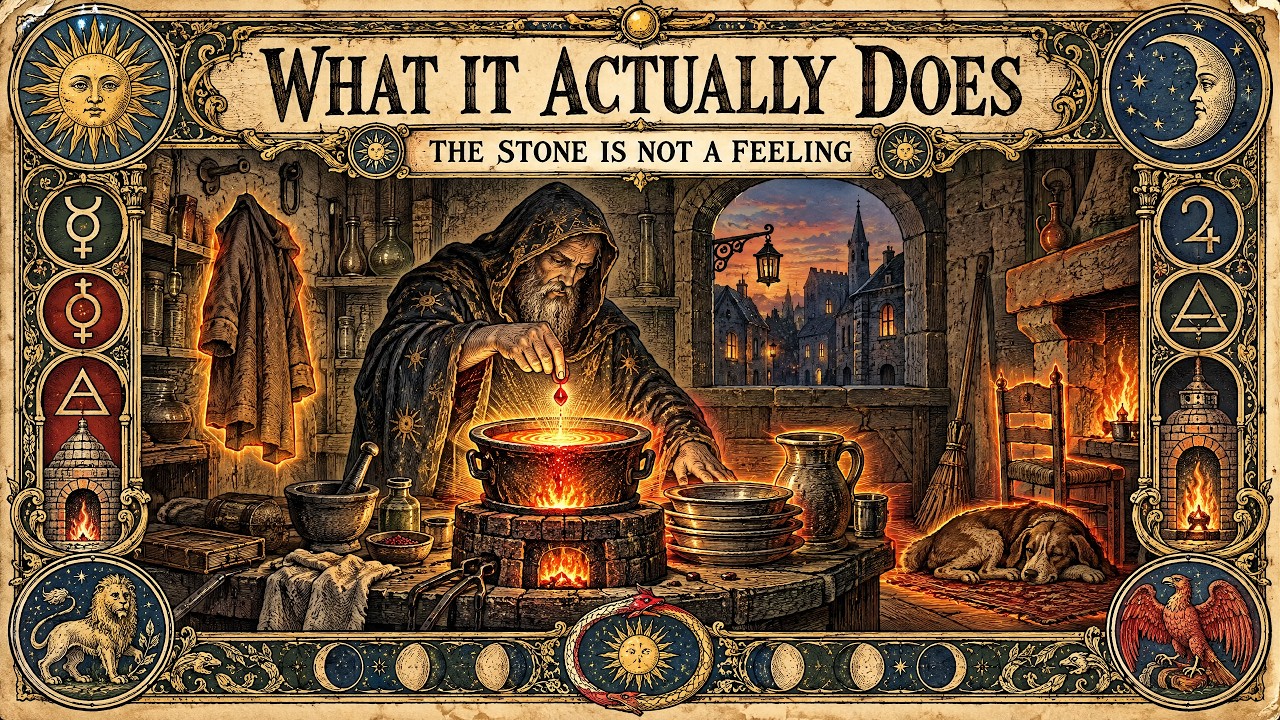
Rubedo — What the Work Actually Produces
The Great Work does not produce enlightenment. It does not produce permanent peace, unshakeable equanimity, freedom from suffering, or a self that no longer has difficulties. Nothing in the alchemical corpus promises any of that, and where it is read as promising it, it is being read through expectations the alchemists did not share.
This episode is about what it does produce. The fourth colour is rubedo — in the Greek sequence iosis, a word derived from a root associated with rust and violet rather than scarlet, which tells you the ending is dark and saturated rather than triumphant. Red carries three associations through the corpus and each is a claim: blood, because investment returns to a material that has been bloodless by design; heat, because the sun generates where the moon reflected; and body, because red is the colour of sulphur, the embodied principle, and the rubedo is where the Work re-enters matter.
At its centre is the most misread fact about the philosopher's stone: it is never described as a condition the operator enjoys. It is described entirely by what it does — projected onto base metal, called the universal medicine, called the elixir. Every property attributed to it is a property of its effect on something outside itself. Which changes the test completely: if the product is a state, the test is how you feel; if it is an agent, the test is what happens around you.
The episode follows Jung's reading carefully, including the point that is usually lost — the Self is not an attainment and was there before the work began — and uses Edinger's ego–Self axis to describe what is actually produced: a working relationship rather than a merger or a possession, which is also why the texts insist the stone can be lost.
It then sets out five ordinary marks of the stage, four things the stage is not, and the two large misreadings: expecting transfiguration, which the phrase aurum non vulgi addresses directly, and expecting an ending, which multiplicatio rules out. It closes with the property that inverts the whole picture — the stone is a medicine, which means the product of the Work is mostly good for other people — and with an argument that the modest answer is the better one.
Episode 19 of THE GREAT WORK, a twenty-four part series following the operations of the opus in order. This episode opens the fourth and final stage.
The Magnum Opus
The complete map of the Great Work: four stages and twelve operations, with the psychology of each.
About the bookSources
- C.G. Jung, Mysterium Coniunctionis (Collected Works vol. 14, 1955–56)
- C.G. Jung, Psychology and Alchemy (Collected Works vol. 12, 1944)
- C.G. Jung, Aion: Researches into the Phenomenology of the Self (Collected Works vol. 9ii)
- Edward F. Edinger, Ego and Archetype (1972)
- Edward F. Edinger, Anatomy of the Psyche: Alchemical Symbolism in Psychotherapy (1985)
- Marie-Louise von Franz, Alchemy: An Introduction to the Symbolism and the Psychology (1980)
This essay is educational and historical. It describes how alchemical and psychological traditions have interpreted human experience. It is not medical or psychological advice, not a diagnosis, and not a substitute for care from a qualified mental health professional. If you are not sleeping, if you believe you have been given a special mission, if people close to you have expressed concern, or if you are hearing or seeing things others do not, please contact a licensed practitioner or a crisis line in your country today.
Go Deeper
Watch the complete teaching with visual symbolism and guided reflection on our YouTube channel.
Watch on YouTube Explore Ebooks