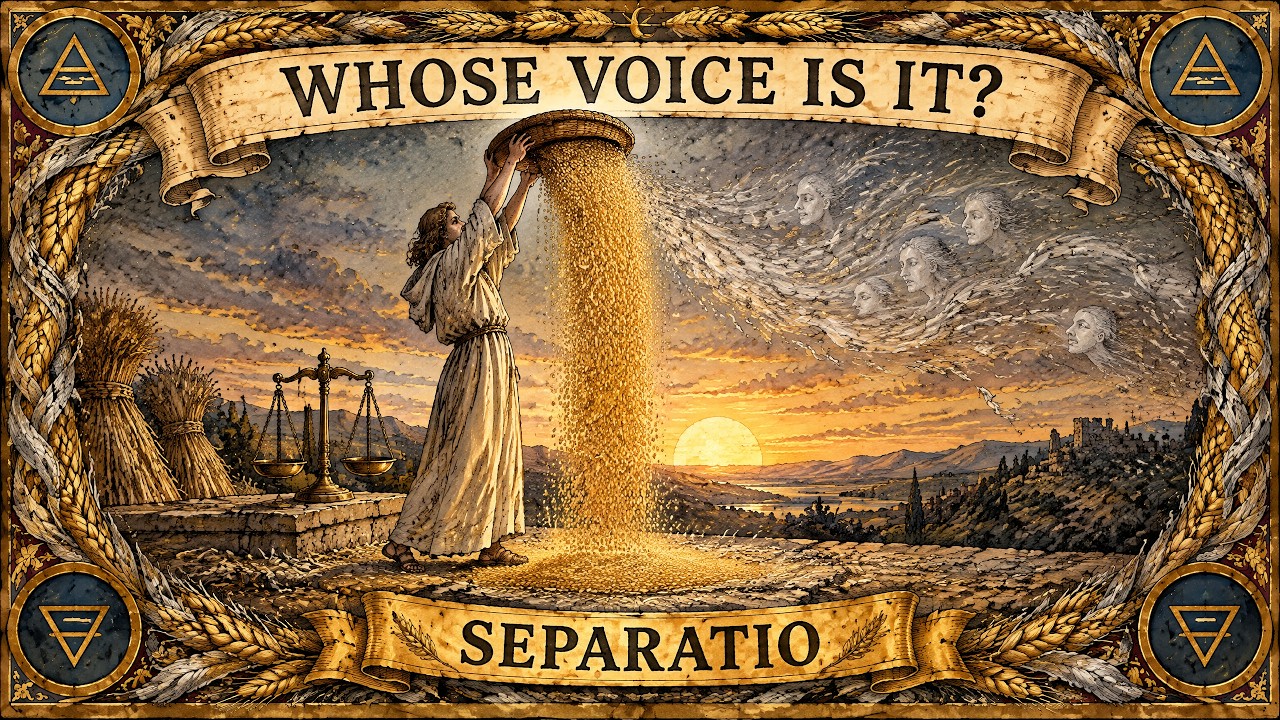
Separatio — Cutting Away What Was Never Yours
There is a sentence running in your head right now that you did not write. It sounds like you. It uses your vocabulary. It arrives in your own inner voice and presents itself as your judgment about what you owe people, about what would be selfish, about what happens if you stop being useful. And because it arrives in your voice, it has never once been examined.
It was installed — by a parent, a teacher, a first employer, a culture, a religion you left twenty years ago — and it is still running unexamined, issuing instructions that you experience as your own conscience.
The alchemists called the operation that deals with this separatio. And in their scheme, it is the sharpest thing in the second stage: not a washing but a cut.
The Emerald Tablet's Instruction
The most famous formulation of separation appears in the Emerald Tablet, the short Hermetic text that sits at the center of the whole tradition. It gives the instruction in one line:
Separate the earth from the fire, the subtle from the gross, gently and with great skill.
Almost everything that matters is in that line, including the part that gets ignored.
The Subtle from the Gross
The alchemical matter, after decomposition and washing, is not one thing — it is a mixture. Some of it is essential, the part the whole operation exists to isolate. Some of it is inert matter that came along with the raw material and contributes nothing. And they are physically intermingled. You cannot pick the essential part out with your fingers because it is distributed through the mass. The operator has to find a method that lets the mixture sort itself.
Psychologically, that is the exact situation after the first stage. The old structure has come apart. What is left is everything you have ever taken in, and it is not sorted. Your values sit next to values you absorbed from people you no longer respect. Your ambitions sit next to ambitions inherited from a parent. Your genuine standards sit next to rules imposed on you at fourteen by someone whose approval you no longer need.
All of it feels equally like you. That is the problem. There is no label.
Gently and with Great Skill
This is the part that gets skipped, and skipping it is how separatio becomes damage.
The tradition could have said burn off the impurities. It did not. It specified the gentlest possible handling for the sharpest possible operation, and it used the word for skill — ingenuity, art. Separation done by force destroys both parts.
The Counterfeit
There is a version of separatio in circulation that consists of cutting off people. Removing the toxic ones. Going no contact. Curating your circle down to those who are aligned.
Sometimes that is genuinely necessary. Some relationships are harmful, and ending them is the correct and adult thing to do. Nothing here argues against it.
But as a general practice, it is not separatio. It is a substitution — an easier operation that feels like the harder one.
Because the voice in your head is not the person. It was installed, and it is now yours to carry, and it will continue running whether or not you ever speak to them again. Cutting off a parent does not delete the sentence the parent put there. A great many people have executed a dramatic external separation and found, years later, that the internal arrangement was entirely intact — still obeying, still measuring themselves by a standard belonging to someone they have not spoken to since.
The alchemical operation is performed on the contents, not on the people. And the practical consequence is almost the opposite of what the culture suggests: it is entirely possible to separate your mother's voice from your own while continuing to have lunch with your mother. In fact, it is usually easier — because the relationship stops being the battleground for the internal work.
The Winnower
The tradition's methods were all methods of letting the mixture sort itself under the right conditions. There is one that maps so precisely onto the psychological operation that it deserves to be the model: winnowing.
You take the threshed grain, which is mixed with chaff, and you throw it into the air on a day with some wind. The grain is denser, so it falls back to the floor. The chaff is light and it blows away.
Notice what the winnower does not do. He does not inspect each grain. He does not decide which piece is chaff. He does not separate anything at all in the direct sense. He creates a condition — height and air — and the difference in weight performs the separation for him.
That is the model. You will not sort your inherited content by analysis. You will create a condition in which the difference reveals itself.
The Question
Here is the condition. It is a single question, and it is sharper than it looks.
When a rule presents itself, ask: whose voice is this in?
Not whether the rule is true. Not whether it is reasonable. Simply: can I hear someone saying it?
Because introjected material — content taken in whole from another person — retains its origin. When you slow down and actually attend to the sentence, a great many of these arrive with a tone, a cadence, sometimes a phrase that was never yours:
"I must not be a burden."
"Who do you think you are?"
"Someone has to be the responsible one."
"If you don't do it, no one will."
You will often be able to hear the exact person. And the moment you can hear it in their voice, it has separated. Not resolved — separated. It has moved from being your judgment to being a sentence you are carrying. That is the whole of the operation, and it is why the tradition insisted on gentleness. Nothing was cut. Nothing was destroyed. The content simply stopped being identical with you, and the distance opened by that recognition is the separation.
Three Classes of Inherited Material
There are three classes of material that come out under this question, and they are worth naming so you recognize them.
Inherited standards. What counts as a life well lived? What counts as failure? How much rest is acceptable? Many people are running a definition of success that belonged to a man who has been dead for fifteen years, and whom they did not particularly like.
Borrowed grief. This is subtler, and it surprises people. Some of what you carry is not your sorrow. It is an unmourned loss belonging to a parent or a grandparent, transmitted in the atmosphere of a household rather than in words. It presents as an inexplicable heaviness attached to nothing in your own history — because it is not attached to anything in your own history.
Absorbed fear. The particular thing a family was frightened of — poverty, shame, illness, being noticed — installed early and still setting the alarm, often in conditions where it no longer applies at all.
The Same Cut, Turned Outward
Jung borrowed a term from the anthropologist Lucien Lévy-Bruhl for the condition separatio works on: participation mystique, a state of unconscious identity in which the boundary between a person and what surrounds them has never been drawn. Inside it, a family’s fear is simply your fear, and another person’s behaviour is simply your feeling.
The question “whose voice is this in?” separates what was put into you. The same operation has an outward form, and it concerns what you have put into other people. Jung called it the withdrawal of projection. The test is a single question, asked about the person who provokes you most: what in them is mine?
It is not a claim that they are blameless, and it does not excuse anything they did. It is a way of finding the part of the charge that belongs to you, because that is the only part you can take back. While it stays out there, attached to someone else, you remain bound to the very person you are trying to be free of.
The Pathology of Over-Separation
Separation has a pathology, and it is the pathology of this entire stage.
You can over-separate. There is a state in which a person has become so practiced at identifying what is not theirs that they end up holding nothing at all. Every value examined and found inherited. Every attachment traced to an origin and set down. What is left is a clarity with nobody in it.
That is the cold figure we met when we looked at the Albedo — detachment mistaken for completion. Separation is a phase of the work, not the aim of it. The point of isolating the essential part is that it will be used later, in the stages where warmth and engagement return.
Inheritance and Possession
And there is a decisive sign of that going wrong. Real separatio does not end with everything discarded.
You will find, going through this, that some of the inherited material is genuinely good. A grandmother's insistence on keeping your word. A father's refusal to complain. These arrived exactly the same way as the harmful ones — installed, unexamined, in someone else's voice.
And the operation is complete not when you have rejected them, but when you can hold them and choose. When you keep your word because you have looked at the value and affirmed it — not because a voice you cannot switch off requires it.
That is the difference between an inheritance and a possession. Separatio does not make you free of your history. It converts what you were given into something you own.
How You Know It Has Taken
One sign, and it is quiet.
The rule presents itself — you should call, you should say yes, you should not rest yet — and there is a pause before compliance. A moment in which the instruction is audible as an instruction.
Something that was ruling has become something that is speaking. And a voice that can be heard as a voice can be answered.
Never React. Never Explain
The rule of silence in full: containment, non-reaction and why explaining the work while it happens undoes it.
Get this guide · $7Sources
- The Emerald Tablet (Tabula Smaragdina)
- C.G. Jung, Mysterium Coniunctionis (Collected Works vol. 14, 1955–56)
- C.G. Jung, Psychology and Alchemy (Collected Works vol. 12, 1944)
- Edward F. Edinger, Anatomy of the Psyche: Alchemical Symbolism in Psychotherapy (1985)
- Marie-Louise von Franz, Alchemy: An Introduction to the Symbolism and the Psychology (1980)
This essay is educational and historical. It describes how alchemical and psychological traditions have interpreted human experience. It is not medical or psychological advice, not a diagnosis, and not a substitute for care from a qualified mental health professional. If you are not sleeping, if you believe you have been given a special mission, if people close to you have expressed concern, or if you are hearing or seeing things others do not, please contact a licensed practitioner or a crisis line in your country today.
Go Deeper
Watch the complete teaching with visual symbolism and guided reflection on our YouTube channel.
Watch on YouTube Explore Ebooks