Acedia: The Noonday Demon and Why You Want to Escape the Life You Chose
Acedia (from the Greek akēdia, "lack of care") is the restless heaviness the early Christian desert monks called the noonday demon: a weariness with the life you chose that disguises itself as a reasonable case for leaving it. Evagrius of Pontus named it in the fourth century, and it later became one of the seven deadly sins, usually translated as sloth.
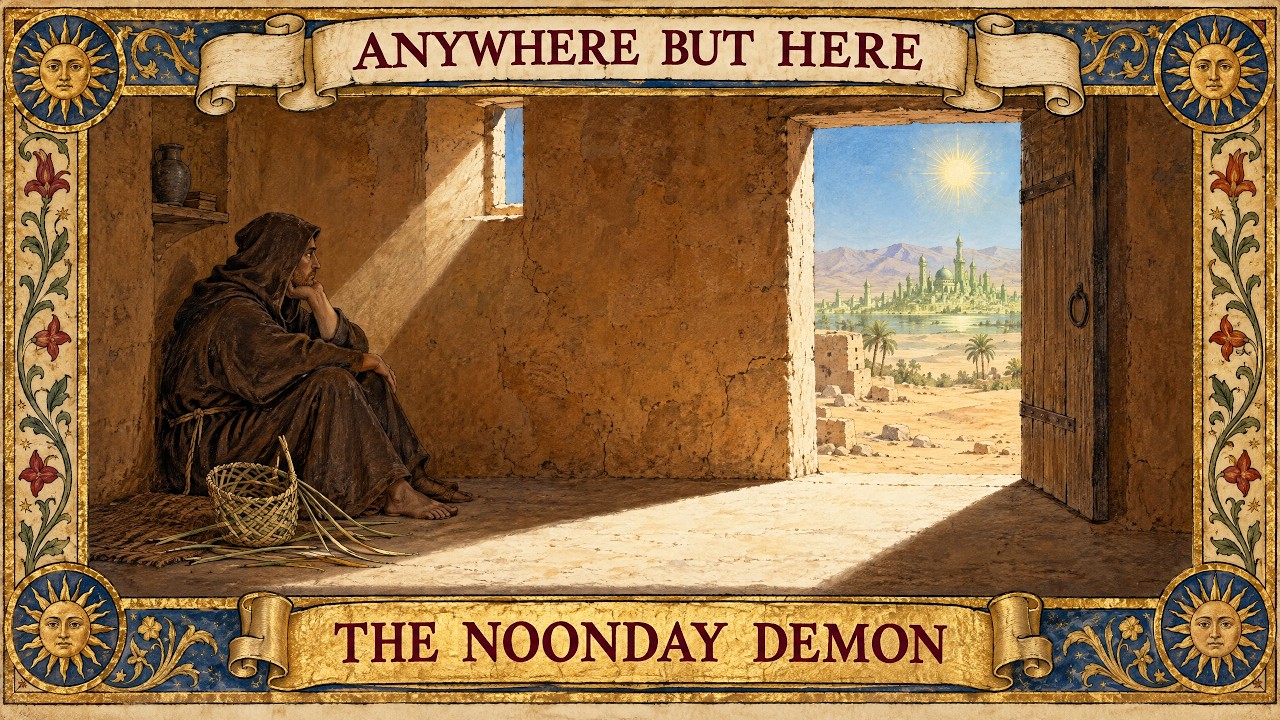
Around the year 390, in the hermit settlement of Kellia in the Egyptian desert, a monk looks out of his window at ten in the morning. The sun has barely moved. He looks again a little later, and it seems to have moved even less. By noon the day feels fifty hours long. By early afternoon he has begun to hate the place, the cell, the brothers, the work, and the whole life he walked into the desert to find.
Nothing has happened to him. No loss, no illness, no crisis. It is simply the middle of the day, and the middle of the day has become unbearable.
Kellia, c. 390
Evagrius of Pontus lived among these men and watched this happen often enough to describe it with the precision of a physician. In his Praktikos he lists eight thoughts that trouble the monk, and he gives this one a name of its own: acedia, a Greek word for a kind of not-caring. Borrowing a line from the Psalms, he calls the power behind it the noonday demon, and he says it is the heaviest of them all.
The symptoms in his account are strikingly modern. The monk keeps going to the window. He watches for visitors. He decides that the brothers no longer love him and that there is no one to comfort him. He thinks of other places where life would be easier and work would be more rewarding. He remembers his family and the life he left. He begins to count the years still ahead of him and to feel the full weight of the labour they will require.
None of this is laziness. The monk in Evagrius's description is restless, agitated, full of plans. That is the first thing to understand about this state, and the thing most modern readings of it miss.
The Demon at Noon
The desert writers placed acedia at a particular hour, and the timing is not incidental. The other thoughts they describe tend to arrive at night or at moments of weakness. This one arrives in full daylight, in the middle of an ordinary day, when the morning's energy has been spent and the evening's rest is still far off.
That is why it is so persuasive. It does not feel like a temptation. It feels like clarity. At noon, with the sun overhead and no shadows to hide in, the life you chose can look exactly as it is: repetitive, slow, unrewarded, and endless. Acedia does not lie about any of those facts. It lies about what they mean.
Later writers kept the diagnosis and moved it. Thomas Aquinas defined acedia as sorrow about spiritual good: not grief at something bad, but a heaviness in the presence of something good that you have committed yourself to. The definition is worth keeping, because it describes the strangest feature of the state. It does not attack what you hate. It attacks what you love, and it attacks it precisely because you have bound yourself to it.
The Case for Leaving
John Cassian, who brought the teaching of the Egyptian desert to the monasteries of southern Gaul, devoted a whole book of his Institutes to this spirit, and he added the observation that makes it so dangerous.
The demon of acedia, in Cassian's account, never suggests anything bad. It suggests good things, located somewhere else. The monk begins to praise distant monasteries and the holier brothers who live in them. He decides he could do more good elsewhere, that his gifts are wasted here, that it would be an act of charity to visit someone, that his present situation is the one thing standing between him and a more fruitful life.
Every argument is reasonable. That is the point. Acedia speaks in the language of growth, service and honesty, and it builds a careful, eloquent case for leaving. The place on the other side of the case is always vague and always better. It never has its own noon.
The modern versions are easy to recognise. The job you chose with care becomes, on a slow Tuesday afternoon, obviously the wrong job. The relationship, the city, the practice, the vocation: each in turn becomes the thing preventing your real life. And the proposed remedy is always the same. Not to change something within the life, but to leave it.
Why Awakening Hurts
A psychological guide to spiritual breakdown: why the dark night hurts, what it is doing, and when it is something else.
Get this guide · $7The Afternoon of Life
In 1930 Carl Jung wrote an essay called "The Stages of Life," in which he compared the course of a human life to the course of the sun. The morning is rising and expansion: building a place in the world, a family, a career, an identity. Then, around the middle of life, the sun reaches its height and begins to descend, and the direction of the work changes.
Jung's warning was that we cannot live the afternoon of life according to the programme of life's morning. What served the ascent does not serve the descent. The goals, measures and satisfactions of the first half begin to feel hollow, not because they were wrong but because they belong to a different hour.
Set beside the desert writers, this is a striking parallel. The monk's noon and Jung's noon are the same moment seen at two scales: the middle of a day and the middle of a life. In both, the energy of the morning is exhausted and the meaning of the evening has not yet arrived, and in both the strongest impulse is to run back to the morning by starting over somewhere else.
Jung's answer was not to stay frozen at noon, and it was not to restart the morning. It was to let the afternoon have its own task: a turning inward, toward meaning rather than accumulation. The desert writers would have recognised this. Their advice, too, was not to escape the hour but to live through it differently.
Four Remedies
The desert tradition was practical, and its remedies for acedia are simple enough to use on an ordinary afternoon.
Know the hour. The first defence is recognition. Evagrius named the hours at which the demon tends to arrive, and that alone changes its force. A thought that feels like a revelation becomes a familiar visitor that comes at the same time every day. If the case for leaving your life is strongest at the same low point of each day or each week, that pattern is information about the hour, not about the life.
Stay in the cell. One of the most quoted sayings of the desert comes from Abba Moses: go, sit in your cell, and your cell will teach you everything. The cell is not a punishment. It is the place where the restlessness can be watched instead of obeyed. Staying is not the same as agreeing to stay forever. It is refusing to decide while the demon is speaking.
The work of the hands. Cassian's chief remedy was manual work, steady and modest, done for its own sake. He tells of an old monk, Abba Paul, who lived too far from any town to sell what he made, and who wove baskets all year and burned them at the end of it, so that the work itself would keep his mind from wandering. The lesson is not that results do not matter. It is that some forms of restlessness are answered by the hands rather than by thinking.
Wait for the evening. Evagrius observed something about this demon that he did not say of the others: when it is endured and not obeyed, no other follows close behind it, and a state of peace and quiet joy comes after the struggle. The afternoon ends. The case that seemed overwhelming at two o'clock often looks very different at seven.
Evening
None of this means that every wish to change your life is a demon. People do outgrow places, work and relationships, and some lives do need to be left. The desert tradition does not deny that. It offers a way to tell the difference.
The case made by acedia arrives at a particular hour and fades when the hour passes. It argues for leaving everything at once. It attacks precisely what you have loved. And it points to a better place that is always vague and never has its own afternoon.
A real turning behaves differently. It persists across hours, moods and seasons. It can be stated specifically and tested slowly. It does not need you to despise the life you have in order to move toward another one. And it is still there in the evening.
Acedia or Depression?
There is one more distinction worth making plainly. What the desert writers called acedia overlaps with what we now call depression, and Andrew Solomon borrowed the same phrase, The Noonday Demon, for his book on that illness. They are not the same thing. If the heaviness does not lift with the evening, if it affects sleep, appetite and the ability to function, or if it comes with thoughts of harming yourself, it is not a spiritual afternoon to be waited out. It is something to bring to a doctor or a qualified professional. The essay on the black sun draws the same line between the tradition and depression.
Before You Decide
For the ordinary noon, though, the advice from Kellia still holds. Notice the hour. Stay in the cell a little longer. Do something with your hands. And wait for the evening before you decide anything about your life.
Not sure which stage you are in? Find your stage.
Sources
- Evagrius of Pontus, Praktikos 12, trans. Luke Dysinger
- John Cassian, Institutes X (On the Spirit of Accidie)
- Thomas Aquinas, Summa Theologiae II-II, q. 35
- Sayings of the Desert Fathers (Apophthegmata Patrum), Abba Moses
- C.G. Jung, The Stages of Life (1930), Collected Works vol. 8
- Andrew Solomon, The Noonday Demon (2001)
This essay is educational and historical. It describes how alchemical and psychological traditions have interpreted human experience. It is not medical or psychological advice, not a diagnosis, and not a substitute for care from a qualified mental health professional. If you are not sleeping, if you believe you have been given a special mission, if people close to you have expressed concern, or if you are hearing or seeing things others do not, please contact a licensed practitioner or a crisis line in your country today.
Go Deeper
Watch the complete teaching with visual symbolism and guided reflection on our YouTube channel.
Watch on YouTube Explore Ebooks