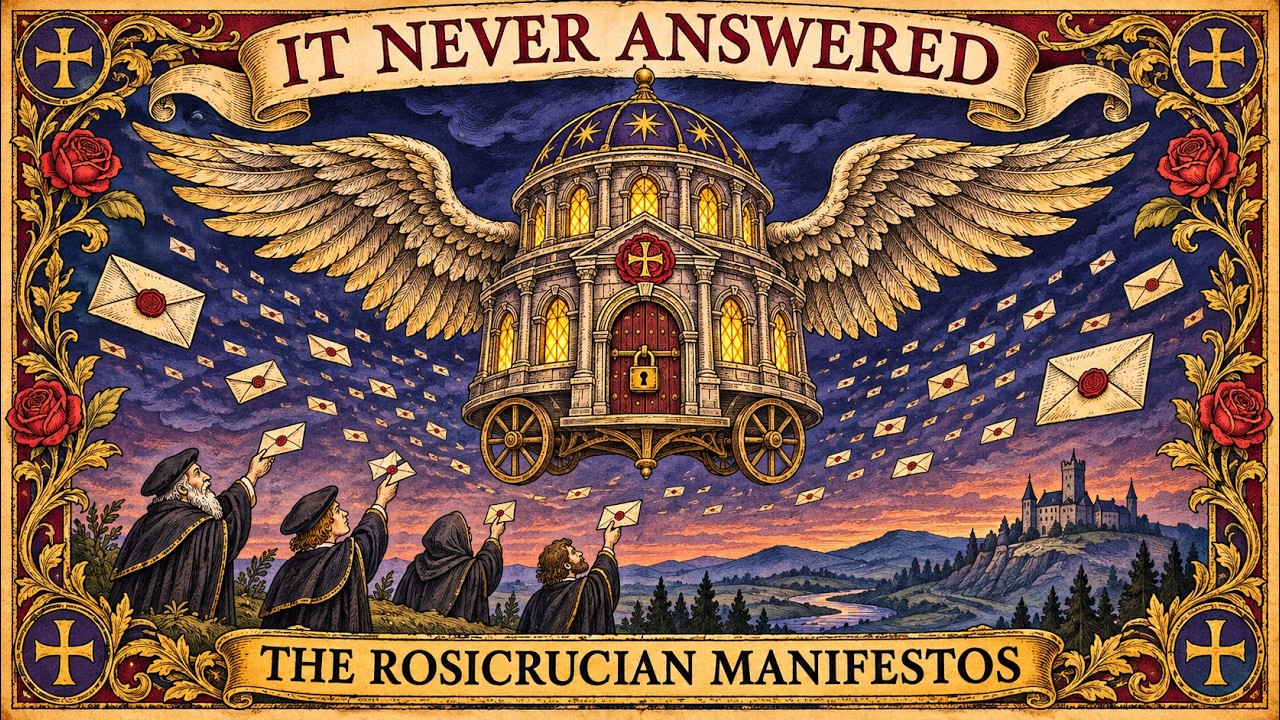
The Rosicrucian Manifestos — A Brotherhood That Never Answered Its Letters
The written work underneath this channel — The Alchemist's Path → https://thehermeticschool.gumroad.com/l/mqeiew?utm_source=youtube&utm_medium=description&utm_campaign=rosicrucian-manifestos
In 1614 a printer in Kassel published a short pamphlet, the Fama Fraternitatis. It announced a brotherhood that had been hidden in Germany for more than a century, told the story of its founder and of the opening of his tomb after one hundred and twenty years, and then asked every learned person in Europe to answer in print, promising that "every one's opinion shall assuredly come to our hands." In the next six years, something like four hundred books and pamphlets answered it. None received a reply.
This video follows the case from the pamphlet to its author: the founder C.R.C. and the vault with seven sides; Adam Haslmayr, the first man to answer, sent to the galleys; Michael Maier and Robert Fludd; the posters on the walls of Paris in 1623; and the circle of friends in Tübingen around the young theologian Johann Valentin Andreae, who wrote The Chymical Wedding of Christian Rosenkreutz and later called it a ludibrium, a game. Quotations are from the 1652 English translation and the Chymical Wedding as reprinted by A. E. Waite (1887), with page numbers.
0:00 Kassel, 1614 1:41 The Tomb 9:36 Europe Writes Back 13:34 The Student 19:45 What the Game Became 24:02 After 120 Years
The Alchemist’s Path
The whole sequence, stage by stage: how Jung read the alchemists and what each operation asks of a life.
Get this guide · $7Sources
- Fama Fraternitatis (Kassel, 1614), trans. Thomas Vaughan (London, 1652)
- Confessio Fraternitatis (1615)
- The Chymical Wedding of Christian Rosenkreutz (Strasbourg, 1616)
- A. E. Waite, The Real History of the Rosicrucians (London, 1887)
- J. V. Andreae, Vita ab ipso conscripta, ed. F. H. Rheinwald (Berlin, 1849)
- Gabriel Naudé, Instruction à la France sur la vérité de l'histoire des Frères de la Roze-Croix (1623)
- Frances Yates, The Rosicrucian Enlightenment (1972)
- IMAGES — Public domain or CC0 (Wikimedia Commons; Rijksmuseum; The Metropolitan Museum of Art; British Library): Fama Fraternitatis (1614); Theophilus Schweighardt, Speculum Sophicum Rhodostauroticum (1618); Geheime Figuren der Rosenkreuzer (Altona, 1785); Heinrich Khunrath, Amphitheatrum Sapientiae Aeternae; Braun and Hogenberg, Civitates Orbis Terrarum (Damascus, Toledo, Seville, Innsbruck, Genoa); Abraham Ortelius; Matthäus and Caspar Merian (Kassel, Tübingen, Calw, Paris, Strasbourg, Nuremberg, Hortus Palatinus); Claes Visscher, London (1616); Lucas Cranach, Passional Christi und Antichristi (1521); after Pieter Bruegel the Elder, The Alchemist; Pieter Bruegel the Elder, The Tower of Babel and Children's Games; Quentin Massys, The Moneylender and his Wife; Gabriël Metsu, Man Writing a Letter; Frans Hals, Laughing Boy; portraits of Paracelsus, Michael Maier, Robert Fludd, Gabriel Naudé, Johann Valentin Andreae and Frederick V; Peter Snayers, The Battle of the White Mountain; Jacques Callot, The Miseries of War (1633); Splendor Solis, British Library Harley MS 3469.
- ABOUT THE HERMETIC SCHOOL — Essays on alchemy, Hermeticism and depth psychology, written from the primary sources listed above.
- © 2026 The Hermetic School. All rights reserved.
- #rosicrucians #alchemy #hermeticism
This essay is educational and historical. It describes how alchemical and psychological traditions have interpreted human experience. It is not medical or psychological advice, not a diagnosis, and not a substitute for care from a qualified mental health professional. If you are not sleeping, if you believe you have been given a special mission, if people close to you have expressed concern, or if you are hearing or seeing things others do not, please contact a licensed practitioner or a crisis line in your country today.
Go Deeper
Watch the complete teaching with visual symbolism and guided reflection on our YouTube channel.
Watch on YouTube Explore Ebooks