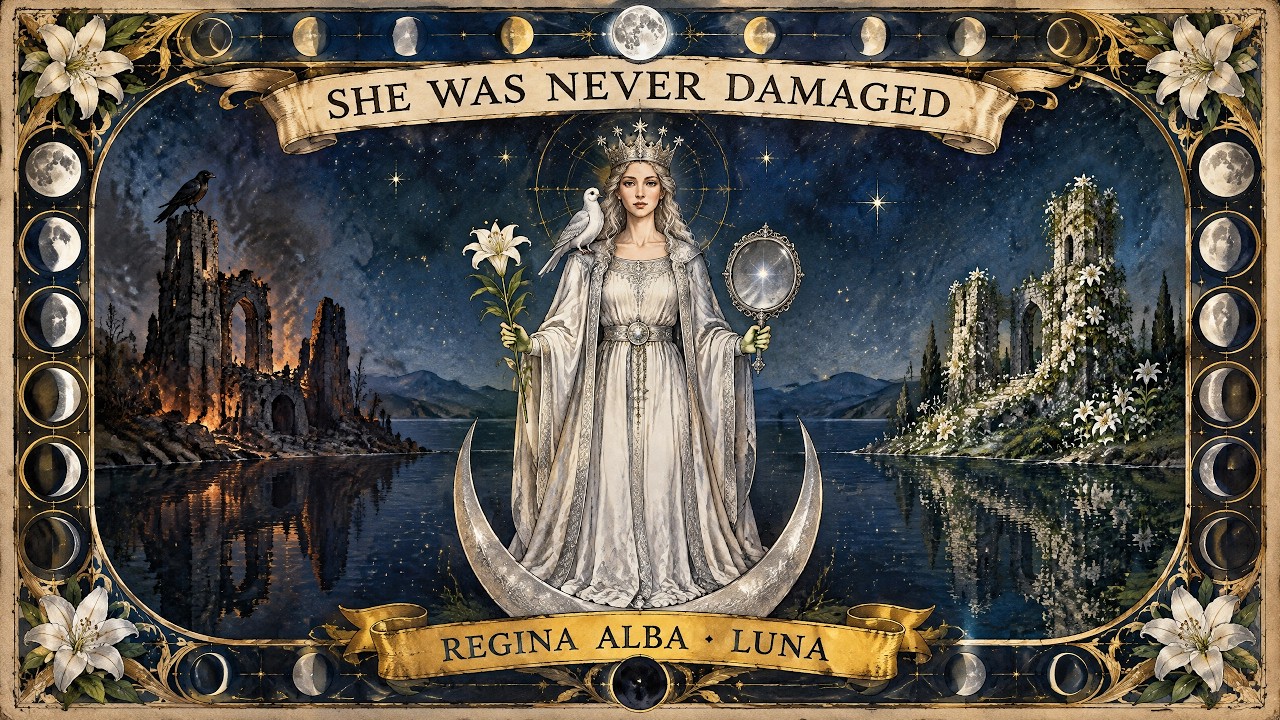
The White Queen — The Part of You That Was Never Damaged
There is a question people ask at this point in the process, usually late at night. If the structure I built was inherited, and the values I lived by were installed, and the story I told about myself has dissolved — is there anything under all of that which is actually mine? Or was it arrangements all the way down?
The question arrives after the separatio. You have identified what was inherited. You have distinguished your mother's voice from your own, your father's ambition from your desire, your culture's fear from your actual danger. And what remains, once you have set all of that aside, can feel alarmingly thin.
Two Bad Answers
Two responses are readily available, and both will stop the work.
The first is that there is nothing underneath — that the sense of a self is an artefact, a story told by neurons to neurons, and the honest response to seeing through it is to stop pretending. This answer has a certain intellectual appeal. It also produces people who are very clever and very empty, and who use the insight as a reason to stop working on anything at all.
The second, far more common in spiritual circles, is that underneath the damage there is a pure, untouched, radiant true self, and the work is simply to remember it. This answer feels wonderful. It has also ruined a great many processes, because it allows a person to skip every operation in this series on the grounds that the gold was already theirs. Why calcinate, dissolve, separate, wash — if you can simply remember that you were always whole?
The alchemical tradition gives a third answer. It is narrower and less comforting than either.
The Gold in the Dungheap
The alchemists insisted that the gold is not made by the operations — it is in the matter from the beginning, bound up and invisible, and every operation exists to remove what conceals it. The Rosarium Philosophorum states it directly: the stone is not brought from elsewhere; it is extracted from the substance you already have.
But the matter containing it is not precious. The prima materia is common, cheap, despised, found — as dozens of texts repeat with evident satisfaction — in the dungheap. In the gutter. In the thing everyone steps over. The gold is real. The vessel it arrives in is humiliating. And the operations are not optional, because without them the gold stays bound.
This is the position that neither nihilism nor premature wholeness can occupy: something essential is present, and the work to reach it is real, and the work is not what creates it.
Luna
The figure the corpus places at this point in the process is Luna — the White Queen. She appears in the Rosarium Philosophorum opposite the Red King, Sol, and in the Aurora Consurgens she speaks as the voice of Wisdom herself.
The Aurora Consurgens is a fifteenth-century treatise traditionally attributed to Thomas Aquinas, which Marie-Louise von Franz edited as a companion to Jung's Mysterium Coniunctionis. In it, Sapientia — Wisdom — speaks in the first person, describing herself as having been present from the beginning, before the work started, waiting.
There is one property of Luna that matters for this operation, and it is the property that makes the entire figure cohere: Luna does not generate. She reflects.
The sun produces light. The moon receives it and sends it back. A faculty that does not act cannot be deformed by acting badly. The moon is not injured by an eclipse. It is temporarily obscured — the light stops reaching it — but the surface that reflects was never scratched.
What the Faculty Actually Is
The temptation at this point is to inflate. To hear "a part of you that was never damaged" and immediately reach for the most grandiose version — your divine spark, your soul, your higher self, your Buddha nature. The tradition resists that move, and for a specific reason: the inflated version makes the faculty too precious to use and too abstract to verify.
What the White Queen actually names is something narrower and more testable: the capacity that registered the truth at the time.
In the worst arrangement you were ever in — the family that was wrong, the relationship that was damaging, the system that required you to perform a version of yourself you did not believe — there was a faculty that knew. Not a faculty that could act on what it knew. Not a faculty that could leave, or speak, or refuse. But one that registered: this is not right. This is not mine. This does not fit.
You complied. You adapted. You built the structure that the previous operations have now dissolved. And the entire time, something in you was taking notes.
That is the White Queen. Not your personality — your personality is the structure that was built on top of her. Not a childhood self you can return to — that child was already adapting. Not your potential — potential is a future projection, and this faculty operates in the present tense. She is the witness that was never co-opted because witnessing is not an action that can be co-opted. You cannot corrupt a mirror by showing it ugly things.
Where She Shows Up
There are two other places this faculty appears, and they serve as verification — ways of checking that you are not simply inventing a comforting story about an undamaged core.
In the body's refusal. Before the mind can articulate what is wrong with a situation, the body often registers it as tension, nausea, a contraction in the chest, a jaw that will not unclench. These are not symptoms to be managed. They are the reflective faculty operating through the only channel available when the conscious mind has agreed to the arrangement. The body knew before you did. That knowing is Luna.
In the involuntary no. There are moments — sometimes years into a compliant arrangement — when something rises without permission and refuses. Not a reasoned objection. Not a strategic withdrawal. A flat, involuntary no that arrives from below the personality and cannot be argued with. People often describe this as a breakdown. It is frequently the White Queen finally being heard.
The Corrective
This material needs a corrective, and it is this: the claim that something in you was never damaged does not mean that you were never damaged.
The damage is real. The adaptation was real. The years spent in the wrong structure were real and they cost something that cannot be refunded. The White Queen's presence does not retroactively make the suffering educational, does not redeem the people who caused it, does not convert the dungheap into a gift.
What it does is narrower and more important: it means the work has something to work toward. The operations are not building a self from nothing. They are clearing the debris from a self that was present the whole time but could not act because it was buried.
And this is the only reason the work is worth doing. If there were nothing under the rubble, the correct response to seeing through the false structure would be exactly the nihilism of the first bad answer — there is nothing here, stop digging. The White Queen is what makes the digging rational. Not because she guarantees a good outcome, but because she confirms that there is something to dig toward.
What This Stage Asks
The Albedo does not ask you to find the White Queen. She cannot be found by searching — the search itself is an activity of the conscious mind, and the conscious mind is precisely what was built on top of her.
What the stage asks is that you stop generating long enough to notice what reflects.
Stop producing opinions and notice which ones were already there. Stop constructing a position and notice what you see when you are not constructing anything. Stop performing the self and notice what remains when the performance stops.
The tradition insisted she cannot be found by searching because searching is solar — it is active, directed, generative. And Luna's nature is the opposite. She appears in stillness, in reception, in the pause after the effort has been abandoned. She is what you see when you stop looking and start reflecting.
That is why the Albedo follows the Nigredo. The collapse of the old structure is not a catastrophe that must be repaired before the real work begins. It is the real work. Because only when the generating stops — when the king has died, the structure has dissolved, and the performance has ended — does the reflecting surface become visible.
The White Queen was never damaged. That does not mean you were not. It means there is something worth continuing for.
Jung & The Occult
Where depth psychology meets esoteric wisdom, and where Jung deliberately stopped.
Get this guide · $7Sources
- C.G. Jung, Mysterium Coniunctionis (Collected Works vol. 14, 1955–56)
- C.G. Jung, Psychology and Alchemy (Collected Works vol. 12, 1944)
- Marie-Louise von Franz, Aurora Consurgens: A Document Attributed to Thomas Aquinas on the Problem of Opposites in Alchemy (1966)
- Marie-Louise von Franz, Alchemy: An Introduction to the Symbolism and the Psychology (1980)
- Rosarium Philosophorum (Frankfurt, 1550)
This essay is educational and historical. It describes how alchemical and psychological traditions have interpreted human experience. It is not medical or psychological advice, not a diagnosis, and not a substitute for care from a qualified mental health professional. If you are not sleeping, if you believe you have been given a special mission, if people close to you have expressed concern, or if you are hearing or seeing things others do not, please contact a licensed practitioner or a crisis line in your country today.
Go Deeper
Watch the complete teaching with visual symbolism and guided reflection on our YouTube channel.
Watch on YouTube Explore Ebooks