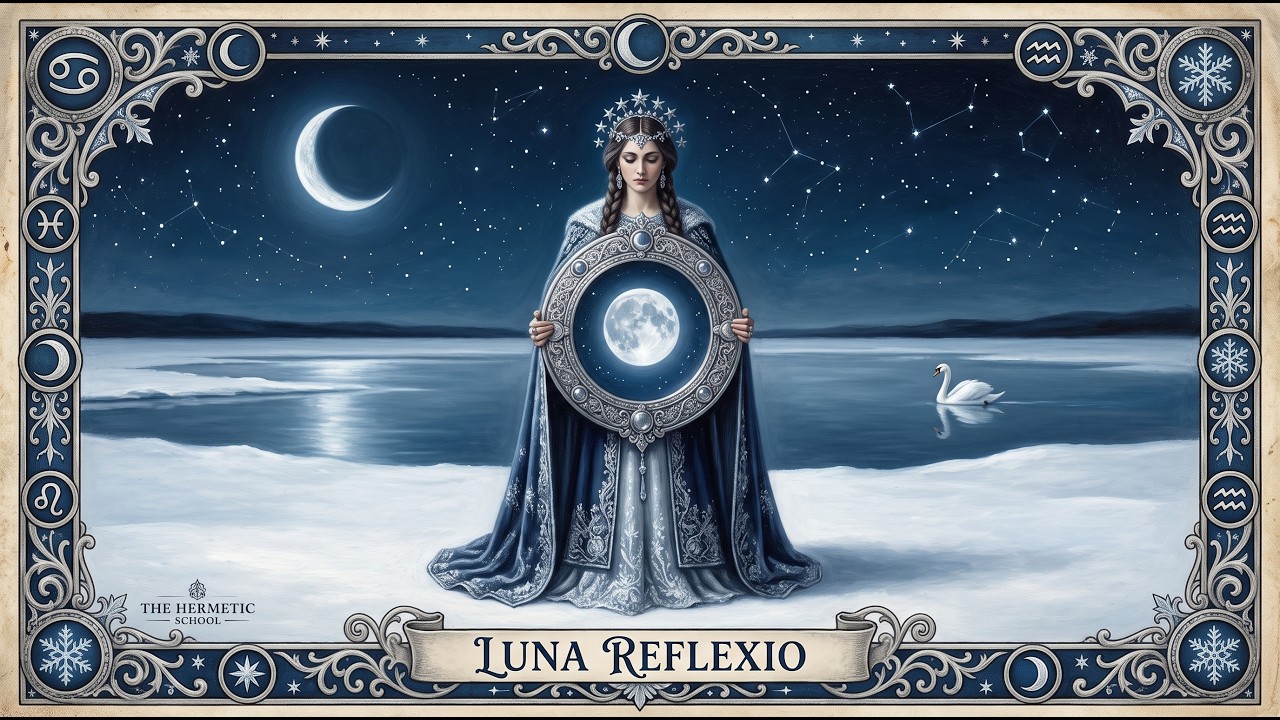
Albedo — The Silence That Comes After the Collapse
https://thehermeticschool.gumroad.com — The Alchemist's Path: the whole sequence, stage by stage.
Nobody warns you about what comes after. There is an enormous amount written about the darkness, and it all shares one implicit promise that is never stated directly because stating it would expose how little support it has: that the darkness ends in light. It does not, in the sense anyone means by that. What comes after the nigredo is a silence — flat, colourless, in which nothing hurts and nothing much matters either.
Almost everyone reads this as failure. They conclude the process did not work, or that they have relapsed, or that nothing is happening at all. That conclusion is the most expensive error in the entire opus: this is the stage at which more people abandon the work than at any other, and they abandon it precisely because it has begun to succeed.
This episode examines the albedo, the whitening, through the cluster of images the corpus uses to mark it — the washing, the baptism, the operation Edinger calls ablutio. And the agent the texts specify is not water but ros, dew: the gentlest possible agent, arriving on its own schedule, produced by nobody, accumulating in silence while the operator sleeps. Whatever cleans the material at this stage is not something the operator does.
What follows is an examination of why the albedo is lunar rather than solar, and what it means that the light which arrives is real and is not yours; the four marks by which the stage is distinguished from depletion and from depression; the temptation to fill the emptiness, and why the period of least apparent activity is the period in which you are least free to make large irreversible changes; and the specific pathology of this stage, which Jung and von Franz both wrote about without gentleness — the figure who completed a genuine descent, arrived at the whiteness, mistook it for the end, and settled there. Clarity without commitment. No blood in them.
Episode 7 of THE GREAT WORK, a twenty-four part series following the operations of the opus in order, from the nigredo through to the rubedo. This episode opens the second stage.
C.G. Jung, Psychology and Alchemy (Collected Works vol. 12, 1944) C.G. Jung, Mysterium Coniunctionis (Collected Works vol. 14, 1955–56) C.G. Jung, The Psychology of the Transference (Collected Works vol. 16) Marie-Louise von Franz, Alchemy: An Introduction to the Symbolism and the Psychology (1980) Edward F. Edinger, Anatomy of the Psyche: Alchemical Symbolism in Psychotherapy (1985) Rosarium Philosophorum (Frankfurt, 1550)
This video is educational and historical. It describes how alchemical and psychological traditions have interpreted human experience. It is not medical or psychological advice, not a diagnosis, and not a substitute for care from a qualified mental health professional. If you are struggling, please contact a licensed practitioner or a crisis line in your country.
Original educational essays on the history of Western esotericism and its reception in analytical psychology. Every script is researched and written from the primary sources listed above, not summarised from secondary content. Throughout, we distinguish between what a historical text actually says and how twentieth-century psychology reinterpreted it.
Go Deeper
Watch the complete teaching with visual symbolism and guided reflection on our YouTube channel.
Watch on YouTube Explore Ebooks