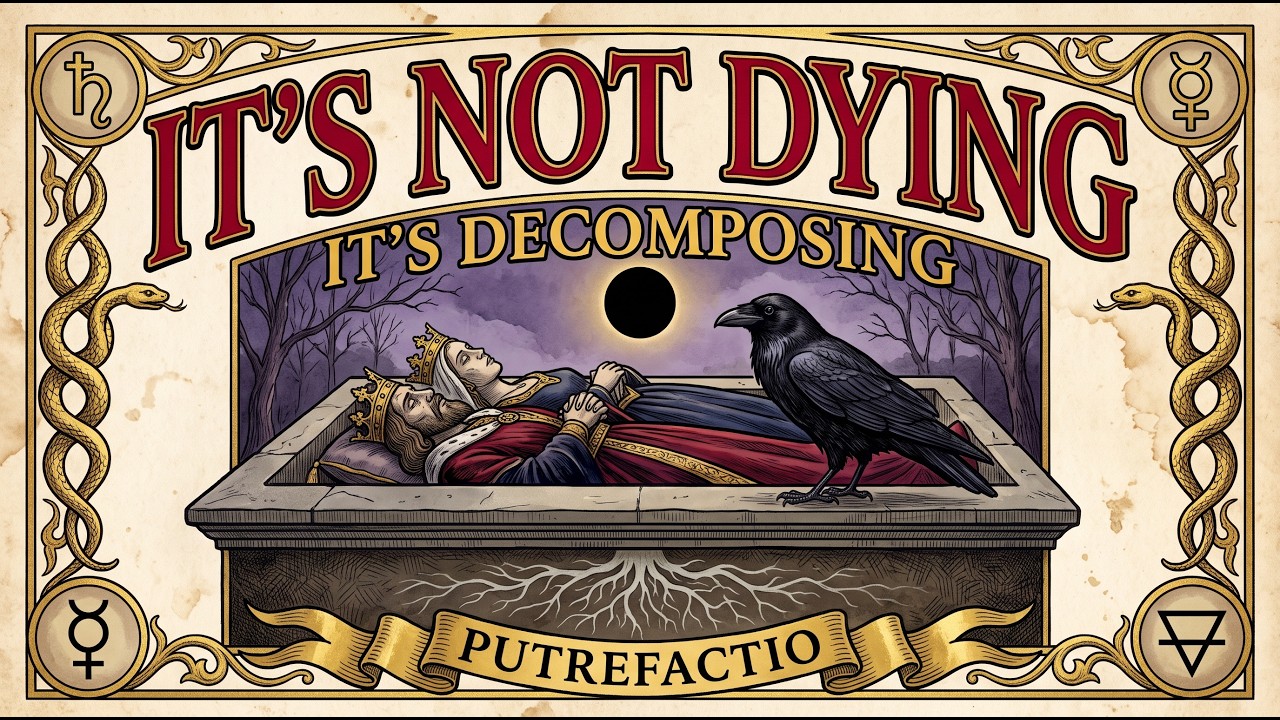
Putrefactio — What Is Actually Rotting When Your Life Falls Apart
Almost everyone in a collapse makes the same category error: they believe what is happening to them is destruction. It is not. It is decomposition — and those are opposite operations with opposite outcomes.
This episode examines putrefactio, the rotting, which the alchemists placed at the centre of the first stage not as a misfortune to be endured but as the operation in which the work is actually done. We begin with the maxim the tradition inherited from scholastic natural philosophy — corruptio unius est generatio alterius, the corruption of one thing is the generation of another — and the claim buried inside it: that rotting and generating are not two events in sequence, but one event seen from two ends.
What follows is an examination of what actually decomposes during a collapse, and why it is the arrangement rather than the components; the grain of wheat, and what the image specifies that its usual reading misses; the alchemical frankness about the stench of putrefying material, and its exact psychological equivalent; why people behave badly at this stage, and why the obvious interpretation of that is both false and paralysing; the almost irresistible temptation to re-bind the compound before the operation is complete, and the repeating collapses that follow; the phrase nigrum nigrius nigro, black blacker than black; and the one reliable sign that the operation has finished.
Episode 3 of THE GREAT WORK, a twenty-four part series following the operations of the opus in order, from the nigredo through to the rubedo.
This channel is no longer monetized. The written work is what funds the research behind every episode — the complete stage maps, the full sequence, and the sources beneath it, in the long form these essays can only compress.
C.G. Jung, Psychology and Alchemy (Collected Works vol. 12, 1944) C.G. Jung, The Psychology of the Transference (Collected Works vol. 16) C.G. Jung, Mysterium Coniunctionis (Collected Works vol. 14, 1955–56) Aristotle, On Generation and Corruption Marie-Louise von Franz, Alchemy: An Introduction to the Symbolism and the Psychology (1980) Edward F. Edinger, Anatomy of the Psyche: Alchemical Symbolism in Psychotherapy (1985) Rosarium Philosophorum (Frankfurt, 1550)
This video is educational and historical. It describes how alchemical and psychological traditions have interpreted human experience. It is not medical or psychological advice, not a diagnosis, and not a substitute for care from a qualified mental health professional. If you are struggling, please contact a licensed practitioner or a crisis line in your country.
Original educational essays on the history of Western esotericism and its reception in analytical psychology. Every script is researched and written from the primary sources listed above, not summarised from secondary content. Throughout, we distinguish between what a historical text actually says and how twentieth-century psychology reinterpreted it.
Go Deeper
Watch the complete teaching with visual symbolism and guided reflection on our YouTube channel.
Watch on YouTube Explore Ebooks