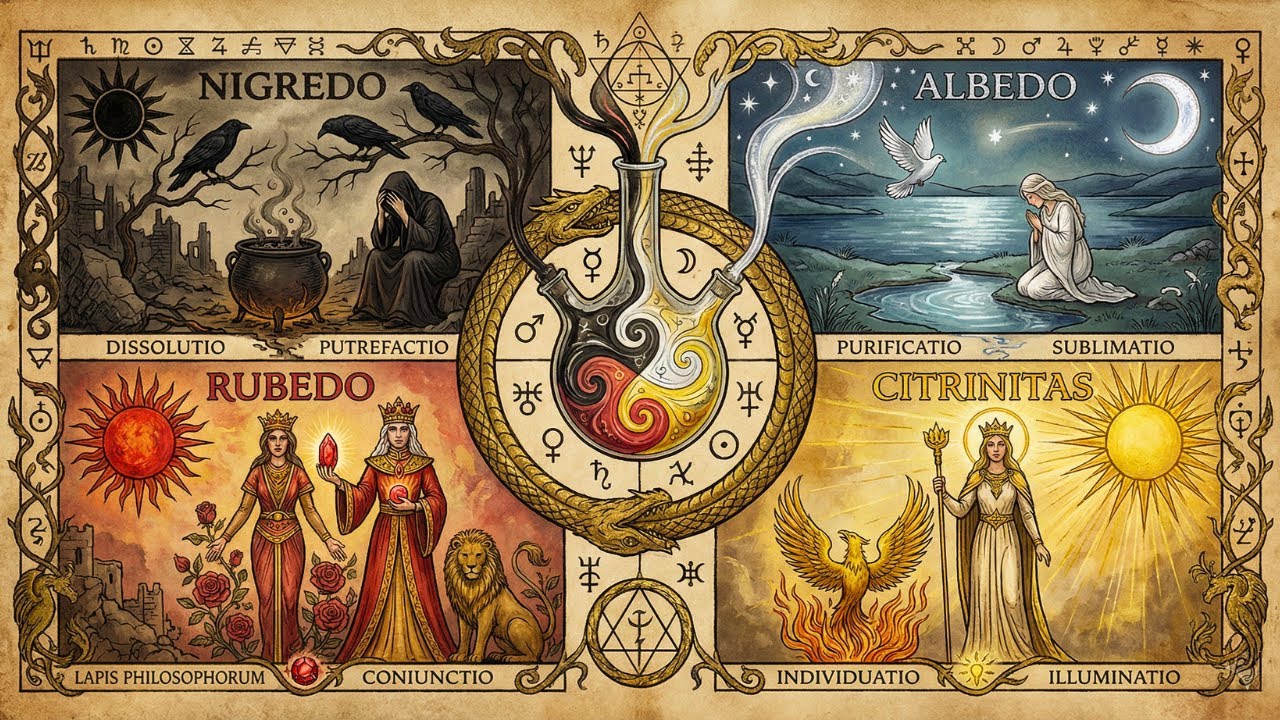
The Magnum Opus — The 4 Stages of Inner Transformation (Jung + Alchemy)
The alchemists of medieval and Renaissance Europe did not labor in their laboratories for gold. Their true opus — buried under cryptic symbolism and deliberately obscure language — was the transformation of the human soul.
The Magnum Opus, the Great Work, unfolds in four stages: Nigredo, Albedo, Citrinitas and Rubedo. Dissolution, purification, the emergence of meaning, and integration. What follows is what each one actually is, and where each one breaks people.
Why Jung Turned to the Alchemists
When Carl Jung encountered the alchemical texts in the early twentieth century, he recognized something that centuries of rationalist dismissal had obscured. These were not the ravings of deluded proto-chemists. They were sophisticated psychological documents.
The recognition arrived during his own crisis. After his break with Freud, Jung descended into what he later called his confrontation with the unconscious — territory for which modern psychology had no adequate maps. It was in the works attributed to Hermes Trismegistus, to Paracelsus, and in treatises like the Rosarium Philosophorum, that he found a language capable of describing what was happening to him.
The alchemists had encoded a map. They just had not written it in the language of psychology, because that language did not yet exist.
The Prima Materia Is You
Every alchemical operation begins with the prima materia — the base matter, chaotic and undifferentiated, that the work will transform.
Jung's insight was that this substance was never lead or mercury. The prima materia is the unrealized self: the psyche in its raw, unintegrated state, containing everything you will become and none of it yet organized.
This is why the alchemists insisted the first matter was "everywhere and nowhere," worthless and priceless at once. They were describing something you cannot buy and cannot escape.
Nigredo — The Blackening
The work begins in darkness.
Nigredo is dissolution. In the imagery of the texts it appears as graves, crows, skeletons, blackened matter, the setting sun. The prima materia is subjected to heat and begins to break down into its constituent parts.
Psychologically, this is the encounter with the shadow — the aspects of yourself you rejected, repressed, or never consciously acknowledged. What most people miss is that the shadow does not only contain what is ugly. It also holds positive capacities that were suppressed during socialization because they conflicted with the persona, the mask built to move through the world.
Nigredo is rarely chosen. It is precipitated: a cherished belief system collapses, a life strategy fails, symptoms erupt — depression, anxiety, illness — that can no longer be ignored. The structures that organized your life stop holding.
This is the stage the alchemists called putrefactio, and it is what the Black Sun symbolizes.
Albedo — The Whitening
After the heat, the cooling. Albedo is the phase of reflection rather than raw experience — the washing of what Nigredo broke apart.
Here you begin to develop an actual relationship with the unconscious: to recognize its communications, to learn the symbolic language it speaks in. This is where the anima or animus appears — the contrasexual archetype that functions as a bridge to deeper material. Not a gendered stereotype, but the compensatory opposite of your conscious orientation. Feeling and connection for someone who has lived through instrumental reason; structure and discrimination for someone whose development emphasized relationship.
Albedo is the dawn, not the full day. It is consciousness achieved through negation — through recognizing what you are not.
And this is where most serious people get stuck.
The danger of Albedo is remaining in permanent reflection: endless analysis without integration. The alchemists warned about it with the image of the multiplicatio — repeating purifications forever, never proceeding to the next operation.
You have seen this. People who spend decades in therapy, who can describe their patterns with extraordinary precision, and who continue to enact them without variation. They understand exactly why they behave as they do. It changes nothing. Insight became a substitute for transformation rather than a step toward it.
Citrinitas — The Yellowing
Some systems fold Citrinitas into Rubedo. Jung treated it as a distinct and crucial passage: the dawning of solar consciousness after the lunar reflection of Albedo.
Albedo gives understanding. Citrinitas gives direction.
Purification separated the essential from the inessential, and that creates a new problem — what do you do with the clarity? This stage is the activation of what Jung called the transcendent function: the psyche's capacity to generate a new symbol that unites contents which were previously in opposition.
During Nigredo and Albedo you encountered and separated conflicting parts of yourself. In Citrinitas those conflicts begin to resolve — not by suppressing one side, but through the emergence of a third position that neither side could have produced alone. It is often experienced as the discovery of vocation: not a job, but a direction that feels less chosen than recognized.
It also cannot be hurried, which is its own law.
Rubedo — The Reddening
Rubedo is integration. The parts that were dissolved, washed and reoriented now function as a coordinated whole — what Jung called individuation.
Its emblem is the conjunctio, the sacred marriage: the union of opposites that were, for most of a life, at war.
The Mortificatio — The Part Nobody Advertises
No honest account of this process omits its most perilous aspect.
The mortificatio is the death that must be endured for rebirth to be possible — and it is not metaphorical. It is a genuine encounter with annihilation, in which your sense of existing is threatened.
Jung's own descent between 1913 and 1917 is the case study. He was assailed by visions and psychological states that bordered on psychosis, describing "a stream of lava" from the unconscious threatening to overwhelm his conscious personality entirely. He recorded it in what became the Red Book — a document that reads less like clinical psychology than like the testament of a mystic.
What he learned is that the descent, while necessary, carries real risk. The ego can be overwhelmed. A person can lose their footing in consensus reality. The alchemists knew this and encoded it as warnings about the volatility of the work: keep the vessel sealed, do not open the furnace prematurely.
This crisis is not ordinary depression or anxiety. Kierkegaard called it the sickness unto death — the despair that comes from confronting the structure of existence itself. Heidegger distinguished angst from fear: fear has an object, anxiety is the mood in which the nothingness at the ground of existence reveals itself.
In the work it usually arrives in the passage from Nigredo to Albedo, or in an especially severe form just before Rubedo. The old self has died and the new one has not stabilized. There is a void, and you exist in it as neither one thing nor another.
What Individuation Actually Looks Like
Jung was careful never to present individuation as perfection or as some idealized final self. The individuated person is not superhuman. They are fully human — integrated, conscious, whole.
Concretely, that means:
- The shadow is not eliminated — it is acknowledged, and expressed deliberately where appropriate, instead of erupting as projection and compulsion.
- The persona is not discarded — it becomes a tool used flexibly rather than a costume mistaken for a face.
- Psychological freedom — no longer driven by unconscious compulsion, no longer helplessly reactive to circumstance or complex. Authorship of your own life rather than being its product.
- A changed relationship to suffering — not its absence. The individuated person still suffers, but no longer unconsciously. As Nietzsche put it: he who has a why to live can bear almost any how.
There is usually a shift in values as well — away from status and recognition, toward meaning and contribution. Jung noted that many patients who achieved real integration left successful careers for work that paid less and cost them less of themselves.
And there is a price. Individuation often creates distance from conventional society. The person who has been through deep transformation may find themselves quietly alienated from people still living inside assumptions they no longer share. Jung acknowledged this openly rather than pretending the work has no social cost.
The Instruction
The alchemists left a dictum for anyone attempting the work: lege, lege, relege, labora et invenies — read, read, reread, work, and you will find.
The emphasis on repetition is not decorative. Transformation does not arrive through a single insight or a peak experience. It comes through sustained, patient engagement with a process that unfolds on its own schedule.
Jung was explicit that the work cannot be forced. The ego's task is not to control it, but to participate consciously, endure what it requires, and integrate what emerges.
That is the whole method. It is also the reason so few complete it.
Frequently Asked Questions
What are the four stages of the Magnum Opus?
Nigredo (the blackening), Albedo (the whitening), Citrinitas (the yellowing) and Rubedo (the reddening). In Jung's reading they describe dissolution of the old identity, purification and clarity, the emergence of direction and meaning, and finally integration into a whole self.
What is the Nigredo stage?
Nigredo is the first stage, the blackening. Alchemical texts depict it with graves, crows, skeletons and the setting sun. Psychologically it is the encounter with the shadow, usually triggered by crisis: a belief system collapses, a life strategy fails, or symptoms appear that can no longer be ignored.
What is the difference between Albedo and Citrinitas?
Albedo gives understanding; Citrinitas gives direction. Albedo is lunar and reflective — you see clearly what you are not. Citrinitas is solar — meaning and vocation emerge, and opposites that were merely separated begin to resolve into something new.
How long does the Magnum Opus take?
It cannot be scheduled. Jung insisted the process unfolds according to its own timing and cannot be forced or rushed. The ego's task is not to control it but to participate consciously and endure what it requires. Attempts to accelerate it typically produce insight without change.
Is the alchemical process dangerous?
It carries real risk. The alchemists called this danger the mortificatio and warned about keeping the vessel sealed and not opening the furnace prematurely. Jung's own descent between 1913 and 1917 brought states that bordered on psychosis. The ego can be overwhelmed, which is why support and containment matter.
What did Jung mean by individuation?
Not perfection — full humanity. The individuated person has not eliminated the shadow but acknowledges it, uses the persona as a tool rather than mistaking it for identity, and is no longer driven by unconscious compulsion. Suffering does not disappear; it stops being meaningless.
Go Deeper
This article is derived from our video teaching. For the complete exploration with visual symbolism and guided reflection, watch the full lesson on YouTube.
Watch on YouTube Get The Magnum Opus