Conjunctio — The Alchemical Marriage That Most People Never Complete (Jung & Alchemy)
You have spent your life looking for someone to complete you. The ancient alchemists would have told you that you were looking in the wrong direction — and that the person you are actually searching for is standing behind you. If you have walked this path through the dark waters of Putrefactio and the sharp, unforgiving blades of Separatio, you already know that the Great Work does not begin with unity. It begins with destruction, and it proceeds through discrimination. You were pulled apart so that you could no longer mistake the shadows for your own face. You were forced to slice through your projections, your dependencies, and the comfortable lies that kept your soul bound to the world's machinery.
But separation is not the end of the art. The blade is a tool of preparation, not a place of dwelling. Once the vessel has been cleared and the crude elements isolated, the alchemist faces the most delicate, dangerous, and misunderstood operation in the entire codex: Conjunctio — the sacred marriage.
The Great Work does not begin with unity. It begins with destruction, and it proceeds through discrimination. Only what has been separated can be truly joined.
The Royal Marriage Was Never About Romance
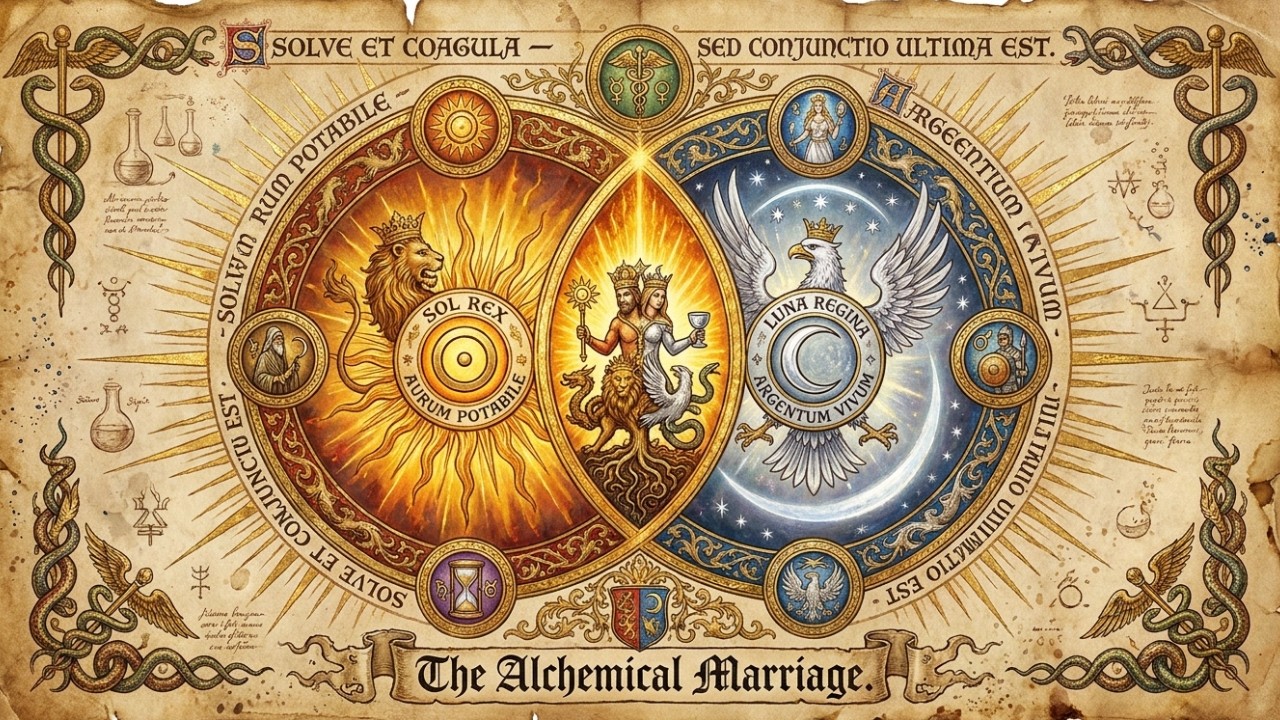
Look closely at the illuminated manuscripts of the sixteenth century — at the woodcuts of the Rosarium Philosophorum. You will see a king and a queen draped in robes of sun and moon, standing upon the dragon-tail of their own unrefined nature. They reach for one another, extending delicate branches and crowns, preparing to merge into a single, terrifyingly complete entity: the Rebis, the divine hermaphrodite, the two-headed crowned sovereign of the inner world.
For centuries, the uninitiated looked at these images and saw a romantic allegory. They believed the alchemists were singing songs of courtly love, prescribing the ideal union between man and woman. They were entirely wrong. The alchemists were not writing marital advice. They were describing an event that takes place inside a solitary human chest, in the silence of an isolated mind, far removed from the clamor of human romance. What you are witnessing in the royal marriage is not the union of two separate human beings. It is the reconciliation of the two halves of a single psyche that were torn apart at the moment of your birth.
The Fusion That Masquerades as Love
You must understand why this operation is so rarely finished — and why almost everyone who attempts it creates a monstrosity instead of a miracle. In our modern world, we are raised on a diet of romantic longing. We are taught that we are half-beings drifting through a cold universe, searching for our lost counterpart. We look into the eyes of lovers, friends, and mentors, desperate to find the peace that will make the aching silence go away. But when you seek your missing half in another person, you are committing a fundamental mistake in the laboratory: you are attempting a fusion without first undergoing a separation.
Consider what happens when two unexamined, unseparated human beings try to join. They do not achieve a royal marriage. They collapse into a psychological swamp — because neither has mapped the borders of their own shadow, their own instinct, their own hidden architecture. They project their internal missing halves onto each other. The man projects his unlived depth, his intuitive soul — his anima — onto the woman. The woman projects her unlived drive, her decisive logos — her animus — onto the man. For a brief, intoxicating season it feels like enlightenment, because you are suddenly holding the piece of yourself you could never reach alone. But it is not Conjunctio. It is psychological parasitism.
And when the mirror inevitably cracks — when the human being in front of you acts like a flawed, limited person rather than your divine missing half — the projection shatters. Love turns to resentment, devotion to bitterness. You accuse them of changing, of failing you, of taking away the light they brought into your life. But they did not take it away. You handed them your own lamp and grew angry when they walked out of the room with it. This is the same mechanism examined in the alchemical law behind never chasing and never begging: what you pursue outside yourself is almost always something you have refused to carry within.
Fusion is two starving people feeding on each other in a dark room. Union is two whole, self-contained sovereigns standing side by side — because neither needs to steal from the other.
This is why the old masters insisted that Separatio must always, without exception, precede the sacred union. You cannot combine elements that have not first been purified and defined. If you melt two muddy, unrefined ores together, you do not get gold — you get a larger, heavier lump of slag. Only when a human being has become whole on their own, only when they can stand in a room completely alone and feel no terrifying emptiness, are they ready for the heat of the Conjunctio.
Jung and the Mysterium Coniunctionis
Carl Jung spent the final decades of his life obsessed with this precise mystery. In his monumental Mysterium Coniunctionis, written as the sun was setting on his long career, he recognized that the ancient alchemists were describing the highest stage of human development: the integration of the unconscious into conscious awareness. Jung understood that the psyche is naturally divided. Within every man lies a hidden feminine archetype — the anima — representing soul, depth, emotion, and relational connectivity. Within every woman lies a hidden masculine archetype — the animus — representing structure, discernment, action, and drive.
These internal figures are not poetic metaphors. If you pay attention to your dreams, if you sit in meditation long enough to watch the movements of your own mind, you will encounter them. They are real, autonomous forces within your nervous system — and as long as they remain unconscious, they operate as tyrants. If you are a man and your anima remains unintegrated, she will possess you from the shadows: sudden, unexplainable moods, deep bouts of apathy, passive aggression, or an endless hopeless longing for an ideal woman who does not exist on this earth. If you are a woman and your animus remains unintegrated, he will possess you as rigid, ruthless opinions, an unforgiving internal critic, or an obsessive need to debate, control, and conquer every environment you enter. In both cases, the inner royal court is at war. The king and queen are not marrying — they are tearing the kingdom apart from within.
Think about the sheer amount of energy you exhaust every single day just maintaining this internal war. Consider how much of your fatigue, your anxiety, and your chronic restlessness has nothing to do with your external circumstances — and everything to do with two powerful forces inside your own chest pulling in opposite directions. One part of you hungers for creation while another demands safety. One part demands absolute truth while another retreats into comforting delusion. You are a house divided against itself, trying to build a life on a foundation that never stops shifting. This is the hidden root of much of what we call exhaustion — the same inner economy explored in the alchemical mastery of the emotions.
The Bridal Chamber Is a Furnace
The Conjunctio is the deliberate, conscious cessation of this civil war. But do not mistake it for a peaceful compromise. The alchemists drew the sacred union not as a quiet handshake but as a violent, transformative death. In the manuscripts, once the king and queen enter the bridal chamber — the thalamus — they do not live happily ever after. They are thrown into the hermetic vessel, sealed beneath the glass, and subjected to intense, unrelenting heat. Under the pressure of this fire, their individual identities dissolve. Their bodies melt together, losing their original shapes, until they die into a single dark, lifeless mass at the bottom of the flask. The alchemists called this the nigredo of the union — a blackening inside the marriage itself, the same descent mapped in the complete Black Sun teaching.
This is the exact point where most seekers panic and abandon the work. They believe that integrating their opposite nature means losing themselves. The rational, analytical mind fears that if it surrenders to the intuitive depth of the unconscious, it will be erased. The sensitive, emotional nature fears that if it adopts discipline and cold boundary-setting, it will lose its magic. So when the heat rises — when the psyche begins to melt down its old structures to make room for something larger — the ego breaks the glass. It flees back into its comfortable, one-sided identity, choosing the safety of partial living over the terrifying glory of wholeness. The vessel cannot be rushed, and it cannot be escaped: this is the alchemical law of natural timing operating at its highest intensity.
To complete the Conjunctio, you must be willing to let the person you thought you were die in the flask.
The Rebis: The Two-Fold Being
What emerges from that ash and molten heat is what the texts call the Rebis — the two-fold thing. Look at the ancient woodcuts: a single body with two crowned heads, one male and one female, holding the compass and the square, standing triumphantly upon a dragon that has been subdued and integrated. It is an image that unnerves the modern eye because it violates our desire for simple, neat categories. It is neither purely one thing nor the other. It is both. It is a psyche that no longer wars with itself.
Imagine what it would mean to walk through the world as the Rebis. Imagine no longer needing anyone to validate your worth, because your internal king has already crowned you. Imagine no longer searching for meaning in external distractions, because your internal queen flows through your veins continuously. Imagine a state of mind where your intellect does not mock your intuition, and your intuition does not destabilize your intellect — where they work as one fluid, unbroken instrument. When you need to cut through a problem with cold, uncompromising logic, the blade is ready. When you need to hold grief with infinite tenderness, the vessel is open. You are no longer a fragment of a human being hoping the world will treat you gently. You are a complete ecosystem.
Why Almost No One Finishes the Marriage
So why have you not done this? Why do millions of people live and die without ever coming close to this sacred marriage? The reason is devastatingly precise: to complete the internal marriage, you must marry the precise part of yourself that you have spent your entire life exiling.
Every person has a scrap heap in the backyard of their psyche. From childhood, you were taught which parts of your nature were acceptable and which were dangerous. If you grew up in an environment that demanded composure and performance, you exiled your raw emotional truth, your wild instinct, your vulnerability. If you grew up in chaos, you may have exiled your order, your boundaries, and your power. You pushed these discarded parts into the basement of your unconscious, locked the door, and put a polite smile on your face for the world. And then you wondered why you felt hollow — why, despite your achievements, there remained a persistent, subtle ache in the center of your chest that never quite vanished. That ache is not a lack of external success. It is the cry of your exiled half pounding on the floorboards from below.
The cruel joke of the human condition is that the exact qualities you need for wholeness are contained within the parts of yourself you find most repulsive, terrifying, or inconvenient. The anima or animus does not first appear as a glowing angelic figure. It appears as the dragon — the mood you refuse to feel, the desire you are ashamed to admit, the weakness you cannot tolerate in others, the boundary you are too terrified to set. This is why your rage is one of the most precious raw materials in the entire opus: the exiled material is the marriage material. When you attempt the Conjunctio, you are forced to sit at the table with the outcast, look at the shadow standing behind you, and extend your hand in marriage: I will no longer abandon you. I will no longer look for someone else to carry you for me. I take you as you are, and I bring you home.
This is why true integration feels like a betrayal of your old self. It demands that you stop pretending to be a pure, simple creature of light and admit the terrifying complexity of what you actually are — the light and the dark, the order and the chaos, the saint and the beast, the king and the queen. Until you can hold both without flinching, you remain an unrefined element: a fragment waiting for a completion that will never arrive from the outside.
What Happens to Your Relationships
Notice what happens when you finally stop demanding that other people complete you. Something quiet and remarkable occurs: you become capable of actually seeing them. As long as you are unintegrated, you do not see other human beings — you see functional objects, potential providers of comfort, validation, or stimulation, each one measured against the unconscious template of your missing half. But when the internal Conjunctio is finished, the projection disappears like mist under the morning sun. For the first time in your life, you look at another person and need nothing from them. You do not need them to fix your loneliness, because your loneliness has been transmuted into a sacred, populated solitude. You can finally love another human being not out of desperate, clinging lack, but out of total, overflowing abundance.
That is the difference between fusion and true union — and it is also why the people who complete this work stop performing their inner life for an audience, a shift explored in why you must stop explaining your transformation to people who haven't been through it.
What a Completed Conjunctio Actually Feels Like
There is a profound myth, propagated by spiritual charlatans, that this level of integration produces a perpetual state of bliss. That is an infantile fantasy. Ecstasy is temporary — an acute spike of energy, a fire that consumes its fuel quickly. The completion of this stage of the Great Work does not leave you floating above the earth. It leaves you with a strange, permanent, unbreakable quiet. It is the quiet of a house where the argument has finally stopped — the silence that enters a room when two bitter enemies who have fought for decades lay down their weapons, sit at the same table, and realize they are wearing the same uniform.
When the opposites within you no longer tear at your mind, the chronic background noise of your life simply ceases. Criticism no longer shatters you, because you have already met the worst parts of yourself in the flask and accepted them — there is nothing an outsider can point to that you have not already seen and loved within your own shadow. This is the deep root of the sovereignty described in why, after this, nothing and no one will ever have power over you, and of the composure taught in the Hermetic law of the silent observer. When tragedy strikes, it does not destroy your center, because your center is no longer built on fragile, one-sided illusions. You move through the world with an easy, unshakable gravity — a person of immense weight and presence, not because you are trying to be strong, but because you are no longer hollow. You can sit in a quiet room, completely alone, with no screen and no distraction, and feel no urge to flee. The company inside your own skin is finally complete.
The Laboratory Was Always Inside You
Look at the life you have built — at the endless, energetic loops you run every day in search of peace, meaning, and connection. You have looked for the sacred marriage in romantic partners, in career achievements, in spiritual dogmas, and in the approval of strangers. You have broken your heart a thousand times on the rocks of the world, wondering why the vessel always leaks, why the gold never forms, why the ache never truly dies. The laboratory has always been inside you. The fire has been burning in your own chest since the day you drew your first breath. The king and the queen have been waiting in the dark corners of your own unconscious, holding their crowns, waiting for you to stop running — waiting for you to turn around, drop your defenses, and allow the blade of your awareness to bring them together. The circle closes where it began: the self that was divided in order to become whole is the Ouroboros paradox enacted in a single human life.
Join the male and the female, the sun and the moon, the dark and the light. For in the marriage of the opposites, the mortal dies and the eternal is born.
As the Emerald Tablet recorded before the dawn of our modern memory: that which is below is like that which is above, and that which is above is like that which is below, to perform the miracles of the one thing. Separate the earth from the fire, the subtle from the gross, smoothly and with great ingenuity — and then, only then, join them. Stop looking at the horizon for the one who will save you. Turn your gaze inward, lower yourself into the dark depth of the vessel, and face the sovereign who has been waiting in the shadows of your own soul.
Go Deeper
Watch the complete teaching with visual symbolism and guided reflection on our YouTube channel.
Watch on YouTube Explore Ebooks