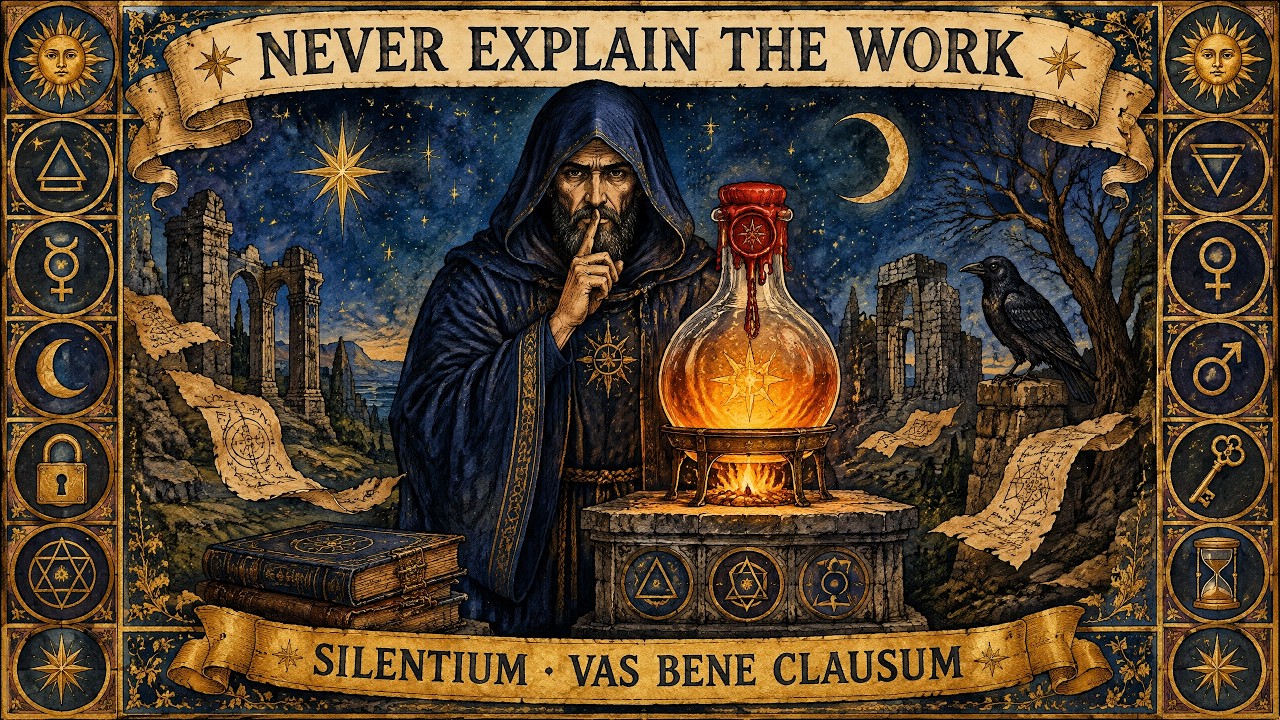
Never Explain the Work — The Alchemical Rule of Silence
https://thehermeticschool.gumroad.com — Never React, Never Explain: the rule of silence in full.
There is a moment in almost every genuine change when you feel the need to tell someone about it. And somewhere in the middle of the explanation, you notice that it is getting smaller. Almost every tradition that took inner transformation seriously arrived at the same instruction about this moment, independently, across centuries and languages that never met: do not explain the work while it is being done.
This episode sets out why, as mechanism rather than mystery. The alchemical sealed vessel held pressure and heat over time; opening it stopped the reaction. An explanation does the same three things to an unfinished inner process: it releases the pressure that was driving the change, it fixes the material in its current incomplete form, and it lets the old structure back in through the expectations of the people who knew the previous version of you.
It then follows the convergence: Harpocrates, the Egyptian child Horus whose raised finger the Greeks misread as a command to silence and kept for a thousand years; the Pythagorean echemythia, the holding of speech required of novices; the Mutus Liber of 1677, a book about the Great Work that chose to be almost wordless and ended with a method made of reading, working and finding; and Jung's Red Book, the private record of his confrontation with the unconscious, kept silent for the rest of his life and published only in 2009.
And it names the counterfeit. The rule of silence is a rule about process, not about people. It is not withholding, not disappearing from a relationship into a private project, and not the stonewalling that John Gottman's research identified as one of the most reliable predictors of a relationship breaking down. The episode gives the distinction, a single sentence that holds it, and the criterion for when the vessel can be opened: you are ready to speak about something when you no longer need a response.
Episode 8 of THE GREAT WORK, a twenty-four part series following the operations of the opus in order, from the nigredo through to the rubedo.
C.G. Jung, Psychology and Alchemy (Collected Works vol. 12, 1944) C.G. Jung, The Red Book: Liber Novus, ed. Sonu Shamdasani (2009) Mutus Liber (La Rochelle, 1677) Diogenes Laertius, Lives of Eminent Philosophers, Book VIII Iamblichus, On the Pythagorean Way of Life Edward F. Edinger, Anatomy of the Psyche: Alchemical Symbolism in Psychotherapy (1985) John M. Gottman, The Seven Principles for Making Marriage Work (1999)
This video is educational and historical. It describes how alchemical and psychological traditions have interpreted human experience. It is not medical, psychological or relationship advice, and not a substitute for care from a qualified professional. If you are struggling, please contact a licensed practitioner or a crisis line in your country.
Original educational essays on the history of Western esotericism and its reception in analytical psychology. Every script is researched and written from the primary sources listed above, not summarised from secondary content. Throughout, we distinguish between what a historical text actually says and how twentieth-century psychology reinterpreted it.
Go Deeper
Watch the complete teaching with visual symbolism and guided reflection on our YouTube channel.
Watch on YouTube Explore Ebooks