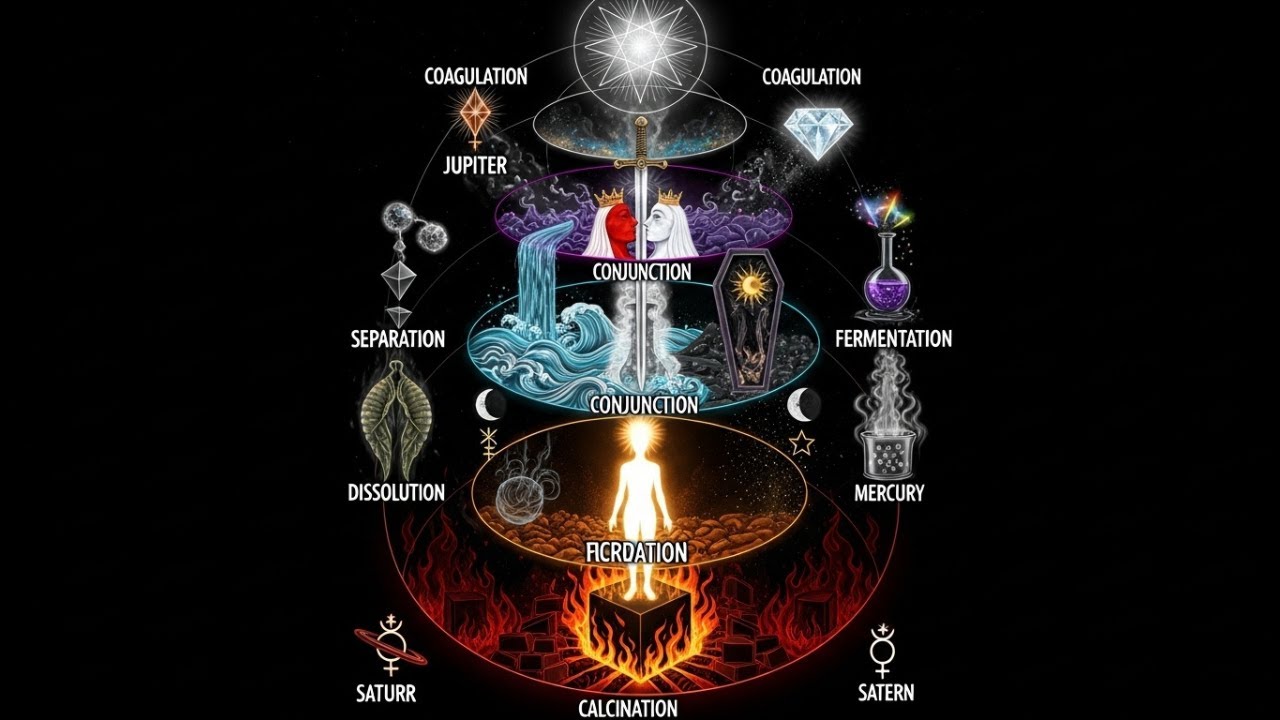
The 7 Steps of Spiritual Alchemy — The Complete Map of Inner Transformation
The modern seeker stands at the threshold of a paradox. In an age saturated with information, drowning in digital mysticism and commodified spirituality, the authentic path of transformation remains obscured beneath layers of distortion and trivialization.
The question that inaugurates genuine esoteric work is not "How can I gain power?" or "What secrets will elevate me above others?" It is this: How does one undergo a fundamental restructuring of consciousness itself?
The answer has existed for millennia — encoded in the language of alchemy. Not the alchemy of lead into gold, but the alchemy of the soul: seven operations that, taken together, form the most complete map of inner transformation ever devised. When Carl Jung encountered the alchemical texts in the early twentieth century, he recognized what centuries of rationalist dismissal had obscured. The alchemists were not failed chemists. They were sophisticated depth psychologists working with the raw materials of the unconscious mind.
What follows is neither a promise of easy transcendence nor a catalog of mystical experiences to be collected. It is a map. And like all serious maps, it describes territory that will cost you something to cross.
The Magnum Opus
The complete map of the Great Work: four stages and twelve operations, with the psychology of each.
About the bookThe Lineage Behind the Map
The seven operations trace their lineage through Hellenistic mystery traditions, Egyptian metallurgy, Greek philosophy, and Gnostic cosmology. At their center stands the figure of Hermes Trismegistus — the syncretic fusion of Greek Hermes and Egyptian Thoth — and the axiom inscribed on the Emerald Tablet: As above, so below; as within, so without.
Paracelsus understood the laboratory as both an outer workspace and an inner theater of consciousness. The three philosophical principles — Salt (body), Sulfur (soul), and Mercury (spirit) — are not chemical substances but dimensions of experience. The seven operations work upon all three simultaneously.
The stages do not form a ladder. They form a spiral. Each may be revisited at deeper levels. And the recognition that transformation is work — not merely revelation — requires the complete engagement of intellect, emotion, will, and body.
Step 1: Calcination — The Fire That Burns the Mask
Element: Fire · Planet: Saturn
The work begins with destruction.
In the physical laboratory, calcination reduces material to ash through intense heat, burning away impurities and leaving only essential salts. Psychologically, it is the collapse of the persona — the social mask — and the ego structures that were mistaken for identity.
This is not mere suffering but productive suffering. Suffering that serves a teleological purpose in the economy of transformation. The familiar world becomes defamiliarized. Previous satisfactions lose their savor. The alchemists described this as acedia — a spiritual dryness in which everything that once sustained you suddenly fails to nourish.
Jung identified this with ego inflation followed by puncture. The persona that was held up as the self is subjected to heat — through crisis, through confrontation with depression, through the sheer friction of a life that no longer fits — and begins to crack.
Two dangers attend this stage. The first is resisting the process by doubling down on ego defenses — more ambition, more control, more rigidity. The second is identifying with the destruction itself, becoming trapped in self-sabotage and nihilistic negation. The authentic alchemist recognizes calcination not as an end but as a beginning: the necessary clearing of ground before new construction can commence.
Step 2: Dissolution — The Waters of the Unconscious
Element: Water · Planet: Jupiter
Where calcination employs active destruction, dissolution involves passive surrender. The calcined material is submerged, liquefied, its rigid boundaries washed away.
Psychologically, this is the flooding of consciousness by repressed material. Dreams become vivid and disturbing. Emotions long suppressed surge into awareness. Memories thought forgotten surface with startling clarity. Jung associated this with the encounter with the anima or animus — the contrasexual archetype that functions as a bridge between the conscious mind and the deeper layers of the unconscious.
The cosmogonic imagery is universal: the Egyptian Nun, the Babylonian Tiamat, the Hebrew Tehom of Genesis. To dissolve in these waters is to return temporarily to the state before individuation — before the crystallization of separate identity.
The practitioner navigating dissolution must develop what Keats called negative capability: the capacity to remain in uncertainty, mystery, and doubt without reaching after fact and reason.
This is the baptismal immersion, the descent into the waters of chaos that precedes all new creation. It cannot be intellectualized. It must be endured.
Step 3: Separation — The Sword That Discriminates
Element: Air · Planet: Mars
After the fire and the flood comes the blade.
Separation is the most explicit and demanding phase of shadow work. It requires sorting through the dissolved material — distinguishing the valuable from the worthless, the true self from the false. Alchemical imagery depicts this as dismemberment, the cutting apart of the composite being into its constituent principles.
The shadow, as Jung repeatedly insisted, is not uniformly negative. It contains gold as well as dross, creative potential as well as destructive impulses. Separation requires the willingness to see oneself without the flattering distortions of ego protection — to acknowledge that we are not unitary beings but multiplicities, containing various voices and impulses that often conflict.
The danger here is becoming trapped in endless analysis without moving toward synthesis. This is the difference between insight and transformation. You can name every pattern, trace every wound to its origin, map every defense mechanism — and change nothing. Separation that does not eventually yield to conjunction becomes a prison of self-knowledge.
Step 4: Conjunction — The Sacred Marriage
Element: Water (nurturing mode) · Planet: Venus
The hieros gamos. The sacred marriage. The union of opposites that generates new life.
Alchemical texts depict this as the marriage of the Red King and White Queen, the union of Sun and Moon. This is not merely a sexual metaphor. Conjunction represents the integration of all manner of opposites that have been separated: consciousness and unconscious, logos and eros, masculine and feminine, spirit and matter, active and passive.
Jung recognized conjunction as the core of individuation. True conjunction involves a third position that transcends both poles — not a compromise that dilutes both, but a synthesis that includes and transforms both. This is what he called the transcendent function: the psyche's capacity to generate a new symbol that neither the conscious nor unconscious position could have produced alone.
In Taoist alchemy, this corresponds to the creation of the immortal fetus. In the Western tradition, it is the creation of the subtle body — the diamond body, the resurrection body, the body of light.
The challenge is maintaining the tension of opposites without collapsing back into one-sidedness. And its effect on relationship is transformative: it turns the desperate search for completion into a meeting of two whole beings.
Step 5: Fermentation — The Dark Night
Element: Water (putrefying aspect) · Planet: Moon
This is the most perilous passage of all seven stages.
Fermentation is the decomposition that paradoxically generates new life — the rotting of the grape that produces wine. In the alchemical imagery, this is the nigredo at its deepest: the blackening that St. John of the Cross called the dark night of the soul.
It is characterized by spiritual desolation so thorough that the entire journey appears to have been futile. Everything the practitioner has built, discovered, and integrated seems to dissolve into meaninglessness. What distinguishes this from clinical depression is precisely its timing: it arrives when genuine progress has been made. It is the false despair that precedes authentic rebirth — the darkness before the dawn that many abandon the path, never recognizing that they stood at the very threshold of breakthrough.
The Buddha experienced it under the Bodhi tree. Mother Teresa's private writings revealed decades of feeling utterly abandoned by the divine she served. Heidegger analyzed it as the mood in which the nothingness at the ground of existence reveals itself. Viktor Frankl survived it in a Nazi concentration camp and found that meaning itself could serve as the anchor.
The practitioner must learn what might be termed hopeless hope — continuing the work without expectation of success, maintaining discipline without belief in its efficacy, persisting in the face of apparent futility.
Two dangers define this passage. The first is the risk of abandoning the work — literal or psychic suicide. The second is spiritual materialism: seeking escape through new teachers, new techniques, plant medicine shortcuts, or technological consciousness hacking rather than enduring the process. What was rotting was the old identity, making space for something genuinely new.
Jung associated fermentation with the transcendent function at its most extreme — the requirement to hold unbearable tension until a third possibility emerges from the void.
Step 6: Distillation — The Refinement of Awareness
Element: Air · Planet: Mercury
After the putrefaction, purification. Distillation is the vaporization and condensation of essential components through repeated cycles — the extraction of quintessence, the fifth element, the spiritual essence of consciousness itself.
Psychologically, this is the emergence of meta-awareness: the capacity to observe consciousness from a refined, detached perspective. Thoughts arise and pass. Emotions swell and subside. Sensations emerge and dissolve. What remains constant is the witnessing awareness itself — the pure consciousness that observes but is not identical with its contents.
This is where contemplative practice — particularly insight meditation — becomes most effective. Not as a technique for producing pleasant states, but as a method for isolating the witness from the witnessed.
Jung associated distillation with the emergence of the Self — the transpersonal center that transcends yet includes the ego. The Hindu tradition names it directly: the atman is Brahman — the individual soul is the universal consciousness. The Self is not created through the alchemical process, but revealed, uncovered through the systematic removal of obscurations.
The challenge of distillation is avoiding spiritual bypassing — using detachment as a defense against genuine feeling. Dispassion that has not passed through the fire of fermentation is merely numbness wearing a spiritual costume.
Step 7: Coagulation — The Stone Made Flesh
Element: Earth · Planet: Saturn
The volatile becomes fixed. The spiritual becomes material without losing its essence. This is the creation of the Philosopher's Stone — not a substance to be possessed, but a state of consciousness to be lived.
Psychologically, coagulation is the incarnation of realized consciousness in concrete life. Insight becomes action. Wisdom becomes ethics. The transcendent is no longer a peak experience but a continuous orientation. This is the creation of what might be called the transpersonal ego — an ego that serves rather than obstructs the Self.
Jung described the goal of individuation not as ego dissolution but as the right relationship between ego and Self. The individuated person does not become egoless but develops an ego that acknowledges its proper place within the larger psyche. This is the meaning of "being in the world but not of it."
In Buddhist terms, this manifests as skillful action — behavior arising from wisdom and compassion rather than from conditioning. In the Hindu tradition, the coagulated being is the jivanmukta: one who has achieved liberation while still living.
The individuated being catalyzes transformation in others through mere presence, not through preaching. The Stone radiates.
What the Individuated Consciousness Looks Like
Four marks distinguish the person who has undergone genuine transformation:
- Psychological integration. The shadow is not eliminated but acknowledged. The persona is a tool used flexibly, no longer mistaken for identity. Opposites are held in creative tension rather than splitting into projection.
- Ethical automaticity. Right action no longer requires deliberation. It arises naturally from an integrated consciousness, the way balance arises naturally from a body that has learned to walk.
- Genuine presence. Martin Buber distinguished I-It relationships — instrumental, transactional — from I-Thou relationships, where the other is encountered as a whole being. The individuated consciousness relates as Thou, not It.
- Transpersonal perspective. The ego remains functional but no longer the center of gravity. The self, in Jung's sense, has assumed its proper place — not as a replacement for the ego, but as the larger field within which the ego operates.
This does not produce perfection. The individuated person still suffers, still errs, still faces limitation. What changes is the relationship to these experiences — they are no longer unconscious, no longer meaningless, no longer the whole of identity.
The Paradox at the Heart of the Work
The alchemists left one final teaching for those who reach this understanding: the stone that is no stone, the stone that is everywhere rejected by the foolish, is the very matter of the work.
The goal you seek is simultaneously the means of seeking it. The treasure you hunt is that which empowers the hunt. And the transformation you pursue is that which pursues you.
This path cannot be commodified or democratized. It requires not merely information but transformation, not concepts but lived experience, not techniques but character. It cannot be completed in a weekend workshop, a plant medicine ceremony, or a neurostimulation session — not because these experiences are worthless, but because they cannot substitute for the sustained engagement the work demands.
The question is whether you possess the philosophical temperament, the spiritual hunger, and the existential courage to walk it.
The gold you seek is not in the crucible, but in the will that lights the fire.
Frequently Asked Questions
What are the 7 steps of spiritual alchemy?
The seven steps are: Calcination (fire — breakdown of ego), Dissolution (water — surrender to the unconscious), Separation (air — discernment of true from false), Conjunction (water — sacred marriage of opposites), Fermentation (water — dark night and rebirth), Distillation (air — refinement of awareness), and Coagulation (earth — embodiment of the transformed self). They correspond to the seven classical planets and form a spiraling process, not a linear sequence.
What is the difference between 4-stage and 7-stage alchemy?
The four-stage model (Nigredo, Albedo, Citrinitas, Rubedo) describes the broad color phases of the Great Work. The seven-stage model describes the specific operations performed within those phases. The seven steps provide a more granular map: Calcination and Dissolution occur within Nigredo, Separation bridges Nigredo and Albedo, Conjunction is the heart of Citrinitas, and Fermentation, Distillation and Coagulation complete the path to Rubedo.
What is the most dangerous stage of spiritual alchemy?
Fermentation is the most perilous passage. It is the "dark night of the soul" — a period of spiritual desolation where the entire journey appears to have been futile. It arrives precisely when genuine progress has been made. The danger is twofold: the risk of abandoning the work entirely, and the temptation of spiritual materialism — seeking escape through new teachers, techniques, or shortcuts rather than enduring the process.
How does Jung relate to spiritual alchemy?
Carl Jung recognized that the alchemists were not failed chemists but sophisticated depth psychologists. He mapped the seven alchemical operations onto the process of individuation: Calcination as ego dissolution, Dissolution as encounter with the anima/animus, Separation as shadow work, Conjunction as the transcendent function, and Coagulation as the emergence of the Self — a transpersonal center that transcends yet includes the ego.
What is the Philosopher's Stone in psychological terms?
The Philosopher's Stone is not a substance but a state of consciousness — what Jung called individuation. It is the creation of a "transpersonal ego" that serves rather than obstructs the Self. The individuated person does not become egoless but develops an ego that acknowledges its proper place within the larger psyche. The alchemists said the Stone was "everywhere rejected by the foolish" because it is already present as potential within every person.
Can the seven stages be completed quickly?
No. The alchemists and Jung both insisted the process cannot be rushed, commodified, or shortcut. Weekend enlightenment experiences, plant medicine shortcuts, and technological consciousness hacking cannot substitute for the sustained, patient engagement the work demands. The stages form a spiral — not a checklist — and each may be revisited multiple times at deeper levels throughout a lifetime.
Works Named in This Essay
- The Emerald Tablet (Tabula Smaragdina), in the Latin tradition from the twelfth century; English translation by Isaac Newton (c. 1680).
- John of the Cross, The Dark Night of the Soul (16th century).
This essay is educational and historical. It describes how alchemical and psychological traditions have interpreted human experience. It is not medical or psychological advice, not a diagnosis, and not a substitute for care from a qualified mental health professional. If you are not sleeping, if you believe you have been given a special mission, if people close to you have expressed concern, or if you are hearing or seeing things others do not, please contact a licensed practitioner or a crisis line in your country today.
Go Deeper
This article is derived from our video teaching. For the complete exploration with visual symbolism and guided reflection, watch the full lesson on YouTube.
Watch on YouTube Get The Alchemist's Path