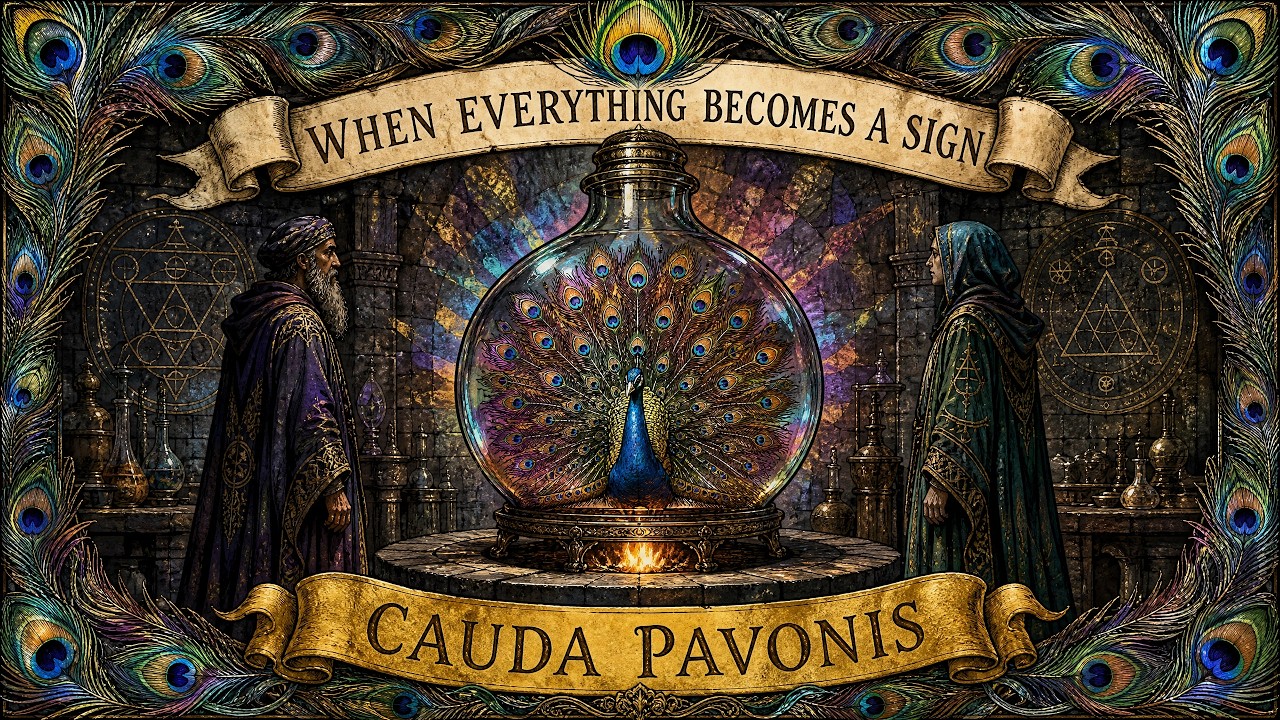
Cauda Pavonis — The Peacock's Tail and the Flood of Meaning
https://thehermeticschool.org/store.html — Jung & The Occult: where depth psychology meets esoteric wisdom, and where it deliberately stops.
There is a phase in this process where everything starts meaning something. A book falls open at exactly the right passage. A song arrives at the precise moment. You think of someone and they message that afternoon. And it is not one or two — it is a flood, all of it charged, all of it apparently addressed to you.
The alchemists gave this phase the most beautiful name in the corpus: the cauda pavonis, the peacock's tail. In the manuscripts you find a sealed vessel with a peacock inside it, tail fully open, every colour at once — there is a famous plate of exactly this in the sixteenth-century Splendor Solis. It is the most spectacular moment of the whole Work, and the tradition is unambiguous that it is not the goal.
This episode explains why the colours appear when they do: the symbol-making faculty comes back online after a long shutdown, at full power, with nothing yet regulating it. Like any faculty returning after disuse, it returns indiscriminate. Everything is significant because the apparatus that decides what is significant has just switched on and has not been tuned.
It then sets two serious accounts side by side. Jung's 1952 essay on synchronicity, written alongside his correspondence with Wolfgang Pauli, whose actual claim is narrower than the popular version — meaningful coincidence clusters around moments when unconscious contents are close to becoming conscious. And the clinical account: in 1958 the psychiatrist Klaus Conrad, studying early schizophrenia, coined apophenia for the unmotivated perception of connections accompanied by a feeling of abnormal significance. Phenomenologically the two are almost identical, the experience does not announce which one it belongs to, and the difference is not found in the intensity of the meaning.
What follows is the distinction that does the work — whether the meanings are converging or proliferating — a plainly stated medical line, four disciplines for the stage, and the detail in the image that is more precise than it first appears: the peacock is inside sealed glass.
Episode 15 of THE GREAT WORK, a twenty-four part series following the operations of the opus in order, from the nigredo through to the rubedo.
This series walks the four stages from the outside. The written work goes underneath them — the twelve operations one at a time, with the primary source under each.
This channel is no longer monetized. The written work is what funds the research behind every episode.
C.G. Jung, "Synchronicity: An Acausal Connecting Principle," in The Structure and Dynamics of the Psyche (Collected Works vol. 8, 1952) C.G. Jung, Psychology and Alchemy (Collected Works vol. 12, 1944) C.G. Jung, Mysterium Coniunctionis (Collected Works vol. 14, 1955–56) Splendor Solis, attributed to Salomon Trismosin (16th century) Klaus Conrad, Die beginnende Schizophrenie (1958) Marie-Louise von Franz, Alchemy: An Introduction to the Symbolism and the Psychology (1980)
This video is educational and historical. It describes how alchemical and psychological traditions have interpreted human experience. It is not medical or psychological advice, not a diagnosis, and not a substitute for care from a qualified mental health professional. If you are not sleeping, if you believe you have been given a special mission, if people close to you have expressed concern, or if you are hearing or seeing things others do not, please contact a licensed practitioner or a crisis line in your country today.
Original educational essays on the history of Western esotericism and its reception in analytical psychology. Every script is researched and written from the primary sources listed above, not summarised from secondary content. Throughout, we distinguish between what a historical text actually says and how twentieth-century psychology reinterpreted it.
Go Deeper
Watch the complete teaching with visual symbolism and guided reflection on our YouTube channel.
Watch on YouTube Explore Ebooks