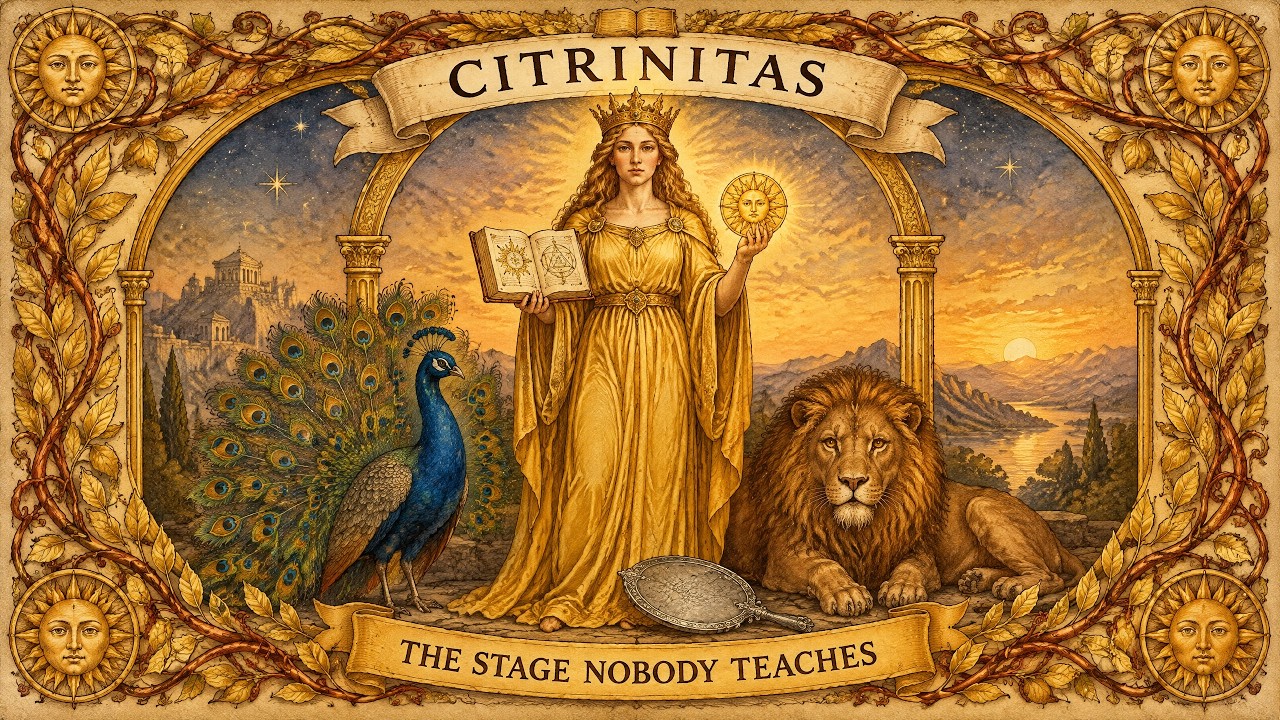
Citrinitas — The Stage Almost No One Talks About
https://thehermeticschool.org/store.html — The Magnum Opus: the complete map of the Great Work, in four stages and twelve operations.
There is a stage missing from the map you were given. If you have encountered the alchemical sequence anywhere, you almost certainly learned it as three: nigredo, albedo, rubedo. Black, white, red. Clean, memorable, widely taught — and not what the tradition originally said.
The Greek alchemical corpus describes four. Melanosis, the blackening. Leukosis, the whitening. Then xanthosis, the yellowing. And only then iosis, the final stage, whose name suggests not simply red but the deep violet of rust on metal. The yellow is the one that went missing: in Latin, citrinitas, and across the later medieval and Renaissance literature it quietly falls out of use until an entire phase has been absorbed into the ones on either side of it. Jung noticed the omission and did not think it trivial.
This episode examines what citrinitas is — the transition between lunar and solar light, the moment when seeing stops being reflected and begins to be generated. The tradition is precise about it: not the sun at noon, but the sun coming up. A fifteenth-century treatise at the centre of this material is named for exactly that moment, the Aurora Consurgens, the rising dawn, which Marie-Louise von Franz edited as the companion volume to Jung's Mysterium Coniunctionis.
It then asks why the stage was removed, and gives two reasons — one practical, one about storytelling. Nigredo has suffering, which is a story. Rubedo has triumph, which is a story. Albedo has peace, which is at least a describable state. Citrinitas has no signature experience at all, and teachings retain what can be told.
The consequence of that deletion is a specific kind of suffering: people come out of a long flat period, find that preference, irritation and direction are returning, and — holding a three-stage map in which white is supposed to be followed by red — conclude that they have relapsed and lost the peace they spent years reaching. That is not a relapse. It is the yellowing, and the map they were handed has no name for it.
The episode closes with the characteristic danger of the stage, premature authority, and the instruction that governs it: dawn is not noon.
Episode 13 of THE GREAT WORK, a twenty-four part series following the operations of the opus in order, from the nigredo through to the rubedo. This episode opens the third stage.
This series walks the four stages from the outside. The written work goes underneath them — the twelve operations one at a time, with the primary source under each.
This channel is no longer monetized. The written work is what funds the research behind every episode.
C.G. Jung, Psychology and Alchemy (Collected Works vol. 12, 1944) C.G. Jung, Mysterium Coniunctionis (Collected Works vol. 14, 1955–56) Marie-Louise von Franz, Aurora Consurgens: A Document Attributed to Thomas Aquinas on the Problem of Opposites in Alchemy (1966) Marie-Louise von Franz, Alchemy: An Introduction to the Symbolism and the Psychology (1980) Edward F. Edinger, Anatomy of the Psyche: Alchemical Symbolism in Psychotherapy (1985)
This video is educational and historical. It describes how alchemical and psychological traditions have interpreted human experience. It is not medical or psychological advice, not a diagnosis, and not a substitute for care from a qualified mental health professional. If you are struggling, please contact a licensed practitioner or a crisis line in your country.
Original educational essays on the history of Western esotericism and its reception in analytical psychology. Every script is researched and written from the primary sources listed above, not summarised from secondary content. Throughout, we distinguish between what a historical text actually says and how twentieth-century psychology reinterpreted it.
Go Deeper
Watch the complete teaching with visual symbolism and guided reflection on our YouTube channel.
Watch on YouTube Explore Ebooks