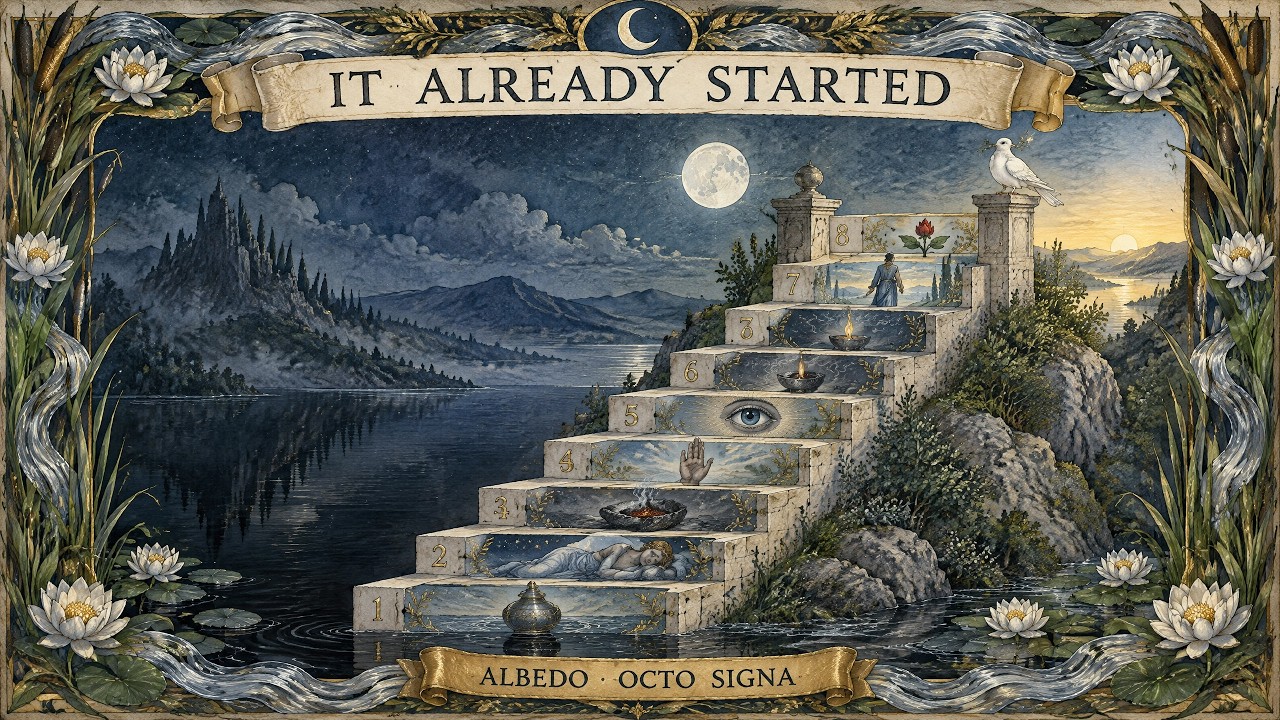
8 Signs the Albedo Has Already Begun
https://thehermeticschool.org/store.html — the written work of the School: the twelve operations, the laws, and the practice, each with its primary sources.
The first stage announces itself. Pain is self-reporting, and nobody passes through the nigredo without noticing. The second stage does not do this. The albedo has no alarm — it arrives as an absence of pressure, of flooding, of wanting, and absences do not draw attention to themselves.
So the characteristic error of this stage is not despair. It is oversight. People pass through the whitening and do not notice it, interpret the quiet as a plateau, and then make a decision: they fill the silence, or conclude the process failed, or settle into the calm and stop.
The alchemists faced exactly this problem in the laboratory, which is why the albedo is described with such precision in the texts. Blackness is obvious; the transition from black to white is gradual, uneven, and the operator staring at the same vessel every day is the person least equipped to see a slow change. So they wrote down marks that could be checked rather than felt.
This episode sets out eight of them: the flooding has stopped; rest works again — the exact inverse of the nigredo's second sign, and the sharpest diagnostic here; you can tell the story without heat; rules have started sounding like rules, with a pause before compliance; you trust a perception you cannot justify; the old triggers fire smaller, and you notice afterwards rather than during; you have stopped needing the listener to agree; and something small has started to matter again — a preference rather than a duty, which is the first colour returning.
It then does the more useful work and separates the albedo from the four conditions that imitate it: depression with flattened affect, dissociation — frequently mistaken for spiritual attainment — the late stage of burnout, whose tell is contempt, and premature peace, the equanimity that was achieved rather than arrived at, which is worked for, defended, and fluent in its own vocabulary. Two of those four need a clinician rather than a framework, and the episode says so plainly.
Episode 12 of THE GREAT WORK, a twenty-four part series following the operations of the opus in order, from the nigredo through to the rubedo. This episode closes the second stage.
This series walks the four stages. The written work goes underneath them — the twelve operations, one by one, the laws, and the practice, each with the primary sources beneath it.
This channel is no longer monetized. The written work is what funds the research behind every episode.
C.G. Jung, Mysterium Coniunctionis (Collected Works vol. 14, 1955–56) C.G. Jung, Psychology and Alchemy (Collected Works vol. 12, 1944) Marie-Louise von Franz, Alchemy: An Introduction to the Symbolism and the Psychology (1980) Marie-Louise von Franz, Aurora Consurgens (1966) Edward F. Edinger, Anatomy of the Psyche: Alchemical Symbolism in Psychotherapy (1985) Rosarium Philosophorum (Frankfurt, 1550)
This video is educational and historical. It describes how alchemical and psychological traditions have interpreted human experience. It is not medical or psychological advice, not a diagnosis, and not a substitute for care from a qualified mental health professional. The signs described here have no diagnostic authority over a medical condition. If your functioning is impaired, if this has run for months without movement, or if you feel unreal or as though you are observing yourself from outside, please contact a licensed practitioner or a crisis line in your country.
Original educational essays on the history of Western esotericism and its reception in analytical psychology. Every script is researched and written from the primary sources listed above, not summarised from secondary content. Throughout, we distinguish between what a historical text actually says and how twentieth-century psychology reinterpreted it.
Go Deeper
Watch the complete teaching with visual symbolism and guided reflection on our YouTube channel.
Watch on YouTube Explore Ebooks