Solve et Coagula — The Law Underneath Every Stage
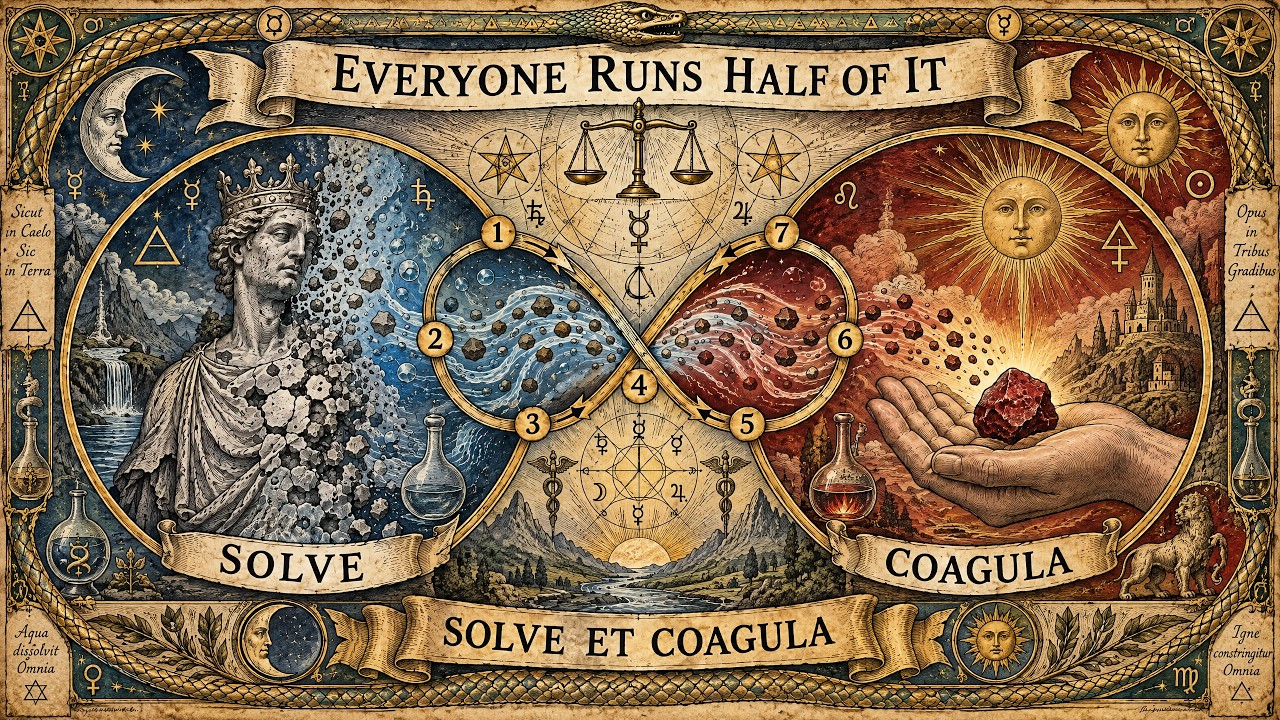
Everything in this series has been one of two things. Every operation examined across seventeen episodes — the blackening, the rotting, the death of the king, the washing, the separation, the rising, the fixing — reduces to a single pair of movements the tradition stated in two words: solve et coagula. Dissolve and coagulate.
The episode begins with the phrase's unusual history, because most people meet it backwards. As alchemical shorthand it is old and everywhere in the literature, a compressed procedural instruction of the kind practitioners use among themselves. But its most famous appearance is not medieval: in 1856 Eliphas Lévi published, in his Dogme et Rituel de la Haute Magie, a drawing of a winged goat-headed figure he called the Baphomet, with SOLVE on one forearm and COAGULA on the other. That image carries three centuries of Romantic baggage the words themselves do not have.
Solve is dissolution: a structure that was bound is loosened and its components come free. Coagula is the opposite: what was fluid settles into a new arrangement and holds. And the claim is stronger than it first appears — neither one is transformation. Transformation is the alternation, run many times on the same material.
The episode then sorts every operation in the series into one column or the other, which reveals the shape of the whole thing: not twelve unrelated techniques but one long dissolution followed by one long re-formation, with the turn happening exactly where the colour changes from white to yellow — which is why the stage that went missing from the popular map is the hinge.
What follows are three failure modes. The perpetual dissolver, who takes every structure apart and builds none, who is often genuinely insightful because dissolution produces insight, and whose tell is a pause when asked what they are committed to. The fortress, whose structure was built early under pressure and never loosened, and who has not been genuinely surprised by themselves in a very long time. And the incomplete alternator, who runs both movements visibly and completes neither, so that each new dissolution starts from the same place as the last. In each case the episode names the original condition the pattern was a correct response to.
It closes with what redeems the formula from tidy symmetry: the two are not equal in fashion. Our culture has a rich and admired vocabulary for dissolution and almost none for binding, for reasons that are not accidental. But the alchemists put the words in a fixed order, and the second one is coagula — the Work ends in a stone, something durable enough to be taken out of the vessel and used.
Episode 18 of THE GREAT WORK, a twenty-four part series following the operations of the opus in order. This episode closes the third stage.
The Kybalion
The seven Hermetic principles read closely, set beside the older sources, and applied.
About the bookSources
- C.G. Jung, Psychology and Alchemy (Collected Works vol. 12, 1944)
- C.G. Jung, Mysterium Coniunctionis (Collected Works vol. 14, 1955–56)
- Eliphas Lévi, Dogme et Rituel de la Haute Magie (1856)
- Edward F. Edinger, Anatomy of the Psyche: Alchemical Symbolism in Psychotherapy (1985)
- Marie-Louise von Franz, Alchemy: An Introduction to the Symbolism and the Psychology (1980)
This essay is educational and historical. It describes how alchemical and psychological traditions have interpreted human experience. It is not medical or psychological advice, not a diagnosis, and not a substitute for care from a qualified mental health professional. If you are not sleeping, if you believe you have been given a special mission, if people close to you have expressed concern, or if you are hearing or seeing things others do not, please contact a licensed practitioner or a crisis line in your country today.
Go Deeper
Watch the complete teaching with visual symbolism and guided reflection on our YouTube channel.
Watch on YouTube Explore Ebooks