Splendor Solis: The Alchemical Manuscript Read Plate by Plate
The Splendor Solis ("the splendour of the sun") is a sixteenth-century German alchemical manuscript of twenty-two paintings, usually called the most beautiful alchemical book in existence. The best-known copy, British Library Harley MS 3469, is dated 1582. The oldest, in Berlin, was painted in the early 1530s, probably in Augsburg.
Beauty is not the strange thing about it. The strange thing is the order. It opens with a coat of arms and a golden sun. It passes through a drowning king, a severed head, a man boiled in a vessel and seven glass flasks with creatures inside them. And at the very end, where a reader expects the gold, it shows children playing in a room and two women doing the laundry by a fountain.
The order was chosen. The only way to see why is to read the paintings the way the book asks: one at a time, in sequence, with the text beside them.
What Kind of Object It Is
The London copy is written on vellum, in German: about a hundred pages of text, with the twenty-two paintings set in painted frames of gold, flowers and birds. There are around twenty copies in all, in London, Berlin, Kassel, Paris and Nuremberg.
The text was printed in 1598, at Rorschach in Switzerland, under the title Aureum Vellus, the golden fleece, with the paintings reduced to woodcuts; a Hamburg reprint of 1708 used engravings. So most people who knew these pictures before the twentieth century knew them small, in black and white, on cheap paper. The printers' title says what they thought the book was: the real prize Jason sailed for, read as the work of the alchemists.
The title page describes the book as a road, in a short rhyme in its own voice: whoever passes along it without rest will find a good life and be blessed at the end. That is the first reason to read the paintings in order rather than as twenty-two separate pictures.
Nature Serves Art
A few pages in, the text gives the sentence that explains the whole manuscript. The art does not try to make gold out of nothing, and does not dig in the caverns where metals begin. It works alongside nature, with different tools: "Here Nature serves Art with Matter, and Art serves Nature with suitable Instruments and method convenient for Nature."
The alchemist in this book is not a magician who commands the world. He prepares the conditions, the vessel, the heat and the time, so that something nature already does can happen more completely. The first four paintings set this out: the arms of the art, which belong to no family; a philosopher pointing at a flask of liquid; a crowned knight guarding a double fountain; and a queen under the moon and a king under the sun, the two bodies whose story fills the rest of the book.
The Seven Parables
The next seven paintings illustrate seven parables, and here the book becomes a story. It begins with geology: two miners digging into a small hill, and a text about how the sun's heat works on moisture underground until ore forms. Then a tree with a silver stem, where black and white birds sit all night and leave at daybreak, when "the raven's head becomes white".
Then the story turns. A king stands on the bank of a lake while another king goes under, only his crowned head above the water. The text describes a fog over the earth and a foul, dark sea, and the king crying out that whoever saves him will reign with him for ever. The next day he rises renewed, wearing three crowns. Beside it the book quotes a line it gives to Aristotle: the destruction of one thing is the birth of another.
A man covered in black mud is lifted out of a swamp by a winged woman who clothes him in purple. A body lies cut into pieces while a dark figure holds the golden head and a paper that reads: "I have killed thee, that thou mayest receive a superabundant life." The head will be hidden and the body buried, the paper says, so that it may putrefy and bear fruit. And a man sits in a vessel over a furnace, being cooked so that he can come out young again.
Read together, the seven parables say one thing seven times. Something royal has to go down into the dark, be dissolved, cut apart and cooked, before it can come back. The rescue only happens after the drowning, never instead of it. The essay on the nigredo follows the same descent through other sources.
The Alchemist’s Path
The whole sequence, stage by stage: how Jung read the alchemists and what each operation asks of a life.
Get this guide · $7Seven Planets, Seven Flasks
The next seven paintings share one layout: a tall glass flask with a crown round its neck, a planetary god driving a chariot across the sky above it, and ordinary life crowded into the margins below. The text beside them is a treatise on heat. Among its lines: "The heat turns every black thing white, and every white thing red." It quotes the Emerald Tablet's instruction to separate the gross from the subtle, and sums the process up in two words: distil seven times.
Inside the flasks, the matter changes from painting to painting. Under Saturn, a child feeds a dragon. Under Jupiter, three birds fight, a red and a white one pinning a black one. Then a white bird with three crowned heads, a three-headed dragon, a peacock spreading its tail, a queen, and finally a young king in red and gold. Black, white, the many colours of the peacock's tail, then the white and red tinctures: the whole work compressed into seven bottles.
The margins are where the London painter did something remarkable. Under Saturn, a man fills a barrel that empties as fast as he pours, beggars ask for alms, a crowd gathers at a gallows. Under Mars, horsemen and burning houses. Under Venus, musicians and bathers. Under the Moon, fishermen, a turning mill wheel and women washing clothes in the river. Each planet rules its kind of human life, an old idea, but here the two run side by side. In the glass, the matter is being transformed. In the margins, life goes on as usual, and hardly anyone looks up at the flask.
A Black Sun, a Game and a Wash
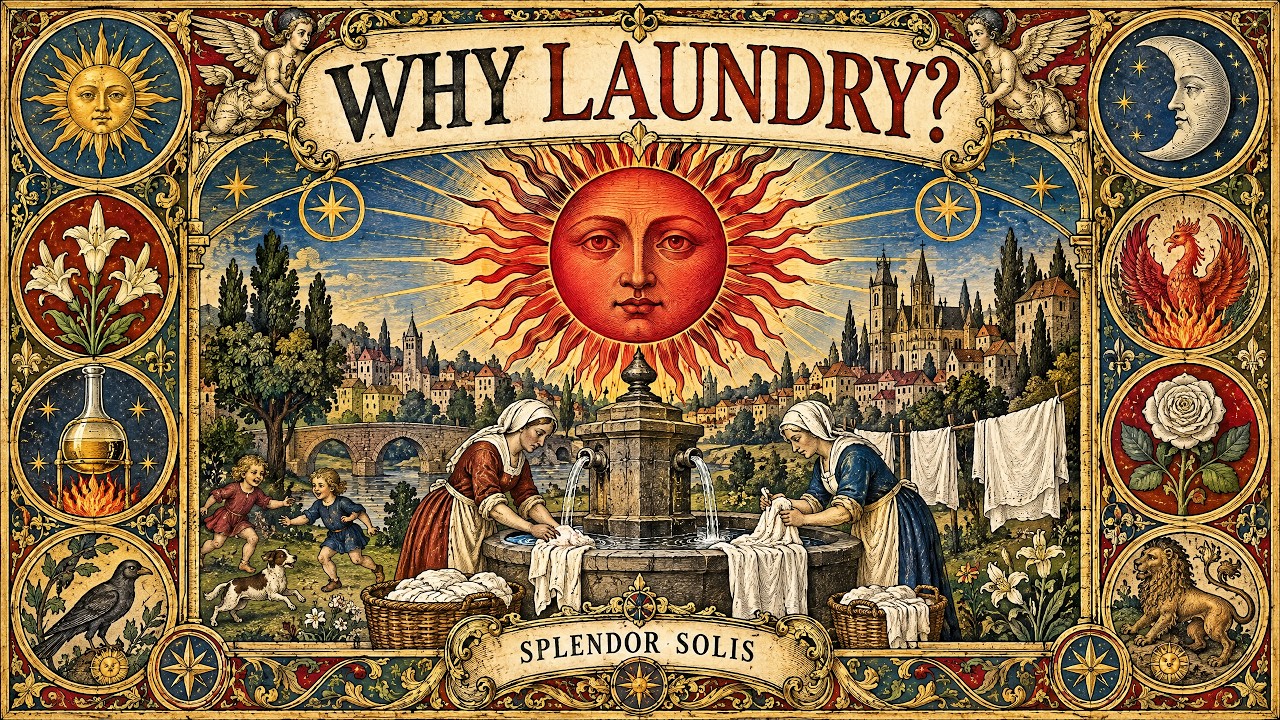
The last section opens with a huge black sun rising out of a landscape of withered trees, the true sun still faintly shining behind it. Then a long room of children at play, one on a hobby horse. Then two women at a fountain, beating and washing clothes, with more laundry drying on the grass. And on the last page, a red sun with a human face rising over a town.
The text beside these paintings describes four operations, the whole work said once more, plainly: dissolution, coagulation, sublimation, and the joining of what was separated. "In these last four Chapters," it says, "is all contained wherewith the Philosophers have filled the whole world with innumerable books."
And it explains the children and the women in two sentences. The art is compared "to the play of children, who when they play, turn undermost that which before was uppermost." And it is like woman's work, which consists in cooking and roasting until it is done.
A Reading of the Ending
What follows is this essay's interpretation, not the manuscript's. The last four paintings may be the most honest pages in the book. After a king drowned and a body cut to pieces, the authors chose to end the work with a game and a wash. The work they were describing does not finish in a revelation. It finishes in repetition: turning the thing over, as children turn a game upside down, and washing it again, as laundry is done, every week, by hand, with no one watching.
Look at the proportions too. Seven paintings of descent, seven of slow work in the flasks, and one page for the rising sun. If the book is a road, most of it runs through the dark, and the authors neither hid that nor hurried it. The light at the end is short and quiet, and it rises over an ordinary town rather than a temple.
Who Was Salomon Trismosin?
The author named on the book is Salomon Trismosin, supposedly a German alchemist and a teacher of Paracelsus. An account of his travels printed under his name describes setting out in 1473, spending eighteen months and two hundred florins going from one alchemist to another, and working fourteen weeks in Italy for two men who made English tin pass for the finest silver, until an assayer in Venice tested it and it "all flew away". A preface of 1617 claimed his medicine kept him alive to the age of one hundred and fifty.
Historians are not persuaded. The name is usually taken as a pseudonym, and the editor of the 1920 English edition, who admired the book, thought most of the other writings under it were spurious. His guess was that a wealthy amateur, perhaps one of the Fugger banking family of Augsburg, paid for the paintings.
The book has kept finding readers. In 2003 the Jungian analyst Joseph Henderson, who trained with Jung in Zurich, published with Dyane Sherwood a reading of all twenty-two paintings as a map of psychological transformation. The most famous alchemical book in the world has an author who probably did not exist, and the most reliable figure in it is a woman doing the washing.
All twenty-two paintings are online in public collections. Look at them once, in order, and notice how long the book stays in the dark, and how short and quiet the ending is.
Not sure which stage you are in? Find your stage.
Sources
- Splendor Solis, British Library, Harley MS 3469 (1582)
- Splendor Solis, Kupferstichkabinett, Staatliche Museen zu Berlin (c. 1531–35)
- Splendor Solis: Alchemical Treatises of Solomon Trismosin, ed. and trans. J.K. (London: Kegan Paul, 1920)
- Aureum Vellus (Rorschach, 1598)
- Joseph L. Henderson and Dyane N. Sherwood, Transformation of the Psyche: The Symbolic Alchemy of the Splendor Solis (2003)
This essay is educational and historical. It describes how alchemical and psychological traditions have interpreted human experience. It is not medical or psychological advice, not a diagnosis, and not a substitute for care from a qualified mental health professional. If you are not sleeping, if you believe you have been given a special mission, if people close to you have expressed concern, or if you are hearing or seeing things others do not, please contact a licensed practitioner or a crisis line in your country today.
Go Deeper
Watch the complete teaching with visual symbolism and guided reflection on our YouTube channel.
Watch on YouTube Explore Ebooks