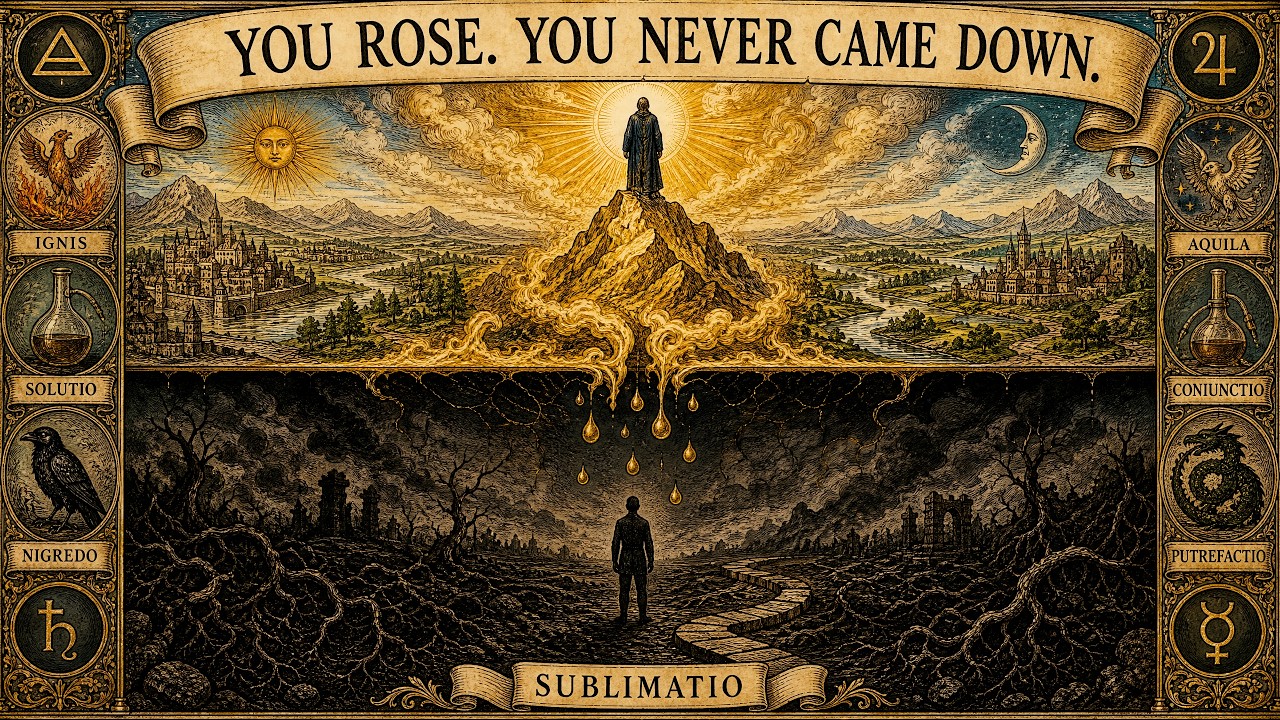
Sublimatio — Rising Without Leaving the Ground
There is a moment in this work when you finally get above it. After the collapse, after the silence, after the flood of meaning, something lifts — and you can see the whole shape of your life at once. The alchemists called that operation sublimatio, the rising, and they considered it both one of the most valuable operations available and one of the easiest to get catastrophically wrong.
In the laboratory, sublimation is specific: a solid is heated, passes directly into vapour, rises through the vessel leaving the heavy residue behind, and condenses higher up as a purer substance. It ascends, it separates from what is heavy, it becomes purer. Edward Edinger treats it as one of the seven fundamental operations, and psychologically it is the operation of perspective — the point at which you stop being identical with your experience and become able to look at it.
The episode distinguishes this from Freud's sublimation, which concerns the redirection of drive energy rather than elevation, and then turns to the failure that is common in people otherwise doing this work seriously: you rise, and you do not come down. Explanation at sufficient height dissolves the requirement to do anything, and the tell is specific — the person can describe the situation better than anyone in it and cannot report one thing they did differently on Tuesday.
The alchemists knew the risk, which is why the operation is almost never described alone. It is paired with circulatio: the substance rises, condenses, falls back onto the material below, and is heated again. What rises is poured back onto what it rose from. The episode closes with two tests for arrested elevation, and with the motto that instructs the opposite movement — V.I.T.R.I.O.L., visit the interior of the earth — and why the tradition held both without contradiction.
Episode 16 of THE GREAT WORK, a twenty-four part series following the operations of the opus in order, from the nigredo through to the rubedo.
V.I.T.R.I.O.L.
The Hermetic descent: visit the interior of the earth, and by rectifying, find the hidden stone.
About the bookSources
- Edward F. Edinger, Anatomy of the Psyche: Alchemical Symbolism in Psychotherapy (1985)
- C.G. Jung, Psychology and Alchemy (Collected Works vol. 12, 1944)
- C.G. Jung, Mysterium Coniunctionis (Collected Works vol. 14, 1955–56)
- Marie-Louise von Franz, Alchemy: An Introduction to the Symbolism and the Psychology (1980)
This essay is educational and historical. It describes how alchemical and psychological traditions have interpreted human experience. It is not medical or psychological advice, not a diagnosis, and not a substitute for care from a qualified mental health professional. If you are not sleeping, if you believe you have been given a special mission, if people close to you have expressed concern, or if you are hearing or seeing things others do not, please contact a licensed practitioner or a crisis line in your country today.
Go Deeper
Watch the complete teaching with visual symbolism and guided reflection on our YouTube channel.
Watch on YouTube Explore Ebooks