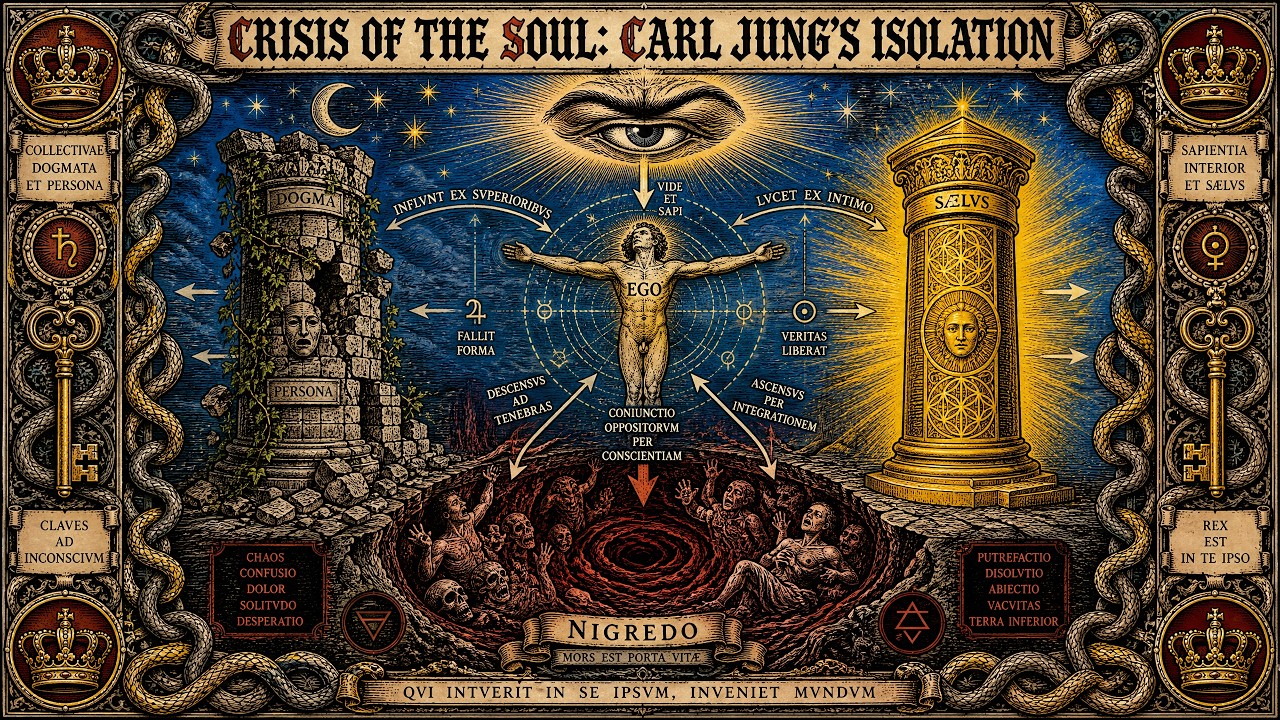
Why the Most Awakened Souls Feel Completely Alone — Carl Jung & Existential Philosophy
Popular culture presents spiritual awakening as a luminous, comforting arrival — an effortless state of bliss, connection, and universal harmony. You are told that expanding your consciousness will make you feel more understood, more surrounded by like-minded souls, and instantly integrated into a compassionate world.
Anyone who has undergone genuine psychological transformation knows that this romantic vision is a delusion. The reality is far more confronting: the immediate and unavoidable consequence of deep awakening is an overwhelming, heavy existential solitude.
You find yourself standing in crowded rooms, listening to conversations that once engaged you, only to realize you can no longer participate. Ambitions that driven your peers suddenly feel like hollow theatre. Relationships built on unexamined projections crumble, leaving you standing in a quiet, unfamiliar landscape. Why does expanding your consciousness isolate you from the human herd?
Exiting *Das Man*: Leaving the Collective Mass Mind
To understand why awakening feels like exile, we must look to existential philosophy — specifically Martin Heidegger's concept of Das Man (often translated as "The They" or the collective mass mind).
Heidegger observed that the vast majority of human beings live in a state of inauthentic existence. They do not think their own thoughts, choose their own values, or confront their own mortality. Instead, they think what "they" think, buy what "they" buy, and fear what "they" fear. Das Man acts as a psychological painkiller, insulating the individual from the terrifying responsibility of personal existence.
When an individual begins to awaken — whether through suffering, profound reflection, or alchemical transformation — the spell of Das Man breaks. Stepping out of the collective mass mind strips away social anesthetics. You can no longer participate in collective self-deception, and that refusal immediately separates you from the crowd.
"Individuation cuts one off from personal conformity and implies a degree of solitude that requires real courage." — Carl Gustav Jung
Jung & The Occult
Where depth psychology meets esoteric wisdom, and where Jung deliberately stopped.
About the bookCarl Jung and the Systematic Withdrawal of Projections
In analytical depth psychology, Carl Jung revealed that most human relationships are not built on seeing the other person clearly. They are built on mutual projection. We project our unexamined Shadow, our unfulfilled desires, and our internal voids onto partners, friends, and institutions.
As you undergo the Great Work of individuation, a radical shift occurs: you systematically withdraw your projections.
• You stop expecting a romantic partner to complete your inner void.
• You stop expecting societal status to validate your worth.
• You stop participating in shared grievances and collective outrage feeds.
When you withdraw your projections, two things happen. First, the noise stops — and the sudden quiet feels like intense isolation. Second, people around you sense that you are no longer playing your designated role in their psychological drama. You refuse to react to their triggers, validate their false personas, or mirror their neuroses. As detailed in The Hermetic Law of the Psychic Shield, withdrawing from emotional toxicity creates a clean break between your sovereign psyche and the collective atmosphere.
The Alchemical *Nigredo* and Existential Vertigo
In spiritual alchemy, this phase of solitude corresponds directly to the Nigredo — the blackening stage of dissolution. The ego's curated identity, constructed out of external opinions and cultural conditioning, must rot away before the gold of the Self can be forged.
Existentialists like Søren Kierkegaard and Jean-Paul Sartre described this state as existential vertigo — the terrifying realization that there is no external script guiding your life. The cultural narratives you relied upon (career ladders, social validation, surface goals) are revealed as arbitrary constructs. You are left alone with the sheer weight of your own freedom and consciousness.
Loneliness vs. Alchemical Solitude
It is vital to distinguish between two radically different inner states:
1. Loneliness (Ego Deficiency): Loneliness is the desperate ache of an fragile ego craving external validation. It is the panic of a personality that cannot endure its own company because it has no internal foundation.
2. Alchemical Solitude (Hermetic Containment): Solitude is the deliberate, airtight sealing of the inner vessel — the Vas Hermeticum. It is not a lack of connection, but the presence of the divine observer within. In solitude, your psychological energy ceases to bleed outward into superficial distractions and begins to condense into an unbreakable core.
The Hermetic tradition has long taught the alchemical rule of silence (V.I.T.R.I.O.L.): the inner fire cannot burn if the vessel is constantly opened to pass-by chatter and premature exposure. Solitude is the furnace where raw experience is distilled into sovereign consciousness.
How to Navigate the Crucible of Solitude
If you are currently experiencing the heavy isolation of awakening, cultivate three Hermetic principles:
1. Stop Explaining Your Transformation: Do not try to convince those still asleep in Das Man to understand your path. Explaining your inner awakening to unintegrated minds bleeds your energy and invites ridicule. Honor your process in sacred silence.
2. Reframe Solitude as Purification: Recognize that isolation is not a punishment or a social failure. It is the necessary quarantine of the soul, stripping away superficial attachments so that your true center of gravity can shift from the ego to the archetypal Self.
3. Anchor in the Sovereign Observer: Dedicate daily time to silent contemplation. Practice observing your thoughts without reacting to them, anchoring yourself in the immortal Sulphur soul — the timeless observer that stands beyond human noise.
Solitude is the tax consciousness collects for sovereignty. You are not alone because you are broken; you are alone because you are becoming whole.
This essay is educational and historical. It describes how alchemical and psychological traditions have interpreted human experience. It is not medical or psychological advice, not a diagnosis, and not a substitute for care from a qualified mental health professional. If you are not sleeping, if you believe you have been given a special mission, if people close to you have expressed concern, or if you are hearing or seeing things others do not, please contact a licensed practitioner or a crisis line in your country today.
Go Deeper
Watch the complete teaching with visual symbolism and guided reflection on our YouTube channel.
Watch on YouTube Explore Ebooks