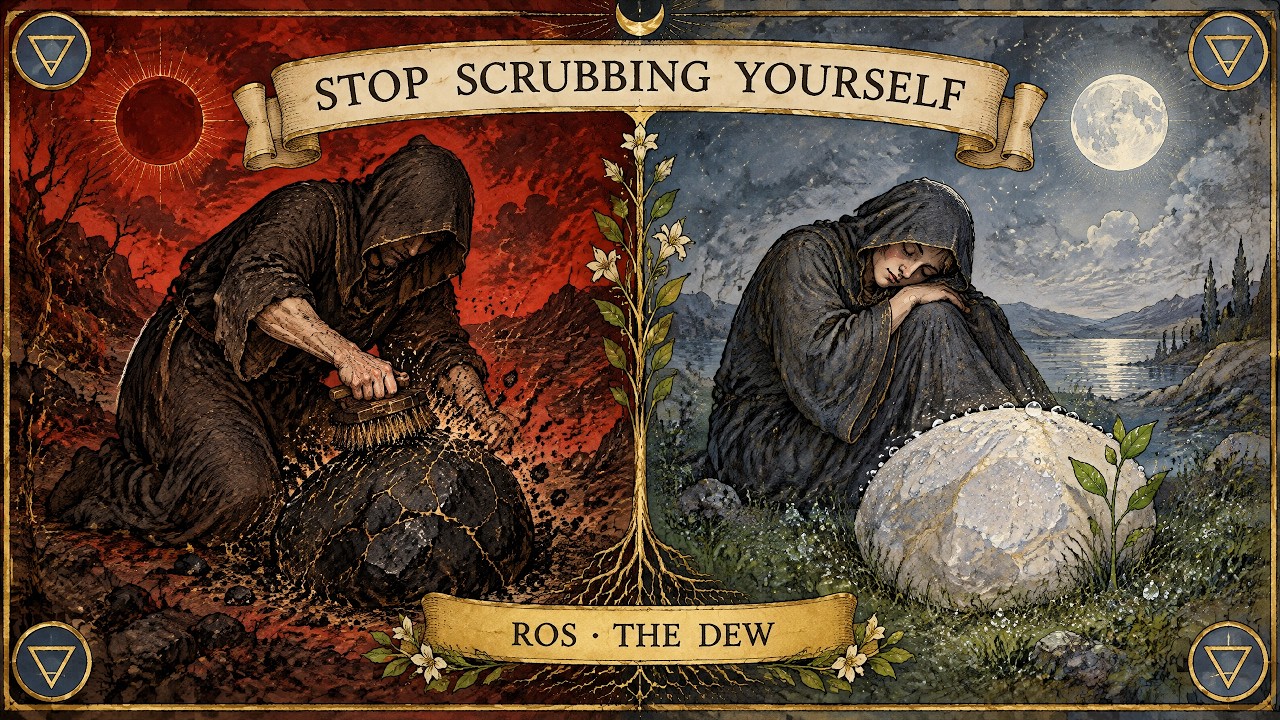
Ablutio — The Washing That Removes What Effort Cannot
https://thehermeticschool.gumroad.com — The Alchemist's Path: the whole sequence, stage by stage.
There is a particular kind of stain that does not come out with scrubbing. Something happened a long time ago, and you have analysed it, understood it from every angle, forgiven it or tried to — and the charge is still there. You have done everything effort can do, and the residue remains.
The alchemists met this residue in the laboratory after the blackening was complete. They did not try to burn it clean. They washed it — and the agent they chose was not fire, acid or force, but dew. This episode examines ablutio, the washing, the gentlest operation in the entire corpus and the one with which the second stage of the Work begins.
In the woodcut sequence of the Rosarium Philosophorum, which Jung used as the backbone of his study of the transference, the washing appears twice: first as the deliberate immersion in the bath, and later as the purification, in which dew falls from a cloud onto the dead body lying in the tomb. No one is washing the corpse. There is no operator in the image. And in the next plate, the soul returns.
What follows is an examination of why dew — water that forms only in stillness and cooling, and that wind and warmth prevent; the difference between washing and scrubbing, and why self-work conducted by force past a certain point grinds the stain further in; the three residues the washing actually removes — charge, the secondhand identity, and the story of injury — and why none of them respond to argument; a modern line of sleep research that converges strikingly with the plate; and the four things the stage asks of you, the hardest of which is to let something be done to you that you cannot take credit for.
Episode 9 of THE GREAT WORK, a twenty-four part series following the operations of the opus in order, from the nigredo through to the rubedo.
C.G. Jung, The Psychology of the Transference (Collected Works vol. 16) C.G. Jung, Psychology and Alchemy (Collected Works vol. 12, 1944) Rosarium Philosophorum (Frankfurt, 1550) Edward F. Edinger, Anatomy of the Psyche: Alchemical Symbolism in Psychotherapy (1985) Marie-Louise von Franz, Alchemy: An Introduction to the Symbolism and the Psychology (1980) Matthew P. Walker and Els van der Helm, "Overnight Therapy? The Role of Sleep in Emotional Brain Processing," Psychological Bulletin (2009)
This video is educational and historical. It describes how alchemical and psychological traditions have interpreted human experience. It is not medical or psychological advice, not a diagnosis, and not a substitute for care from a qualified mental health professional. If you are struggling, please contact a licensed practitioner or a crisis line in your country.
Original educational essays on the history of Western esotericism and its reception in analytical psychology. Every script is researched and written from the primary sources listed above, not summarised from secondary content. Throughout, we distinguish between what a historical text actually says and how twentieth-century psychology reinterpreted it.
Go Deeper
Watch the complete teaching with visual symbolism and guided reflection on our YouTube channel.
Watch on YouTube Explore Ebooks