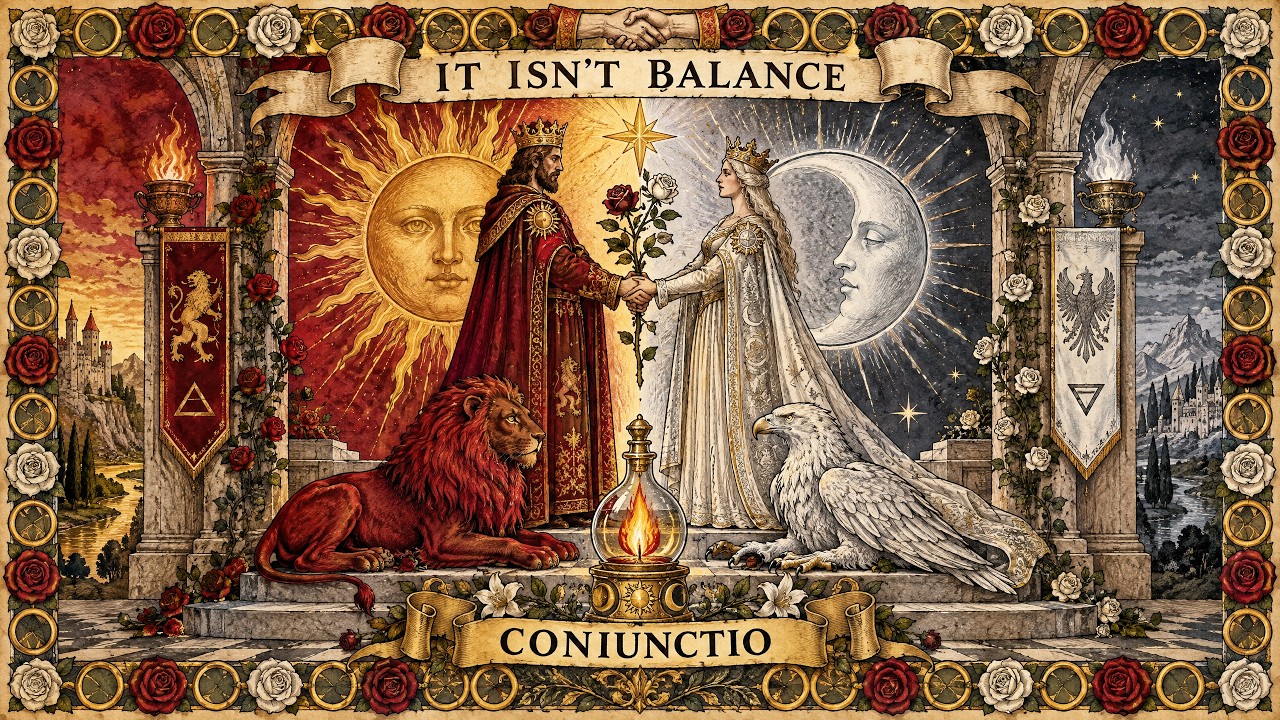
Coniunctio — The Marriage of What You Refused to Join
There is an image at the centre of this entire tradition, and it is the one that makes modern readers most uncomfortable.
A king and a queen, naked, joined.
It appears everywhere in the corpus. In the Rosarium Philosophorum, the sequence of woodcuts printed in Frankfurt in 1550, it is the plate the whole series turns on. Jung built his study of the transference on that sequence, and he gave the last major work of his life, Mysterium Coniunctionis, to this single image: the union of opposites.
And it is almost universally misunderstood as balance. So let us begin by removing that, because the mistake makes everything after it impossible.
Not Balance
The coniunctio is not balance. It is not moderation, not the golden mean, not a healthy middle between two extremes.
Balance means that neither pole gets its full expression. You take some of each and arrive at a compromise that is characteristic of neither. That is a perfectly reasonable way to run a life, and it is not what this tradition is describing.
The coniunctio is the two poles held at full strength, simultaneously, without resolution.
The Third Thing
Jung gave this a technical name in an essay he first drafted in 1916 and revised four decades later: "The Transcendent Function." His claim there is precise and worth stating carefully.
When two genuinely opposed positions are held together, not compromised, not resolved, but held, with the tension intact and very nearly unbearable, a third thing may appear. It is not a mixture of the two. It is something new, which neither pole could have produced and which could not have been reached by reasoning.
He was explicit that this cannot be forced and cannot be predicted, and that the only contribution consciousness makes is the refusal to collapse the tension too early. That refusal is the whole discipline of this operation, and it is exhausting.
The Opposites, Concretely
So what are the opposites? Not abstractions. The tradition is specific, and so is a life.
They are the pairs in you that you have quietly decided cannot both be true. You have chosen one and suppressed the other, and you experience the suppressed one only as a kind of pressure. Wanting to be known and wanting to be hidden. Needing people and being proud of not needing them. The wish to be good and the wish to be free.
Two of them are worth working through properly.
Ambition and the wish to be left alone. Most people running hard have a genuine longing for a small, quiet life, and most people who have chosen the small, quiet life carry a real, unlived ambition. Each treats the other as a threat to the chosen identity. The ambitious person calls the longing for quiet laziness and pushes harder. The quiet person calls the ambition vanity and withdraws further. Both are spending a great deal of energy holding a door shut.
Love and genuine resentment. These coexist in every long relationship, and almost everyone resolves the tension by deciding which one is the real feeling and treating the other as a failure. Either the resentment is suppressed in the name of the love, and comes out sideways, as coldness or sarcasm, or the love is discounted in the name of the resentment, and the relationship is quietly written off. Both are a refusal of the coniunctio. Both feelings are true, at full strength, at the same time.
None of these pairs is a pathology. They are the actual structure of being a person, and the trouble does not come from having them. It comes from the resolution: from picking one, calling it your character, and spending decades managing the pressure of the other.
Why the Image Is Erotic
It is fair to ask why the alchemists drew this as a sexual union rather than, say, a treaty or a pair of scales.
The answer is that two ideas can be reconciled on paper and two bodies cannot be reconciled conceptually. A treaty is a compromise between positions that stay where they are. A union of bodies involves both parties entirely, holds nothing back, and produces something that neither could have produced alone. The image was chosen because it is the one human experience in which full opposition and full joining happen in the same act. It is not decoration, and it is not prudishness to notice that it makes us uncomfortable. The discomfort is part of the point.
After the Wedding
What most people miss is what happens next.
In the Rosarium, the conjunction is the fifth of ten plates. It is not the end of the sequence. It is followed immediately by death: the joined pair lies in a tomb, a single corpse with two heads. Then the soul leaves the body. Then dew falls on the corpse and washes it. Only at the end does the soul return, and what rises from the tomb is a new figure.
The alchemists were not being morbid. They were saying that a genuine union ends the two things that entered it. Neither the old ambition nor the old solitude survives the marriage intact, and what comes out of it is not either of them.
Jung & The Occult
Where depth psychology meets esoteric wisdom, and where Jung deliberately stopped.
About the bookThe Rebis
What comes out has a name, and it is deliberately not beautiful.
The rebis, the double thing: one body with two heads, male and female, standing together on a single base. The tradition refused to resolve this figure for centuries. It did not make the two heads into one face, and it did not let one of them win. Emblem XXXVIII of Atalanta Fugiens shows it being born of two mountains; the Rosarium shows it crowned at the end of the sequence.
It is awkward to look at, and that is accurate. A person who has genuinely joined two opposites does not look harmonious from the outside. They look like someone who contains more than one thing, and who is no longer trying to hide it.
The Counterfeit
Now the counterfeit, which is common and which feels like success.
Premature synthesis. The tension becomes unbearable, and instead of holding it, you produce a formula that makes it go away. I've realised I'm not ambitious, I just wanted to prove something. I've realised I don't actually love them, I was only attached. I've realised I don't need people at all.
Each of these resolves the tension instantly, and each is a dissolution disguised as an integration, because one pole has been eliminated rather than joined.
The mechanism that makes it so attractive is simple: the tension hurts, and a formula ends the hurt at once. It also flatters the one who arrives at it, because it sounds like insight, and it is usually delivered in the vocabulary of insight.
The tell is always the same. The relief is immediate and complete. Genuine coniunctio does not produce relief. It produces a widening: the ability to contain more than you could before, which is not comfortable. The discomfort continues, and your capacity to hold it increases. So if a resolution arrived quickly and made everything simpler, it was a collapse of the tension, not a marriage of it.
Three Practices
The third thing cannot be produced on demand, but the conditions for it can be kept.
Say "and" instead of "but". I love them, but I resent them is a sentence that has already chosen; the second half cancels the first. I love them and I resent them holds both at full strength. It sounds like a small change of grammar. It is the whole operation in miniature.
Give each pole a place in the week. Seeing that you contain both ambition and the longing for quiet is not enough. Put both into the calendar: a block of time in which the ambition is allowed to run at full strength, and a block in which nothing is asked of you at all. Neither block is there to make up for the other.
Do not decide at the peak of the tension. When the pressure is highest, the formula that would end it is most attractive. Make it a rule not to settle the question on the worst day. Let it wait until the pressure has dropped, and see whether the question still looks the same.
Dorn's Three Conjunctions
Jung's account of how this proceeds over time is more specific than most people know. In Mysterium Coniunctionis he works through a scheme he takes from Gerhard Dorn, a sixteenth-century alchemist, who described the conjunction as three distinct stages rather than one event.
The first Dorn calls the unio mentalis, a union within the mind. The person becomes conscious of the split, sees both poles clearly and holds them as ideas. This is an achievement, and it is incomplete. It is the conjunction understood, which, as The Yellow Dawn established, is not yet the conjunction seen.
The second is the union of that mental insight with the body. The realisation has to descend into how the person actually lives: into behaviour, relationships, the way Tuesday is spent. Dorn regarded this as the harder stage, and Jung agreed. The second practice above belongs here.
The third Dorn calls union with the unus mundus, the one world: the conjunction of the individual with the reality outside them. This is the most speculative part of the scheme. Jung treated it with considerable caution, and this episode does the same. It is worth knowing the shape of the claim without pretending it is established.
What matters in practice is the first two, and specifically that the first is not enough. Almost everyone who gets this far stops at the unio mentalis.
The Sign
How do you know it has occurred? There is a sign, and it is the last thing this episode has to give.
You stop having to choose.
Not because you found a compromise, but because the question that demanded a choice has quietly stopped being the right question. The person who has genuinely joined ambition and solitude does not split the difference. They work with complete commitment and go home without residue, and it does not occur to them that these are in conflict. They would have difficulty explaining to their younger self what the problem had been.
That is the third thing Jung was describing. It is not a compromise between the poles and it is not one of them winning. It is a position that was not available while the two were treated as alternatives, and it cannot be described in advance, only recognised afterwards, usually with some surprise at how much energy the conflict had been consuming.
The next episode takes the test the tradition placed on the returning operator: why you cannot go back the way you came, and what happens to people who try.
This is Episode 20 of THE GREAT WORK and the second essay of the fourth stage. Not sure which stage you are in? Find your stage.
Sources
- C.G. Jung, Mysterium Coniunctionis (Collected Works vol. 14, 1955–56)
- C.G. Jung, "The Transcendent Function," in The Structure and Dynamics of the Psyche (Collected Works vol. 8)
- C.G. Jung, "The Psychology of the Transference" (Collected Works vol. 16)
- Rosarium Philosophorum (Frankfurt, 1550)
- Marie-Louise von Franz, Alchemy: An Introduction to the Symbolism and the Psychology (1980)
- Edward F. Edinger, Anatomy of the Psyche: Alchemical Symbolism in Psychotherapy (1985)
This essay is educational and historical. It describes how alchemical and psychological traditions have interpreted human experience. It is not medical or psychological advice, not a diagnosis, and not a substitute for care from a qualified mental health professional. If you are not sleeping, if you believe you have been given a special mission, if people close to you have expressed concern, or if you are hearing or seeing things others do not, please contact a licensed practitioner or a crisis line in your country today.
Go Deeper
Watch the complete teaching with visual symbolism and guided reflection on our YouTube channel.
Watch on YouTube Explore Ebooks