The Yellow Dawn — When Understanding Turns Into Sight
You can understand something completely and it can change nothing. Everyone who has done inner work seriously has run into this: you know exactly why you do the thing, you can trace it to its origin and explain the whole structure to a stranger, and you do it again next Thursday.
Jung found this exasperating in his own practice — patients with perfect intellectual insight into their condition whose lives were indistinguishable from three years earlier. He was blunt that understanding on its own is not therapeutic, and went further: it can be an obstacle, because a person who can explain their problem has acquired a satisfying substitute for solving it.
This episode is about the transition the alchemists placed at the completion of the third stage, which they described as a colour change — the yellowing completing into dawn. What changes is not the amount of information. You do not know more at the end of this stage. What changes is what kind of thing the knowing has become.
Understanding is propositional: it exists as a statement, lives in memory, and requires retrieval, which is why you usually retrieve it afterwards. Sight is perceptual — not a statement you fetch from storage but how the situation looks to you, with no gap between knowing and use. Cognitive psychology makes a parallel cut between declarative knowledge, which you can state, and procedural knowledge, the kind involved in a skill — acquired differently, behaving differently, and not convertible into one another by effort of will. Which is why understanding harder does not work.
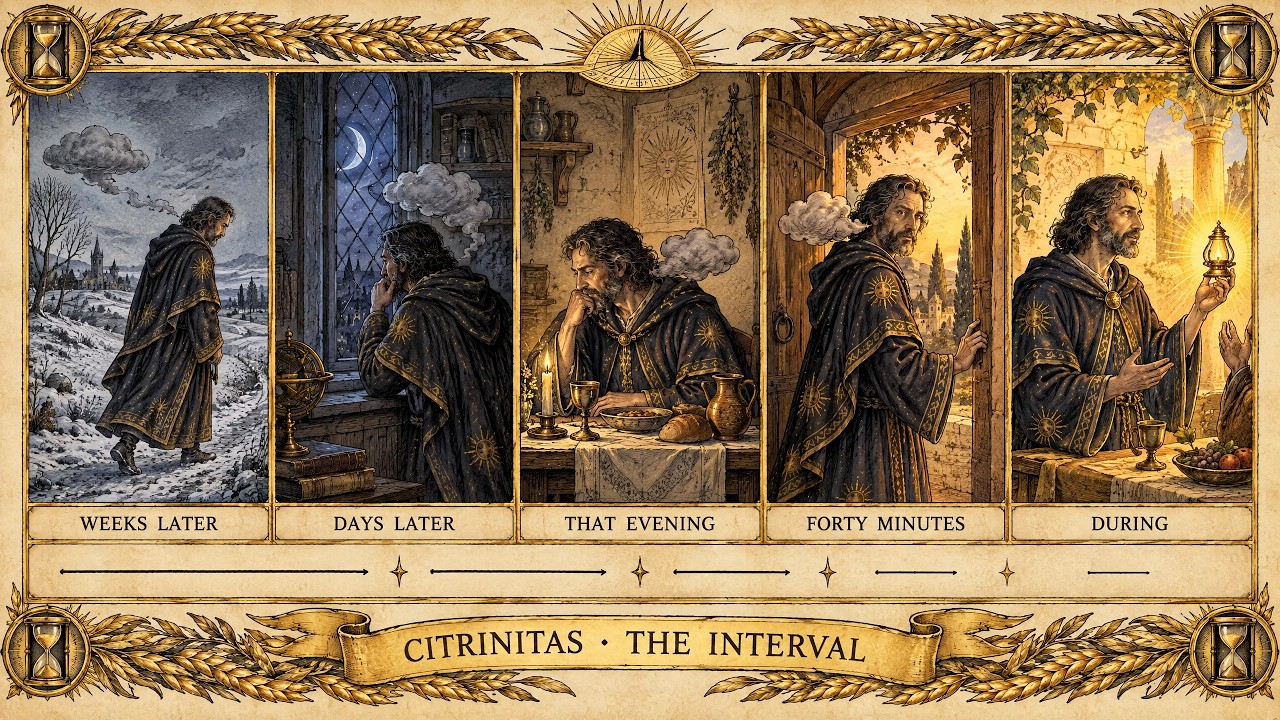
The episode works this through two concrete cases, then describes the progression that actually occurs when it works: noticing weeks later, then days, then that evening, then forty minutes after, then during. It addresses the characteristic danger — mistaking articulacy for sight, and the mechanism by which high articulacy actively slows the transition — including a plain statement about what consuming material like this one does and does not accomplish.
It closes with three small practices for the waiting, and two signs: you are still in understanding if you notice afterwards and have reached sight when you notice during; and the quieter one, that when something finally lands you stop rehearsing it — which means the most transformed material in a person is usually what they never mention.
Episode 17 of THE GREAT WORK, a twenty-four part series following the operations of the opus in order, from the nigredo through to the rubedo.
The Alchemist’s Path
The whole sequence, stage by stage: how Jung read the alchemists and what each operation asks of a life.
About the bookSources
- C.G. Jung, Two Essays on Analytical Psychology (Collected Works vol. 7)
- C.G. Jung, The Practice of Psychotherapy (Collected Works vol. 16)
- C.G. Jung, Mysterium Coniunctionis (Collected Works vol. 14, 1955–56)
- Marie-Louise von Franz, Aurora Consurgens (1966)
- Edward F. Edinger, Anatomy of the Psyche: Alchemical Symbolism in Psychotherapy (1985)
This essay is educational and historical. It describes how alchemical and psychological traditions have interpreted human experience. It is not medical or psychological advice, not a diagnosis, and not a substitute for care from a qualified mental health professional. If you are not sleeping, if you believe you have been given a special mission, if people close to you have expressed concern, or if you are hearing or seeing things others do not, please contact a licensed practitioner or a crisis line in your country today.
Go Deeper
Watch the complete teaching with visual symbolism and guided reflection on our YouTube channel.
Watch on YouTube Explore Ebooks