Imaginatio — The Alchemical Power the Mind Has Over the World (Hermetic Philosophy & Jung)
For thousands of years, every major philosophical and esoteric tradition maintained a single, radical premise: the human mind does not merely observe reality — it actively structures, shapes, and dictates it. This principle was not mystical speculation. It was the technical foundation of Hermetic philosophy, the operative doctrine of Renaissance alchemy, and, finally, the empirical discovery that Carl Gustav Jung made through four decades of clinical psychiatric observation.
At the center of this tradition lies a single, vastly misunderstood Latin term: Imaginatio.
To the modern mind, imagination is fantasy — a pleasant but ultimately impotent faculty reserved for artists and escapists. To Paracelsus, the sixteenth-century physician and alchemist, Imaginatio Vera was an objective, plastic force: an active spiritual organ capable of generating concentrated forms in the subtle realm that, through natural metaphysical law, condense and materialize in physical space. Paracelsus explicitly distinguished between Phantasia — passive, undisciplined daydreaming that drains vital energy and produces nothing of substance — and Imaginatio Vera, the deliberate, concentrated act of the Corpus Astrale, the sidereal body, through which the mind becomes an internal creator operating upon the medium of the world.
Jung rediscovered this Hermetic doctrine through clinical observation, formalizing it as the Wirklichkeit der Seele — the Reality of the Psyche. Psychic images, Jung demonstrated, are not secondary byproducts of brain chemistry. An archetype, an autonomous complex, or an intensely held internal image possesses measurable causal power over physiology, behavior, and external circumstance. When Jung recognized that the alchemists projecting symbolic struggles into their retorts were engaging in unconscious dialogue with the archetypes of the collective unconscious, he was confirming what Paracelsus had already mapped: the external world is the macrocosmic reflection of the microcosmic soul, and the contents of the sovereign mind are not trapped within the skull — they are resonant forces operating through the fabric of the Anima Mundi, the World Soul.
This video maps the rigorous path from Phantasia to Imaginatio Vera through the four operative stages of the alchemical Opus: the Nigredo, in which passive fantasy is confronted and its psychological cost is made visible; Meditatio, the alchemical equivalent of Jung's Active Imagination, in which the individual enters disciplined ethical dialogue with the autonomous contents of the unconscious; the Albedo, in which the internal lens is purified of projection and the mind achieves objective vision; and the Rubedo — Solve et Coagula — in which the purified vision is solidified through Coagulatio into a sovereign, gravity-bearing creative authority.
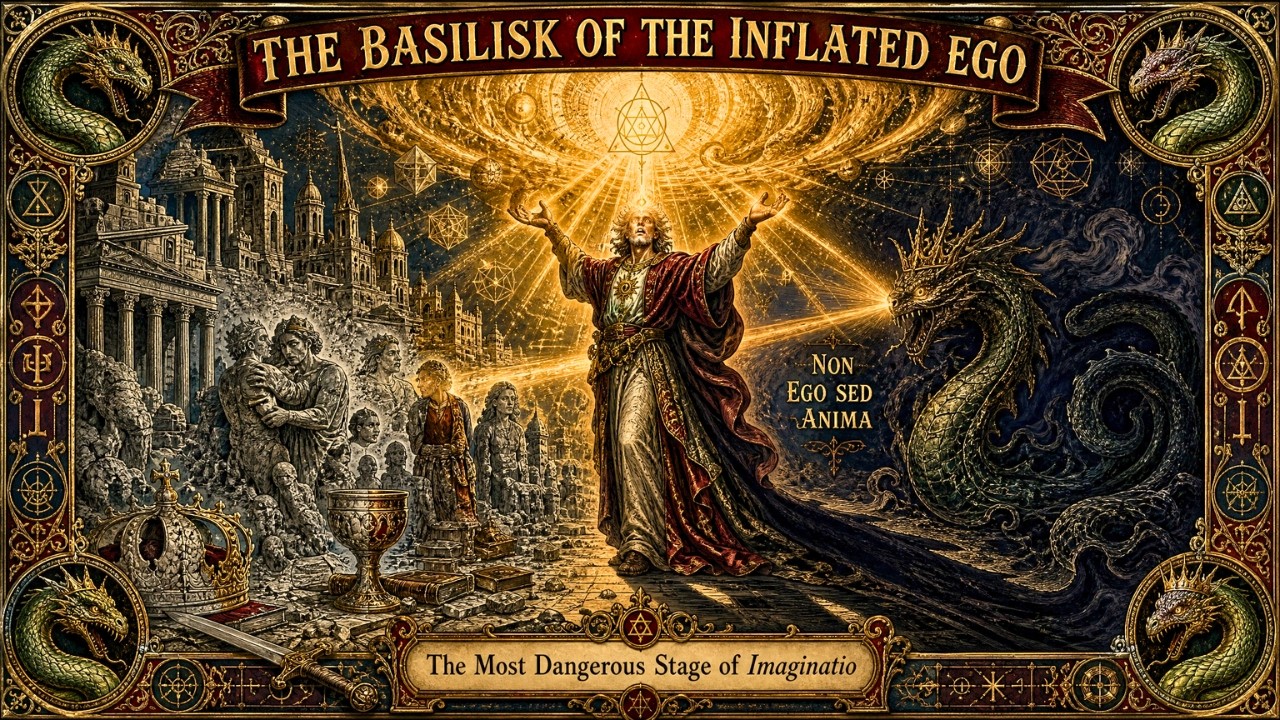
We examine in detail the three dangers the Hermetic tradition explicitly warns against: Psychological Inflation — the Basilisk whose gaze turns genuine inner development to stone by allowing the ego to mistake itself for the source of archetypal power; Possession by the Unconscious, in which an undisciplined ego is overwhelmed by the very images it attempted to command; and the Acor — the bitter void of the Dark Night of the Soul, the existential vacuum between the death of the old self and the crystallization of the new.
The Lapis Philosophorum — the Philosopher's Stone — is not a physical object. It is the fully integrated psyche in which Imaginatio Vera operates with complete sovereignty: a mind that has united the conscious ego with the creative depths of the unconscious, and through which the external world has no choice but to organize itself around the architecture of the internal blueprint.
The Hermetic School is dedicated to the rigorous study of alchemical philosophy, Jungian depth psychology, and the Western esoteric tradition.
Go Deeper
Watch the complete teaching with visual symbolism and guided reflection on our YouTube channel.
Watch on YouTube Explore Ebooks