Never Return the Way You Came — The Final Test of the Opus
Everything up to this point happened to you, or happened inside you.
The collapse was not chosen. The silence arrived. The clarity came on its own schedule. Even the operations that required discipline, the containment and the refusal to act early, were disciplines of restraint. They asked you not to do things.
The last movement of the Work asks something different, and it is the only part of the opus that is genuinely optional.
You have to come back.
The tradition is clear that this is where a significant number of people fail: not in the darkness, which most people survive, but here, at the return, which a great many never attempt.
The Cave, Read to the End
The oldest description of the problem in Western thought is more precise than anything the alchemists wrote, so it is worth starting there.
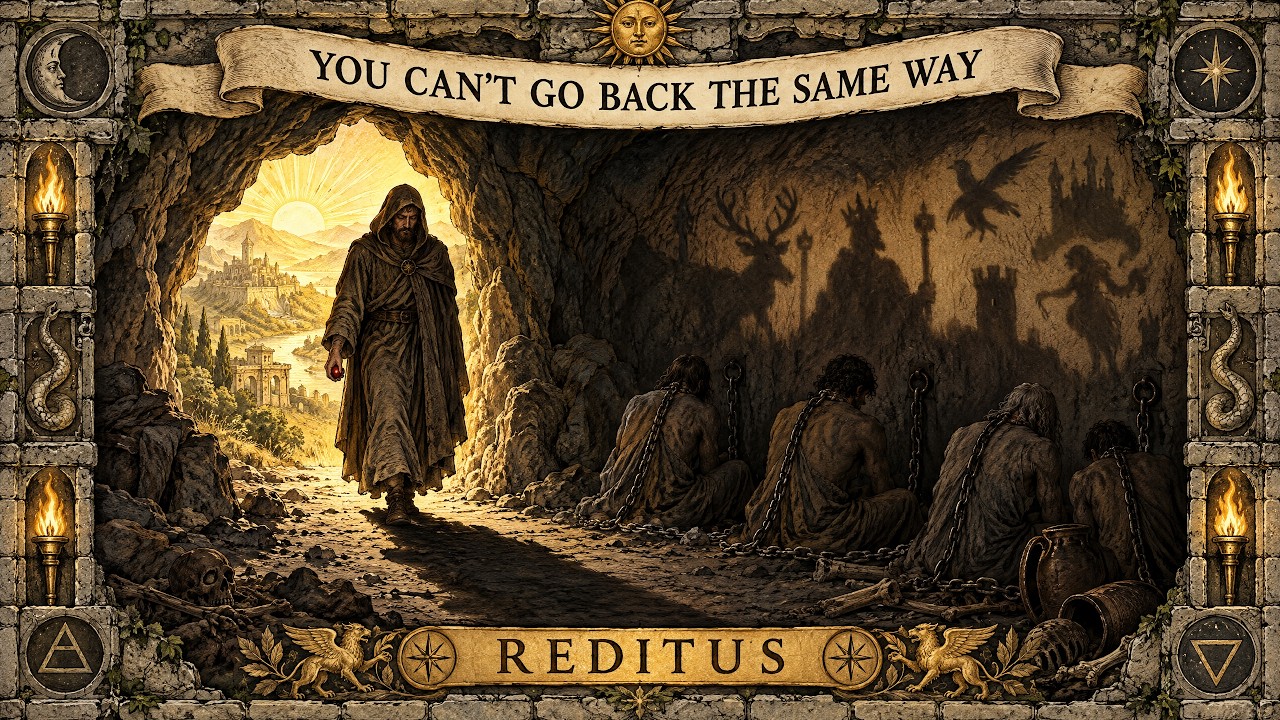
In the seventh book of the Republic, Plato describes prisoners in a cave who have only ever seen shadows on a wall. One of them is released, and the ascent is not the liberation scene it is usually made into. He is dragged out against his resistance. The light hurts. Plato says explicitly that he would prefer to turn back to the shadows he can see. Only gradually do his eyes adjust, first to reflections, then to things, and at last to the sun.
Then Plato asks the question that most retellings skip. What happens when he goes back down?
His answer is bleak and specific. The returning prisoner's eyes, adjusted to daylight, are now useless in the dark. He stumbles. He is worse than the others at the one skill the cave rewards, which is identifying shadows. They conclude that going up ruined his sight, that the journey is dangerous, and that anyone who tries to release them should be resisted. Plato says, without softening it at all, that they would kill him if they could.
And then he adds the sentence that matters most for this episode. The ones who have seen, he says, must be compelled to go back down, because they will not want to. The descent into the cave is not presented as a reward. It is presented as an obligation that the person who has seen will try to avoid.
That is the final test of the opus, described four centuries before Christ. Not: can you get out. Can you go back in, knowing you will be worse at the local game, and stay anyway.
The Same Shape in Another Tradition
The shape is not peculiar to Greece. In twelfth-century China, a Chan teacher named Kuòān Shīyuǎn left a sequence of ten pictures that became one of the most copied images of the path in the Buddhist world: the ox-herding pictures.
A young man searches for a lost ox, finds its tracks, glimpses it, catches it, tames it and rides it home. In the seventh picture the ox is forgotten. The eighth is an empty circle: both the ox and the self are gone.
A modern reader expects the sequence to end there, with the circle. It does not. The ninth picture is a plain landscape, a river and a tree, the world returned to itself. And the tenth is a heavy, ordinary-looking man walking into a village marketplace, often drawn barefoot and carrying a gourd, with nothing remarkable about him at all. The caption speaks of entering the town with helping hands.
Two traditions with no contact between them put the same thing at the end: not the vision, but the return to the market.
Four Ways the Return Fails
There are four ways the return fails, and each one is common and each one looks reasonable from inside.
The first is attempting to resume. You come back and try to pick up the old life exactly as it was: the same role in the family, the same posture at work, the same conversations. For a while it almost works, because everyone around you is helpfully reinforcing the old version of you, not out of malice, but because that is the person they know.
It costs something specific. Every day spent performing a structure that has already dissolved is a day of pressure, and the pressure accumulates, and it usually ends in a second collapse that is worse than the first, because it is voluntary and therefore shameful. You cannot resume. The version of you that occupied that position is not available, and pretending otherwise is one of the most exhausting things a person can do.
The second is demanding that everyone else come too. This one is subtler, and it is very common among people who have done real work.
You return, and you can see clearly what the people around you are running. The pattern in your father. The arrangement your friend is trapped in. The thing your partner will not look at. And because it is so obvious, and because you have just been through something that showed you how much is possible, you begin, gently at first, to try to take them with you.
They did not ask. That is the whole problem. The tradition's position here is uncompromising, and the episode on the rule of silence set it out: the Work cannot be given. It can be made available, and it cannot be administered. A person who returns and immediately starts operating on the people around them has converted the Work into a role, and the role is the same inflation the third stage warned against. The sign of this failure is simple and uncomfortable: you have become tiring to be around.
The third is the professionalised return. Here the person does come back, and comes back as an explainer. The Work becomes a subject, then a vocabulary, then a source of standing, and eventually a living. Explaining the descent becomes a way of never again submitting to it. Joseph Campbell, mapping the hero's journey across the world's myths, gave a whole stage to the hero who does not want to come home, and called it the refusal of the return. This is a version of it that looks like the opposite, because the person is everywhere, talking. It should be said plainly that a channel like this one is implicated in it. Explaining the Work is not doing it, and the one explaining is not exempt.
The fourth is not returning at all. This is the most respectable failure, which is why it is the most dangerous.
The person stays up. They arrange a life with as little friction as possible: few obligations, few people, a great deal of solitude, considerable peace. And they call it what the tradition calls something else entirely. The second stage named it: silver rather than the stone, clarity without commitment. It is hard to argue against because it is genuinely pleasant, the person is genuinely calmer than they were, and nothing is visibly wrong.
But the stone is defined by what it acts on. A stone that is never projected has no properties anyone can observe, including its owner.
Why Awakening Hurts
A psychological guide to spiritual breakdown: why the dark night hurts, what it is doing, and when it is something else.
About the bookWhat a Return Looks Like
So what does a successful return look like? It looks like nothing.
That is the whole difficulty. There is no ceremony, no announcement, no visible change. You go back to the same work, the same house, the same people, and you operate differently in ways that are mostly invisible from outside.
The conversation you would have had, you do not have. The obligation you would have taken, you decline, without a speech. The thing you would have needed reassurance about, you simply carry. Nobody notices, because what changed is what stopped happening, and absences are not observed.
Four Practices for Coming Back
The return cannot be staged, but it can be approached sensibly.
Start with one relationship, not your life. The temptation after a long transformation is to rearrange everything at once. Choose one relationship, the one where the old role costs you most, and let the change happen there first. Everything else can wait.
Do not explain. People will notice that something is different and will ask. A long account of what you have been through will either sound like a conversion story or like an accusation. A short, true answer is enough: I've been through a hard stretch and I'm doing some things differently.
Let people be wrong about you. Some will decide you are depressed, or difficult, or going through a phase. Correcting them is a way of needing their recognition, and it rarely works. Let the misreading stand and let time correct it, or not.
Re-earn rather than assert. Whatever authority, trust or closeness you had in the old arrangement was partly built on the old you. Do not announce the new terms. Show them, slowly, in what you actually do, and let the relationship catch up.
Three Griefs
There is real grief in all of this, and it should not be skipped. There are three, and they should be counted honestly.
The first is the absence of any recognition. A return that changes nothing visible is a return without witnesses. You have been through something enormous and there is no one to tell: partly because of the rule of silence, partly because there is no available language for it, and partly because the people who love you did not experience any of it and cannot be expected to understand it. That is a genuine loss, and it should be counted as one. The tradition does not promise that the Work will be witnessed.
The second is the relationships that do not survive. Some do not, and this needs to be said carefully. Not because you outgrew anyone; that framing is arrogant and usually false. It is because some relationships were held together by an arrangement, the arrangement was one you were maintaining, and when you stop maintaining it the relationship has to find another basis or it ends. Sometimes it finds one. Often it does not, and the ending is sad rather than triumphant.
This is not permission to leave. The number of people who use inner work as a justification for exits they wanted to make anyway is very large, and the tradition offers no cover for that. What is required is that you stop performing a role. What follows from that is not yours to arrange.
The third is the one nobody mentions. The good parts of the old arrangement go too. The ease of being the one everyone relied on, the warmth of being needed in a particular way, the jokes that only worked because of who you used to be: they were partly made of the old structure, and when it goes, they go with it. It is possible to be certain you were right to change and still miss them very much. Both are true.
The Sign of a Genuine Return
There is a sign of a genuine return, and it is the last thing this episode has to give.
You can be among people who have no idea, without contempt and without performance.
Both halves matter. Contempt is the mark of the incomplete return: the quiet superiority of the person who has been outside the cave and cannot stop knowing it. It leaks. It is audible in how they listen.
Performance is the other half: the person who is working hard to appear unchanged, managing their difference, being careful not to be too much.
A completed return has neither. You are simply there, with people who are running arrangements you can see clearly, and you do not need them to know that you can see, and you are not straining to hide it either. The seeing has stopped being a possession.
Plato's prisoner goes back into the cave and is bad at shadows. That is not a failure of his transformation. It is the cost of it, and he pays it, and he stays.
The next episode takes the operation that makes the return durable, coagulatio, the fixing: what it means to make something real enough to live in, and why it comes so late in the sequence.
This is Episode 21 of THE GREAT WORK and the third essay of the fourth stage. Not sure which stage you are in? Find your stage.
Sources
- Plato, Republic, Book VII
- C.G. Jung, Two Essays on Analytical Psychology (Collected Works vol. 7)
- C.G. Jung, Mysterium Coniunctionis (Collected Works vol. 14, 1955–56)
- Joseph Campbell, The Hero with a Thousand Faces (1949)
- Ten Ox-Herding Pictures, attributed to Kuòān Shīyuǎn (12th century)
- Edward F. Edinger, Anatomy of the Psyche: Alchemical Symbolism in Psychotherapy (1985)
This essay is educational and historical. It describes how alchemical and psychological traditions have interpreted human experience. It is not medical or psychological advice, not a diagnosis, and not a substitute for care from a qualified mental health professional. If you are not sleeping, if you believe you have been given a special mission, if people close to you have expressed concern, or if you are hearing or seeing things others do not, please contact a licensed practitioner or a crisis line in your country today.
Go Deeper
Watch the complete teaching with visual symbolism and guided reflection on our YouTube channel.
Watch on YouTube Explore Ebooks