Why Your "Dark Side" is Your Greatest Weapon — The Jungian Secret to Unstoppable Willpower
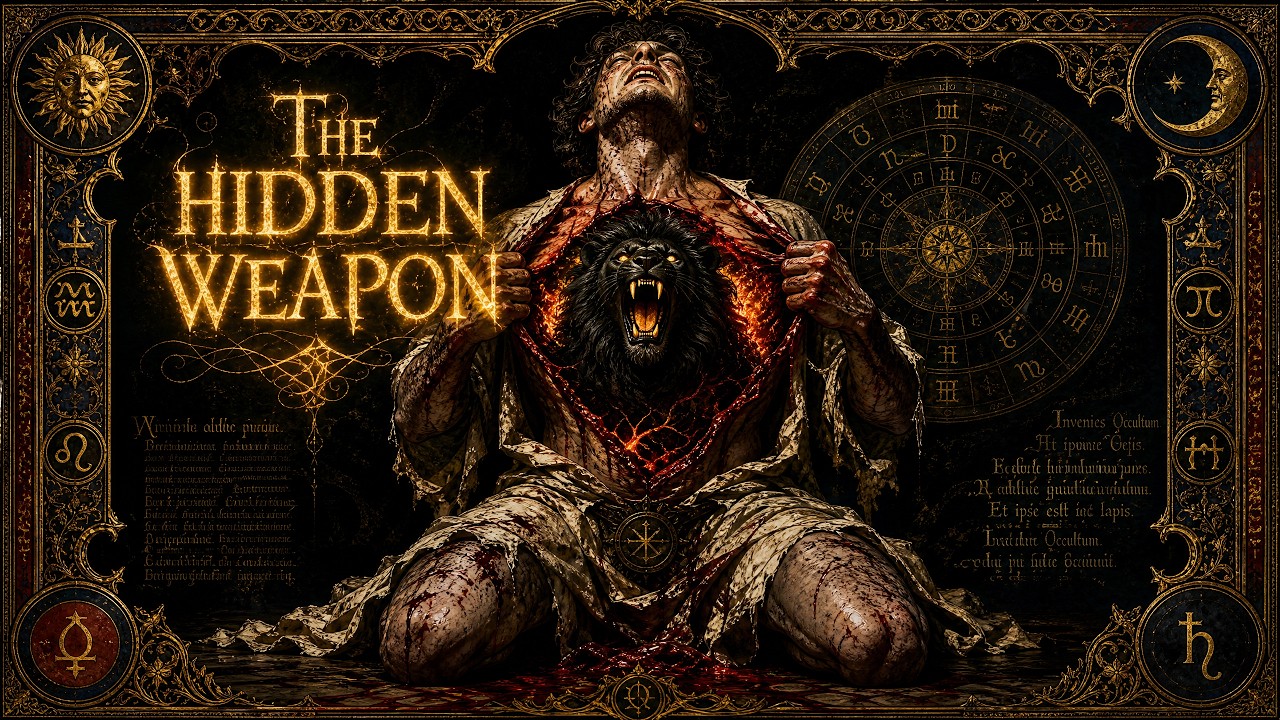
There is a catastrophic misunderstanding at the foundation of modern psychology, self-help culture, and virtually every institutional system designed to produce "well-adjusted" human beings. The misunderstanding is this: that the dark impulses residing in the basement of your psyche — your rage, your ruthless ambition, your capacity for cruelty, your hunger for dominance — are defects to be suppressed, medicated, or confessed away. Carl Gustav Jung spent the second half of his career demonstrating, with clinical precision, that the exact opposite is true. The shadow is not the enemy of the will. The shadow is the will.
What contemporary culture calls "willpower" is almost always a form of ego-driven repression — the conscious personality white-knuckling its way through existence by holding down the very forces that could liberate it. This is why willpower, as commonly understood, always breaks. It is a finite resource drawn from the smallest, most superficial layer of the psyche. Meanwhile, beneath the surface, an ocean of untapped psychic energy churns in darkness — energy that the individual has been trained since childhood to fear, deny, and disown. The Jungian secret to unstoppable willpower is not the strengthening of repression. It is the integration of shadow.
One does not become enlightened by imagining figures of light, but by making the darkness conscious. The latter procedure, however, is disagreeable and therefore not popular.
The War Against Your Own Nature
From the moment you entered a classroom, a family system, or a religious institution, a systematic campaign was waged against your instinctual nature. You were taught that anger is bad, that ambition is selfish, that assertiveness is aggression, that sexuality is shameful, and that the desire for power is inherently corrupt. Each of these teachings performed a surgical operation on your psyche: it severed a living part of your personality from conscious awareness and drove it underground into what Jung called the personal shadow.
The shadow is not a metaphor. It is a psychic structure — a semi-autonomous constellation of repressed impulses, forbidden desires, and rejected capacities that continues to operate beneath the threshold of consciousness with its own agenda, its own energy, and its own survival instinct. Every trait you were punished for expressing did not vanish when you learned to suppress it. It was merely exiled to a region of the mind where it ferments, grows denser, and accumulates charge.
The result is the condition that defines the modern individual: a person spending roughly sixty to seventy percent of their available psychic energy on the act of not being themselves. The exhaustion you feel at the end of each day is not primarily physical. It is the metabolic cost of maintaining a 24-hour repression campaign against your own depths. This is why conventional willpower fails — it draws from the same depleted reservoir that is already overtaxed by the labor of self-suppression. The mechanism is identical to the one explored in the Archon: an internal force that feeds on your unconscious expenditure of energy.
What the Shadow Actually Contains
Jung made an observation that most of his followers have been too uncomfortable to fully absorb: the shadow is not composed primarily of negative qualities. It contains everything the ego has rejected — and that includes your most potent gifts. The individual who was shamed for being "too intense" has exiled their capacity for passionate engagement. The child who was punished for questioning authority has buried their critical intelligence. The person who learned to mask their ambition has disowned the very drive that could fuel extraordinary achievement.
This is why shadow integration does not produce monsters. It produces whole human beings — people who have access to the full spectrum of their psychological resources instead of operating with a fraction of their available power. The integrated individual can be gentle without being weak, assertive without being aggressive, ambitious without being ruthless, and peaceful without being passive. They possess what Nietzsche called the capacity to be dangerous while choosing restraint — a distinction utterly lost on a culture that confuses harmlessness with virtue.
Consider the energetic mathematics. When you repress your rage, you spend energy containing it. When you repress your ambition, you spend energy disguising it. When you repress your sexuality, you spend energy sublimating it into neurotic channels. When you repress your hunger for meaning, you spend energy pretending that surface-level existence satisfies you. Remove these repressions — not by acting them out impulsively, but by consciously integrating them — and you suddenly have access to a reservoir of psychic energy so vast that the concept of "willpower" becomes obsolete. You do not need willpower when you are no longer fighting yourself. This is the same liberation described in the alchemical death of the false self.
The Nigredo of Willpower
Integration does not begin with light. It begins with darkness — the nigredo, the stage of putrefaction and psychological death that the alchemical tradition identifies as the non-negotiable first phase of every genuine transformation. To access the power locked inside your shadow, you must first descend into the territory where the shadow lives. This is not a pleasant journey. It is the systematic confrontation with everything you have spent your life avoiding.
The nigredo of willpower involves a specific, uncomfortable practice: sitting with the impulses you have been trained to reject, without acting on them and without repressing them. When rage rises, you neither explode nor suppress — you observe. You let the dark energy exist in your conscious awareness without judgment, without narrativizing it as good or evil, and without the ego's desperate attempt to control the experience. This is the space between stimulus and response that Viktor Frankl identified as the seat of human freedom.
The Nigredo Journal
Thirty days of guided shadow work, with a prompt and an alchemical reflection for each day of the descent.
About the bookWhat happens in this space is alchemical in the most literal sense. The raw, undifferentiated energy of the shadow — which has been experienced as destructive precisely because it was unconscious — begins to undergo transmutation simply by being held in the light of awareness. Unconscious rage, when consciously witnessed without identification, reveals itself as raw assertive power. Unconscious envy, when observed without shame, reveals itself as a compass pointing toward unlived potential. Unconscious fear, when held without flight, reveals itself as the precise location of your next necessary growth. The same principle governs the alchemical map of anger: your most volatile emotion is your most potent fuel.
The Nietzschean Override
Nietzsche understood this dynamic with a clarity that still disturbs. His concept of the Wille zur Macht — the will to power — has been catastrophically misread as a prescription for domination. What Nietzsche actually described was the fundamental drive of all living systems toward self-overcoming: the organism's inherent impulse to expand beyond its current limitations, to become more than it presently is. This is not the will to dominate others. It is the will to dominate yourself — to overcome the internal resistances, the inherited weaknesses, and the comfortable stagnation that prevent the full expression of your nature.
The will to power, properly understood, is the shadow's own voice demanding integration. When you feel the dark surge of ambition that society taught you to hide, you are feeling the Wille zur Macht in its raw, pre-moral form. When you experience the fierce, almost predatory clarity that arrives during moments of extreme pressure, you are glimpsing the integrated shadow operating at full capacity. When you feel the unsettling, antisocial desire to strip away every comfortable lie and face reality without filters, you are hearing the call of the Nietzschean Übermensch — not the blond beast of fascist propaganda, but the self-overcoming individual who has transcended the herd morality that keeps the shadow in chains.
Jung extended Nietzsche's insight by providing the psychological mechanism. Where Nietzsche proclaimed the necessity of self-overcoming, Jung mapped the interior process by which it actually occurs: the withdrawal of projections, the confrontation with the shadow, the integration of the anima or animus, and the final encounter with the Self. The will to power without Jungian individuation is grandiosity — inflation without substance. Individuation without the Nietzschean will is passivity — insight without the force to act on it. Combined, they produce what this teaching calls unstoppable willpower.
The Kierkegaardian Leap
There is a moment in the integration process where intellectual understanding is no longer sufficient. Kierkegaard called it the leap of faith — the point where the individual must jump across the abyss between knowing and being. You can read every book on shadow work. You can intellectually map every repressed impulse in your psyche. You can discuss the nigredo and the albedo with sophisticated fluency. None of it matters until you actually enter the darkness.
The leap, in the context of shadow integration, is the moment when you stop analyzing your dark side from the safe distance of the ego and allow it to rise fully into consciousness. This is the moment most seekers retreat. The sheer volume of accumulated shadow material — decades of repressed rage, grief, shame, and desire — can feel like a psychological tsunami. The ego screams that it will be annihilated. And in a sense, it is correct: the ego as it currently exists, constructed primarily as a defense mechanism against the shadow, cannot survive the integration process. It must be dismantled and rebuilt.
This is the Black Sun — the Sol Niger of the alchemical tradition. The total eclipse of the old personality. The moment when the carefully maintained facade collapses and the raw, unedited truth of your psychological nature stands fully revealed. It is terrifying. It is also the single most liberating experience available to a human being. Because on the other side of that collapse, for the first time in your life, you are no longer spending energy maintaining a lie.
Integration as Unstoppable Force
What does the integrated shadow actually look like in daily life? It looks like a person who no longer hesitates. Not because they are reckless, but because the internal friction that produces hesitation — the war between the conscious personality and its disowned depths — has been resolved. Decision-making becomes clean, immediate, and rooted in the full spectrum of available information, including the instinctual, non-rational data that the shadow provides.
The integrated individual possesses a quality that others find simultaneously magnetic and unsettling: congruence. Their words, actions, body language, and energy are all expressing the same thing. There is no gap between presentation and reality, no incongruence for the unconscious of others to detect and distrust. This congruence is what produces the experience of "presence" — that quality possessed by certain rare individuals that makes others fall silent when they enter a room. It is not charisma in the superficial, performative sense. It is the gravitational field of a psyche that is no longer at war with itself.
The willpower that emerges from integration is qualitatively different from the willpower of repression. Repressive willpower is brittle, exhausting, and eventually breaks under sustained pressure. Integrated willpower is elastic, self-renewing, and actually strengthens under pressure — because pressure activates the shadow's energy, and when the shadow is integrated, that activation fuels rather than undermines conscious action. This is the operative principle behind why nothing and no one will ever have power over you again: external forces cannot manipulate a psyche that has no hidden levers to pull.
The Sovereign Will
The final stage of shadow integration produces what the Hermetic tradition calls the sovereign will — a state of psychological functioning where action arises from the unified totality of the psyche rather than from the narrow, frightened ego alone. In alchemical terms, this is the Conjunctio — the sacred marriage of opposites within the individual: light and dark, masculine and feminine, spirit and instinct, consciousness and the unconscious.
The sovereign will does not suppress the dark side. It includes it as an essential component of its power. The individual who has achieved this integration can access their aggression without becoming aggressive, their ruthlessness without becoming cruel, their hunger without becoming greedy, and their darkness without being consumed by it. They have not destroyed the shadow. They have made it conscious — and in doing so, they have transformed it from an enemy that drains their vitality into an ally that provides an inexhaustible source of psychological force.
This is the Jungian secret that Nietzsche intuited and Kierkegaard demanded: your dark side is not the obstacle to your will. Your dark side, integrated and made conscious, is your will. The raw energy you have spent a lifetime suppressing is the exact fuel your Great Work requires. Stop fighting it. Stop hiding it. Stop confessing it away in exchange for the false comfort of social approval. Descend into the laboratory. Face the darkness. And discover that the weapon you have been searching for has been locked inside you all along — waiting, with infinite patience, for you to stop being afraid of your own power.
This essay is educational and historical. It describes how alchemical and psychological traditions have interpreted human experience. It is not medical or psychological advice, not a diagnosis, and not a substitute for care from a qualified mental health professional. If you are not sleeping, if you believe you have been given a special mission, if people close to you have expressed concern, or if you are hearing or seeing things others do not, please contact a licensed practitioner or a crisis line in your country today.
Go Deeper
Watch the complete teaching with visual symbolism and guided reflection on our YouTube channel.
Watch on YouTube Explore Ebooks