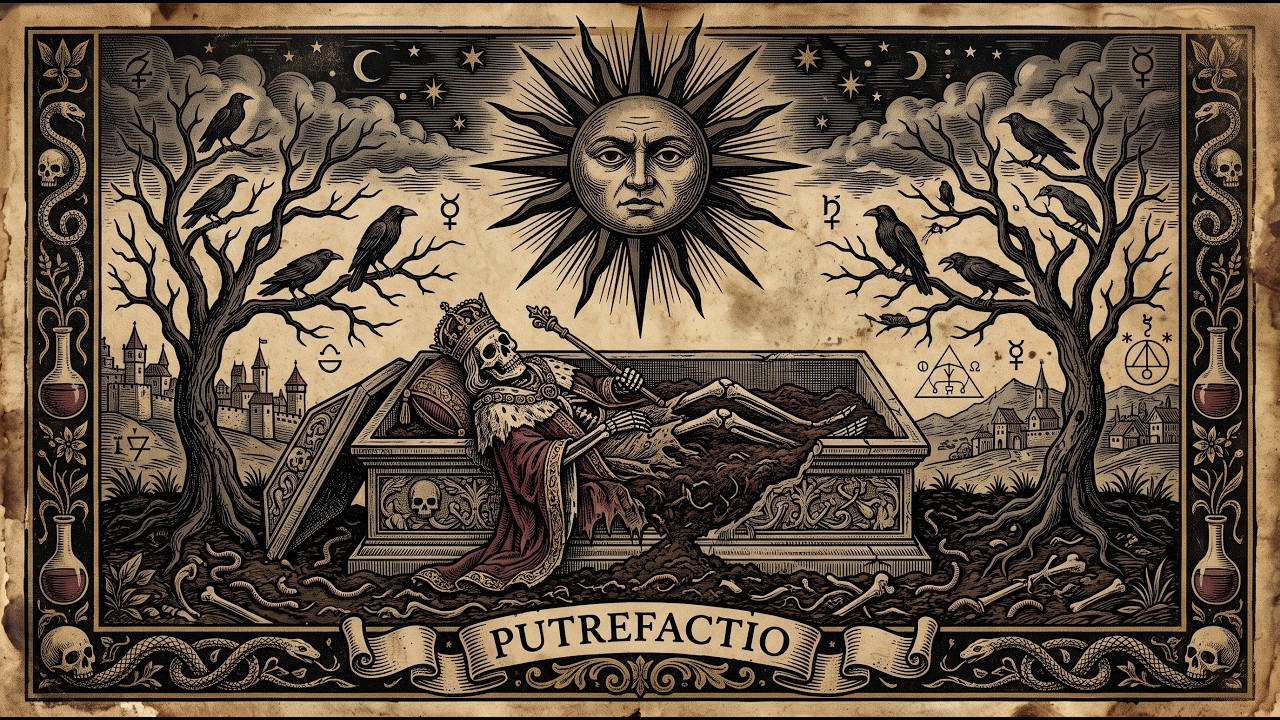
Putrefactio — The Stage Where Everything You Built Appears to Die (Jung + Alchemy)
The supreme hubris of human consciousness lies in its desperate architecture of permanence. We move through our brief biological window constructing elaborate psychological monuments — careers, pristine social personas, highly managed relationships, rigid conceptual identities — convinced that if we only apply enough willpower, stability will follow. We treat our lives as engineering projects, assuming that growth is a linear climb from baseline confusion to absolute mastery.
Beneath this frantic scaffolding of the ego lies a quiet, unyielding cosmic law that every ancient initiator understood and every modern individual desperately flees: before any structure can achieve its ultimate incorruptible refinement, it must first be brought to absolute ruin. It must rot. This is not a metaphor borrowed for dramatic effect. It is the precise architecture of Putrefactio — the alchemical operation in which carefully gathered, separated, and purified compounds are abandoned to a slow, moist internal heat until their forms dissolve entirely.
If you have found yourself standing in the ruins of what you spent decades building, you are not witnessing a cosmic accident. You have been placed inside the crucible. The question is no longer how you can rebuild your old monument — it is whether you possess the intellectual endurance to watch it decompose until only that which cannot die remains.
The Trap of a Clean, Rationalized Identity
To penetrate the actual mechanics of this operation, we must bypass the literal absurdities of medieval charlatanism and engage alchemy as what it actually was: a sophisticated proto-psychological science of transformation. The historical alchemists were depth psychologists who lacked the modern vocabulary of the unconscious, so they projected the intricate anatomy of the soul onto the behaviors of matter in the laboratory. They understood a fundamental paradox — a compound cannot be altered as long as it retains its original rigid form. To transform a substance, its structural integrity must first be broken.
Carl Jung observed that Putrefactio represents the precise psychological transition that occurs when the ego-personality is forced to surrender to the collective unconscious. Prior to this phase, the seeker has typically already engaged in Calcination, the burning of blatant self-deceptions, and Separatio, the intellectual sorting of one's values from societal programming. These earlier operations produce a clean, well-ordered, and ultimately sterile state of mind. The individual believes the work is complete because the problems have been intellectualized — a neat, rationalized identity has been built.
The doctrine of Putrefactio asserts that this rationalized state is the ultimate trap. It is a state of sterile fixity. Because the ego still holds the steering wheel, the new identity is just as fragile as the old one — simply wrapped in more sophisticated vocabulary.
To break this impulse, the psyche introduces a dark solvent. In laboratory alchemy, this is the Ignis Inversus — the inverted, internal fire — and the sealing of the matter within a moist, dark environment. Psychologically, it corresponds to the sudden withdrawal of psychic energy from the conscious mind back into the depths of the unconscious. When this occurs, the clean structures of the intellect begin to ferment and rot.
Mortificatio: When the Fuel Runs Out
The descent into Putrefactio is a nonlinear progression that cannot be hurried by sheer force of will. It is a slow structural collapse that systematically dismantles the final hiding places of the ego, unfolding across distinct stages, each demanding a more radical surrender of the need for control, clarity, and psychological comfort.
The initial stage rarely announces itself with a dramatic external catastrophe. Instead, there is a subtle, pervasive loss of vitality. For years your life has operated with predictability — your career, your identity, your values seemed secure. But imperceptibly, the color begins to drain from the landscape. The goals that once ignited your ambition now feel meaningless. The praise that once fed your ego leaves you completely cold. This is Mortificatio: the realization that your current identity has run out of psychological fuel. The container of your life has become a coffin.
The ego, terrified of this creeping numbness, typically responds by doubling down on its old patterns — seeking greater external stimulation, setting new aggressive goals, switching environments in a desperate attempt to manufacture a sense of movement. But the internal heat has already been turned low. The old form has done its job. It has reached its absolute limit, and it must now be permitted to die.
Nigredo: The Ingress of the Unconscious
As the old form surrenders its grip, the boundaries of the conscious mind begin to leak. This is the stage where the unconscious pours its raw, undigested contents directly into the pristine halls of the intellect. It manifests as an influx of uninvited dreams, strange moods, and an overwhelming undercurrent of existential doubt. The neat explanations you use to organize your life no longer hold. You are forced to confront the unprosecuted hypocrisies of your character, the insecurities that drove your historical successes, and the shadow traits you spent a lifetime denying.
This ingress feels like a slow-motion drowning. You cannot look at your achievements without seeing the neurosis that built them. You cannot look at your relationships without seeing the dependencies that sustain them. The knife of analysis has turned inward, and the shield of your logic has dissolved into a wet, dark uncertainty. This blackening — the Nigredo — rests on a principle the untrained mind refuses to accept: life and death are not opposites but phases of a single continuous operation. Rotting is an intensely active state. It is the process by which a composite entity is broken down into its fundamental, irreducible components.
Once this substance enters the core of the rotting process, the structures you built are no longer merely leaking — they are completely falling apart. In daily existence, this is the phase where your external life mirrors your internal collapse. Plans fail. Networks fracture. Roles you played for decades are stripped away. You are forced to watch your own history be consumed by the crows of the shadow, recognizing that every piece they tear away was a piece you never truly owned. This is the systematic reduction of the ego to the Prima Materia — the raw, chaotic, undifferentiated sludge from which all authentic creation originally sprang. Readers who have already mapped their own descent through this territory will recognize it in the alchemical death of the false self and in the transmutation of depression into raw material for the work.
Caput Mortuum: The Value Hidden in the Ash
Once the decomposition has claimed every superficial structure, the volatility subsides and the matter settles into a flat, dense, motionless state. The alchemists called this the Caput Mortuum — the dead head, the worthless ash left at the bottom of the crucible. Psychologically, this is the state of absolute neutrality that follows a profound depression or loss. The panic is gone. The grief has exhausted itself. The stories you used to tell yourself have been completely silenced. You are left standing on a barren, black landscape of your own mind — no inspiration, no rapid illumination, no immediate hope.
And yet this ash is of supreme value to the alchemist. It is a completely stable substance. It can no longer be corrupted, because it has already reached the bottom of its decay. It can no longer be hurt, because it has abandoned all attachment to form. In this state of radical simplification, you discover a strange, unshakable bedrock. Stripped of all pretense, you occupy reality exactly as it is, for the first time free of the distorting lens of egoic desire.
The Sealed Vessel and the Temptation of Regression
The passage through Putrefactio brings the individual face to face with the ultimate crisis of human existence: the absolute silence of the existential void. In normal life, when we face an emotional storm, we rely on historical coping mechanisms — titles, social validation, habits, intellectual arrogance — to steady the ship. But in the midst of this operation, these coping mechanisms are precisely the elements undergoing decomposition. You cannot use your intellect to escape a crisis caused by the exhaustion of the intellect itself.
The supreme danger of this phase is the psychological phenomenon of regression. As the ego watches its carefully built structures rot, it is seized by an overwhelming primal terror — it feels itself sliding into a state of total dissolution, which it equates with madness or permanent failure. In this moment of acute panic, the temptation to abort the operation becomes almost irresistible. The individual will rush to pull the matter out of the fire: patching up a dead relationship, returning to an obsolete and toxic career path, or adopting a ready-made ideological dogma just to fill the terrifying silence of the void.
To abort the process at this stage is a catastrophic error. It forces the psychic material to cool prematurely, turning it into a hardened, brittle mass of resentment and permanent neurosis — a person who lives in a haunted house of their own making, constantly guarding structures they know are already dead.
Surviving the void requires a rare, cold-blooded philosophical discipline. The emptiness is not evidence that your life has failed — it is evidence that the space is being cleared. The rot must be permitted to complete its mathematics. The ancient masters insisted that the container must remain hermetically sealed: if the external air of common opinion, social comparison, or the quick fixes of psychological first aid penetrates the vessel during the phase of decay, the volatile essence escapes, and the matter can never be brought to its ultimate crystallization. This is the same disciplined patience examined in the alchemical law of natural timing — the recognition that the work has a mathematics of its own, indifferent to how badly the ego wants it finished.
Albedo: What Emerges From the Black Ash
If the vessel remains sealed, if the heat is maintained, and if the practitioner refuses to flee from the stark neutrality of the black earth, an organic shift begins to manifest within the crucible. The decay reaches its natural mathematical conclusion. The old identity has been entirely digested, and its energy is returned to the reservoir of the deep psyche. In the classical texts, this transition is heralded by the Albedo, the unexpected whitening — described as a sudden crystallization where a pure, bright, silver substance emerges directly out of the black ash at the bottom of the vessel.
The individual who completes this terrifying cycle does not step back into the world as an enthusiastic idealist or a loud champion of self-help paradigms. They return with a quiet, dense, and unshakable gravity. Having watched their own identity rot, they have been liberated from the ultimate slavery: the fear of losing themselves. The threat of status loss, the fear of isolation, the anxiety of failure — the levers the world uses to manipulate human behavior — have lost their grip. This is the same quiet sovereignty explored in what remains once nothing and no one can hold power over you again, and it is visible even physically, as described in why those who have integrated their shadow carry themselves differently.
Integration Without the Old Hunger
Integration means moving through the world with a permanent structural alignment with reality. You no longer build monuments out of a desperate need to validate your existence. You create from a position of absolute internal abundance. You can still play social roles, occupy professional titles, and engage in relationships — but you do so with a profound detachment. You use the form. You never again allow the form to possess you. If the structures you build tomorrow should fail or dissolve, you will not panic, because you now know the secret law of the crucible.
Your true value was never located in the architecture you constructed, but in the silent, indestructible intelligence that observed the collapse.
This is the Lapis — the Philosopher's Stone within your own psyche — a center of gravity so refined, so authentic, and so deeply rooted in the objective reality of the self that it stands sovereign, immune to both the seductions of the world and the fires of temporal change. Real psychological power is never verified by your capacity to hold your life together when everything is aligned. It belongs exclusively to the consciousness that can stand in the absolute ruin of its own creation, look at the debris without despair, and recognize that its essential truth cannot be touched by decay. For those navigating this passage across the wider arc of a life, this same law reappears in the alchemy of the second half of life and in the ouroboros paradox that governs every true ending. Those still trying to name what stage they are currently living through may find further orientation in the hermetic knowledge that is disappearing from modern life.
The Hermetic School is dedicated to the rigorous study of alchemical philosophy, Jungian depth psychology, and the Western esoteric tradition.
Go Deeper
Watch the complete teaching with visual symbolism and guided reflection on our YouTube channel.
Watch on YouTube Get The Magnum Opus