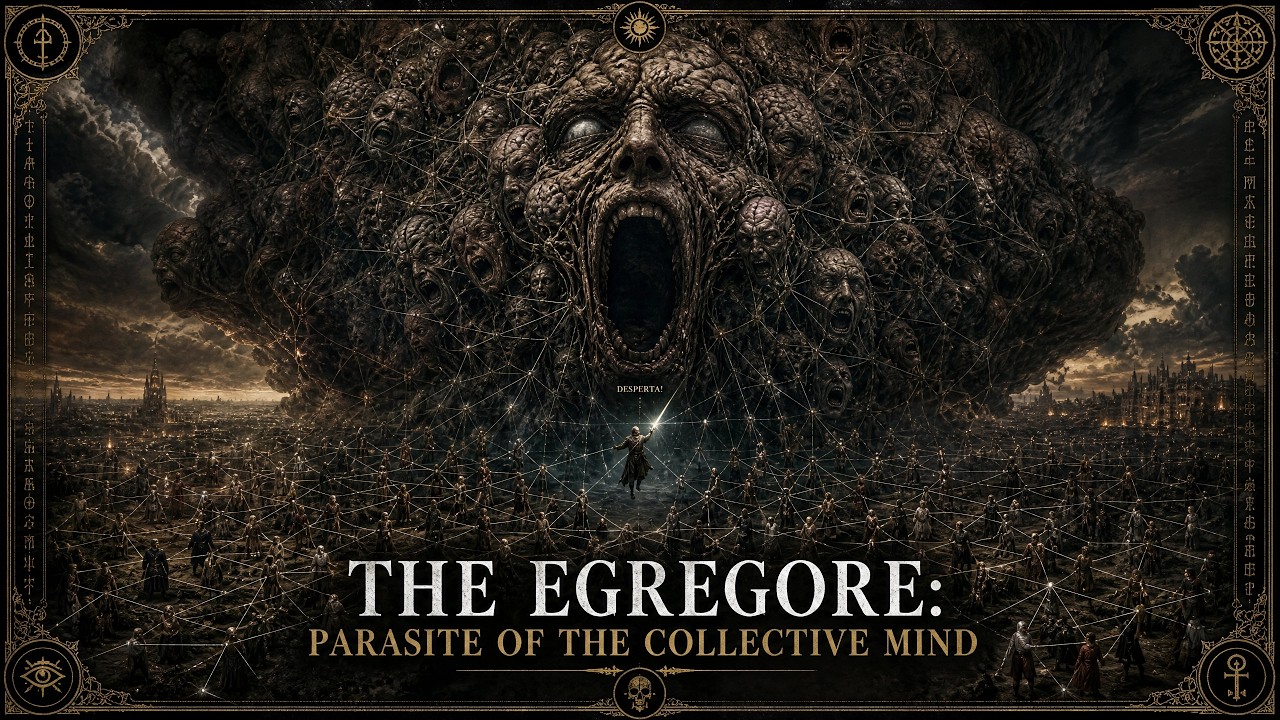
The Egregore — The Invisible Entity Created by Your Unchecked Thoughts
Ask yourself a question you have probably never asked seriously: do your thoughts actually belong to you? Not the deliberate ones — the ones that arrive unbidden. The opinion that surfaced fully formed before you had examined the evidence. The flash of contempt for a stranger whose politics you inferred from a single sentence. The certainty about a group of people you have never met. Trace those thoughts backward and you will rarely find their origin in your own reasoning. You will find that they were handed to you.
The Western esoteric tradition has a name for what hands them to you. It calls it the egregore — from the Greek egrégoroi, "the watchers." An egregore is an autonomous psychic entity generated by the sustained collective attention of a group. It is not a metaphor for groupthink and it is not a demon in the theological sense. It is something stranger and far more practical: a self-sustaining pattern of thought that has acquired enough momentum to behave as though it possesses its own interests, its own appetite, and its own will to survive.
What an Egregore Actually Is
Strip the occult vocabulary away and the mechanism is observable. Whenever a sufficient number of people invest sustained emotional energy in a shared idea — a nation, a brand, a movement, a family myth, a grievance — the idea stops being merely descriptive. It begins to prescribe. It develops rules about who belongs and who does not. It develops enforcement mechanisms carried out by members who believe they are acting on their own initiative. It develops a survival instinct: it punishes doubt, it rewards zeal, and it rearranges the perception of anyone who hosts it so that evidence against it becomes invisible.
No individual designed this behavior. No one is in charge of it. That is precisely what makes it an entity rather than an opinion. The medieval magicians who wrote about egregores were not being superstitious — they were describing emergence, centuries before there was a word for it. A structure arose from the interaction of parts that none of the parts intended and none of them control.
The critical claim of the Hermetic tradition is that these structures feed. Their nourishment is attention charged with emotion. Indifference starves them; agreement fattens them; and — this is the part almost everyone misses — opposition fattens them fastest of all. The person raging against an egregore twelve hours a day is its most productive host, not its enemy.
Jung: The Autonomous Complex Writ Large
Carl Jung arrived at the same territory from the direction of clinical psychology. He observed that the psyche is not a single unified thing but a colony of partial personalities — complexes, clusters of memory, affect, and image gathered around an emotional core. A complex that has been sufficiently charged behaves autonomously. It interrupts. It speaks in your voice while pursuing an agenda you did not choose. Jung's language was unambiguous: complexes "behave like independent beings."
Now scale that observation from one psyche to a collective. Jung's collective unconscious — the inherited substrate of archetypal patterns shared across humanity — supplies the raw material. A group's shared story supplies the emotional charge. What emerges is a complex hosted not by one mind but distributed across thousands, and it exhibits every symptom of the personal complex at industrial scale: it possesses, it distorts perception, it projects its rejected content onto an out-group, and it defends itself ferociously when examined.
Jung watched this happen in real time in the Germany of the 1930s and wrote that a nation had been seized by an archetype. He was not speaking poetically. He was making a psychological diagnosis about an entity that had grown larger than any of the individuals conducting its business — the same feeding mechanism examined in the teaching on the Archon, only turned outward and multiplied.
Das Man: The Anonymous One Who Lives Your Life
Martin Heidegger gave the phenomenon its most precise philosophical description without ever using the word egregore. He called it das Man — "the They," the anonymous one. We say one does not say such things. One dresses this way. People think that. Who is this "one"? No one. And yet this no one issues verdicts on your career, your relationships, your body, your beliefs, and you obey.
Heidegger's point was devastating: in the ordinary condition, das Man does not merely influence your choices — it makes them, and it removes the burden of having chosen. This is what he called fallenness. You are absorbed into an anonymous consensus that relieves you of the terrible freedom of being a self.
Sartre named the same surrender mauvaise foi — bad faith. The waiter who performs "waiter" so completely that nothing of him remains outside the role. The person who says I had no choice when what they mean is I could not bear the anxiety of choosing. Bad faith is the doorway. The egregore does not break in; it is invited, because hosting it is easier than sovereignty. This is the mechanism dissected in the alchemical death of the false self.
The Digital Incubator
Egregores have always existed. What has never existed before is machinery purpose-built to breed them.
A recommendation algorithm does not have opinions. It has an objective function: maximize engagement. It discovers, through blind iteration across billions of interactions, that the content which reliably maximizes engagement is content that produces moral outrage, tribal identification, and fear. It therefore selects for exactly the emotional substrate egregores require, and it does so continuously, at planetary scale, at zero marginal cost.
The result is an artificial incubator. Ideological formations that once required decades and physical proximity to cohere now assemble in weeks among strangers on different continents. The feedback loop tightens: the entity produces the outrage, the outrage produces the engagement, the engagement instructs the algorithm to produce more of the entity. Nobody planned it. Nobody profits from it in the way conspiracy would require. It is emergence, industrialized.
You are not being lied to by a hidden hand. You are being farmed by a pattern that does not know you exist — and your outrage is the crop.
Diagnosing Possession
The honest question is not whether egregores exist. It is which ones you are currently hosting. There are reliable diagnostic signs, and every one of them is uncomfortable to apply to yourself.
Reflexive certainty. You know your position on a complex issue before you have examined the specifics. The conclusion precedes the reasoning.
Emotional disproportion. Your physiological response to a stranger's opinion exceeds any rational stake you have in the outcome. Something is metabolizing your nervous system.
Perceptual asymmetry. You can articulate every weakness of the opposing view and none of your own. Steel-manning the other side feels not difficult but forbidden.
Identity fusion. An argument against the idea registers as an attack on you personally. This is the surest sign of all: the entity has annexed your sense of self, so that defending it feels like survival.
The scan. You open a feed with no purpose, seeking something to react to. That is not curiosity. That is a host organism looking to feed its passenger. The moment you can see this clearly is the moment described in the psychology of no return — you cannot unsee it, and you cannot fully sleep again afterward.
Starving the Entity
The instinct is to fight. The instinct is wrong, and it is wrong in a way that is structurally guaranteed to fail. The egregore metabolizes charged attention and is entirely indifferent to its valence. Your furious rebuttal is a meal. Your exposé is a meal. Your five-hundred-word comment correcting a stranger is a banquet. The entity does not need you to agree with it. It needs you to care intensely and continuously, and it will accept hatred as readily as devotion.
Starvation works where combat does not, and it operates through three practices.
The withdrawal of charge. Not withdrawal of thought — you may continue to hold a position, argue it when it matters, and act on it. What you withdraw is the compulsive emotional investment. The provocation arrives; you observe the surge in the body; you decline to convert it into fuel. This is the operative discipline behind the Hermetic law of the silent observer and the alchemical law of silence.
The recovery of the gap. Viktor Frankl located human freedom in the interval between stimulus and response. The egregore's entire operation depends on that interval collapsing to zero — on your reaction arriving before your judgment does. Every deliberate expansion of that gap is territory reclaimed.
The cut. Some material must simply be removed from the field of attention, because no amount of discipline survives unlimited exposure. This is separatio, the alchemical operation of division — the subject of the alchemical cut that removes what was never yours. It is not avoidance. It is the refusal to keep handing your interior to something that has no use for it beyond consumption.
Individuation: Becoming Someone the Entity Cannot Use
Starvation clears the ground. It does not build anything, and a cleared psyche does not stay empty — vacate one egregore and another will occupy the space within the month, often one that flatters you by presenting itself as the cure for the last. This is why Jung insisted that the goal was never merely liberation but individuation: the long labor of becoming a differentiated self, distinct from both the collective and the persona built to please it.
Individuation requires the specific and unglamorous work of separating what you actually think from what you have absorbed. It requires reclaiming projections — recognizing that the qualities you find intolerable in your ideological enemies are, with remarkable consistency, disowned contents of your own shadow, the descent traced in the teaching on the Black Sun. It requires tolerating the isolation that follows, because a person who no longer performs the tribe's reactions will be read as a traitor by the tribe, and there is no version of this work that avoids that cost.
Camus offers the final image. Sisyphus, condemned to push a boulder eternally, becomes free at exactly one moment — the walk back down, when he sees his fate clearly and neither denies it nor is crushed by it. Lucidity without illusion, and without despair. Applied here, it means this: you will never inhabit a world without egregores. Collective thought-forms are a permanent feature of a species that thinks in groups. What you can do is see them operating, in real time, including inside your own skull — and having seen them, decline to be their instrument.
The Hermetic axiom holds that all is mind. The egregore is what happens when mind runs unattended and organizes itself around an appetite. The remedy is not belief and not war. It is attention, deliberately governed — the sovereignty examined in why nothing and no one will ever have power over you again, and the same engine dissected from the outside in the Demiurge Engine.
Your thoughts can belong to you. But only the ones you have actually examined.
Go Deeper
Watch the complete teaching with visual symbolism and guided reflection on our YouTube channel.
Watch on YouTube Get The Kybalion