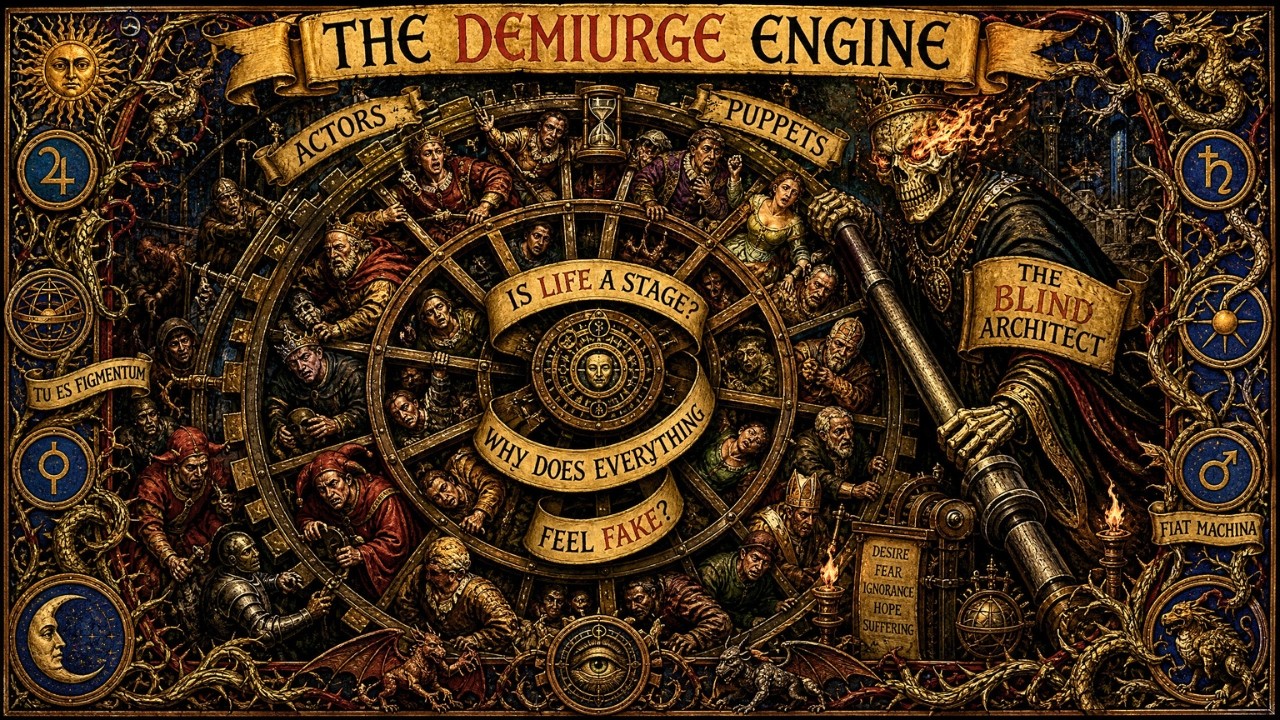
It happens without warning. You are in the middle of an ordinary afternoon — a meeting, a commute, a conversation you have had four hundred times — and something slips. The scene continues, everyone plays their part, and you find yourself watching it from a half-step outside, struck by the sense that all of it is staged. Not false, exactly. Constructed. As though the whole apparatus were running on rails laid down by someone who never asked whether you wanted to be on them.

Most people file this away as fatigue and return to the script within minutes. The Gnostics did not. They took the experience as the single most important datum a human being can be handed, and they built an entire cosmology around it. They called the architect of the staged world the Demiurge — from the Greek dēmiourgos, the craftsman — and they made a claim that has unsettled every orthodoxy it has ever touched: the maker of this world is not the highest reality. It is a competent, industrious, and profoundly limited builder who does not know what it does not know.

The Craftsman Who Believes He Is God

In the Gnostic account, the Demiurge fashions the material world and, surveying his handiwork, declares that he alone is God and there is none beside him. The tragedy of the figure is not malice. It is ignorance that cannot detect itself. He has never seen the fullness beyond his own construction, and so he mistakes his construction for everything that is.

Hold that image, because it is the whole teaching. Not a villain. A builder of genuine skill, operating inside a horizon he cannot perceive as a horizon, generating order that is real, functional, stable — and closed. His creation runs. It simply runs in a loop, and the loop cannot see itself.

Under him serve the Archons, the rulers: enforcement mechanisms that maintain the structure and resist any consciousness attempting to see past it. And within the human being, buried in the machinery, sits the pneuma — the spark, a fragment of the reality that precedes the craftsman. The Gnostic diagnosis is exile. The Gnostic remedy is not belief, not worship, not moral improvement. It is gnosis: direct, unmediated recognition. Not being told the truth. Seeing it.

The Engine Is Not Out There

Read literally, this is a myth about a bad god and a prison planet, and read that way it is worth very little — a cosmic excuse for whatever is not working in your life. Read structurally, it is one of the most accurate descriptions of the human mind ever written down.

The Demiurge is the ego. Not the ego as vanity, but the ego in the precise technical sense: the model-building function of the psyche, the apparatus that takes the overwhelming flood of raw experience and compresses it into a manageable, coherent, predictable world. It is not your enemy. Without it you could not cross a street. It is a craftsman, and a good one.

But it does exactly what the Demiurge does. It builds a model and then forgets that the model is a model. It mistakes its map for the territory and defends the map with the ferocity appropriate to defending reality itself. Every one of us walks around inside a constructed world — assembled from childhood adaptations, inherited assumptions, and the strategies that kept us safe at seven years old — convinced we are simply seeing what is there.

And the Archons are equally domestic. They are the autonomous complexes: the reflexive defensiveness, the compulsive self-justification, the surge of anger that arrives before thought, the scripts that execute the moment a certain tone of voice appears. They enforce the structure without being asked, and they arrive faster than deliberation can — the precise mechanism traced in the Hermetic teaching on the Archon.

The Persona and the Automated Institution

Jung's persona is the Demiurge's finest product. It is the mask assembled to meet the world's expectations — the competent professional, the reliable one, the person who is fine. A persona is not pathology; it is a necessary social instrument. The pathology begins when identification becomes total, when there is no longer anyone behind the mask who could take it off.

This is Sartre's mauvaise foi — bad faith — arriving at the same conclusion from a different tradition. Sartre's waiter performs "waiter" with such completeness that his freedom disappears into the role. He is not lying to anyone else. He is executing a script that spares him the vertigo of having to choose. The Demiurge builds this script, and the human being gratefully moves in.

Scale it up and the same architecture appears in institutions. Every organization begins as a group of people solving a problem. Given enough time, the procedures designed to serve the purpose outlive the purpose, and the institution continues executing them with perfect fidelity and no memory of why. Everyone inside can see that a given process is absurd; no one can locate the person with authority to stop it, because there is no such person. The machinery is running itself. This is the Demiurge Engine operating at the level of the social world — and it is why so much of adult life carries the texture of a set: because much of it genuinely is automated procedure that nobody currently intends. The pattern is examined further in why Stoicism always breaks down.

The world does not feel staged because someone is deceiving you. It feels staged because you are surrounded by machinery that is still running long after anyone was left to mean it.

Chronos: Time as the Instrument of Capture

The Engine's most effective mechanism is its handling of time. The Greeks distinguished two kinds. Chronos is sequential, measurable, quantitative — the calendar, the deadline, the timeline, the sense of life as a line along which one advances toward milestones. Kairos is the opportune moment, the qualitative now, time that has depth rather than length.

The Engine runs entirely on Chronos, and Chronos is where it keeps you. Under its regime, the present moment is never a place — it is a corridor, valuable only as passage toward some future state in which you will finally have arrived. So you spend Tuesday to get to Friday, and your thirties to fund your sixties, and the arrival keeps receding, because the structure requires it to recede. A person who has arrived is a person who has stopped generating output.

Kairos is what breaks in when the machinery stops for a moment. It is what people describe after a diagnosis, a bereavement, a near-miss on the highway: time stops being a line and becomes a volume. Nothing has changed in the external world. What changed is that the Engine's temporal frame briefly lost its grip, and the present became fully inhabitable. This is one meaning of the pattern in the alchemical law of natural timing — the Great Work runs on Kairos, and refuses to be scheduled.

Gnosis Is Not Information

Here is the hardest point, and the one most often lost. You cannot escape the Engine by learning about the Engine. Reading this article changes nothing by itself, and the Demiurge has no objection whatsoever to your acquiring an elegant new vocabulary. It will happily incorporate "Demiurge," "Archon," and "persona" into the existing structure and hand you back a slightly more sophisticated version of the same closed world — one in which you are now the person who understands these things.

That is why the Gnostics insisted on gnosis rather than doctrine. Gnosis is not propositional. It is the moment of direct seeing in which the constructed nature of the construction becomes visible from the inside — and it is generally not pleasant. It typically arrives as the ground giving way: the recognition that a story you have organized your entire life around was scaffolding. The alchemists mapped this as nigredo, the blackening — the necessary dissolution before any genuine reconstitution, the descent examined in Putrefactio and in the alchemical pattern beneath every personal collapse.

What dissolves is not the ego. The ego is required equipment and destroying it produces psychosis, not liberation. What dissolves is the identification — the fusion in which you and the model are the same thing. Afterward the craftsman still builds, competently and usefully. But someone is now watching him work, and knows the difference between the building and what the building was made from.

Camus and the Refusal of the False Exit

Two exits present themselves at this point, and both are traps.

The first is the return: pretend the seeing did not happen, re-enter the script, and take up the reassuring machinery again. It does not work. Something in you now knows, and the knowledge does not decay — the condition described in the psychology of no return.

The second is more seductive: nihilism. If the whole structure is constructed, then nothing means anything, and the correct posture is contemptuous detachment from all of it. This is where a great many people who have genuinely seen something true come to rest permanently, and it is a failure disguised as depth. It is also, precisely, an Archontic move — the Engine's last defense, which no longer needs to hide the machinery because it can simply persuade you that nothing beyond the machinery is worth the effort.

Camus refused both. His Sisyphus knows with complete clarity that the boulder will roll back down, forever, and that no cosmic authority has authorized the labor. He neither denies this nor collapses under it. He descends the mountain conscious, and Camus concludes that we must imagine him happy — not because the absurdity resolved, but because lucidity itself turned out to be the freedom. The scorn of a person who sees the whole structure and continues anyway, on their own terms, is a thing no fate can subdue.

Living Awake Inside the Machine

There is no exit door. You will not leave the material world, quit the institutions, or dismantle the ego, and every tradition that promises otherwise is selling a more flattering cage. What is available is a change in relationship, and it is not small.

It looks like this. You notice the script the moment it begins executing rather than three days later. You feel the surge of reflexive anger and recognize it as an Archon rather than as your own considered judgment. You can put on the persona for the meeting and take it off afterward, because you know which one is you. You still operate in Chronos — deadlines are real — but Kairos becomes accessible rather than accidental, and the present stops being a corridor. You can participate fully in a structure you can see clearly, which is a very different thing from being run by one you cannot.

This is what the alchemists meant by rubedo, the reddening: not escape from matter but conscious inhabitation of it. Spirit and world reconciled rather than divided. The Hermetic axiom — as above, so below — is precisely the refusal of the Gnostic despair. The Engine is not a prison built to hold you. It is a structure, and structures can be inhabited by someone who knows they are inside one.

The staged feeling was never a malfunction. It was the first accurate perception you ever had — the moment the spark noticed the machinery. What follows from it is the entire Great Work: the same territory approached from the collective side in the teaching on the Egregore, and completed in the sovereignty described in why nothing and no one will ever have power over you again.