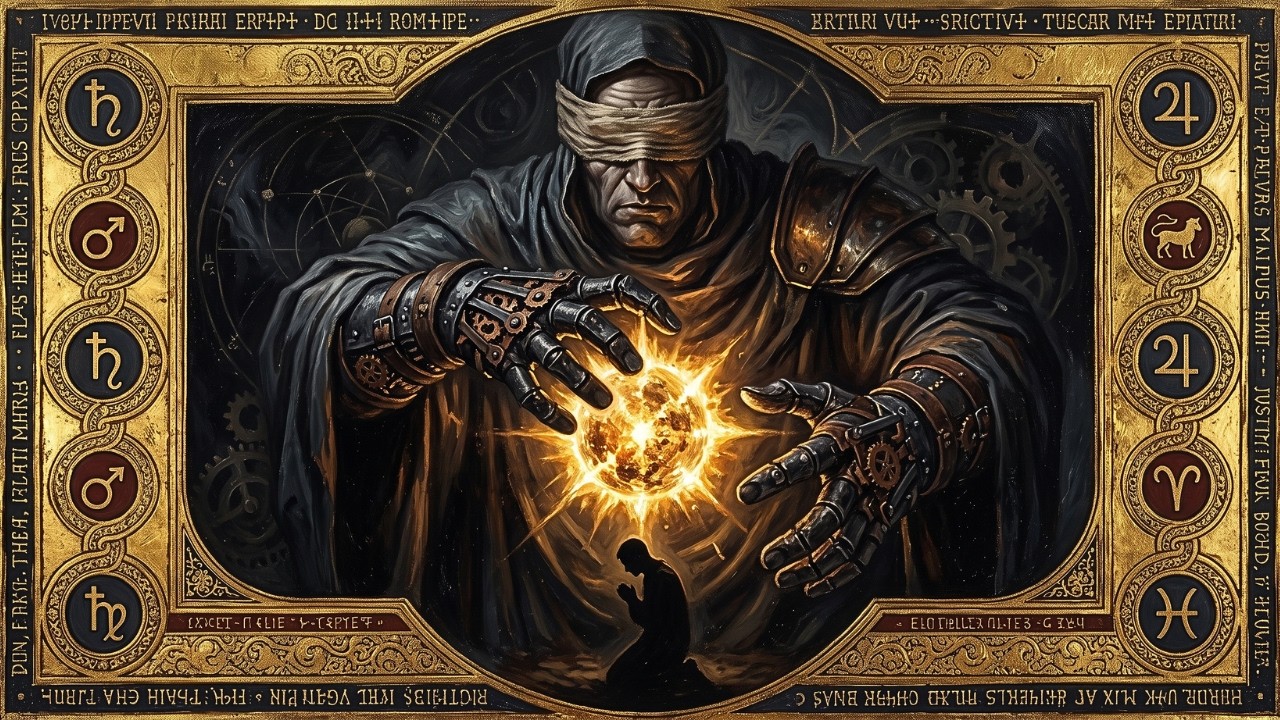
The Gnostic Mystery — What the First Christians Knew About Reality (And Why It Was Buried)
In December 1945, an Egyptian farmer named Muhammad Ali al-Samman struck his mattock into the soft limestone near the town of Nag Hammadi and unearthed a sealed clay jar containing thirteen leather-bound papyrus codices. The texts within had been buried for approximately 1,600 years — hidden, it appears, by monks from the nearby monastery of St. Pachomius sometime after Bishop Athanasius of Alexandria ordered the destruction of all non-canonical writings in 367 AD. What those codices contained was not merely an alternative theology. It was a complete psychological cartography of human consciousness — a map so precise, so threatening to institutional power, that its suppression required the coordinated effort of the Roman imperial church across several centuries.
The texts are collectively known as the Gnostic gospels, though the term "gospel" barely captures their nature. These are not narratives of faith. They are operational manuals for the liberation of the mind from its own self-constructed prison. Read through the lens of depth psychology — through Jung, who spent the last decades of his life studying precisely these texts — the Gnostic cosmology reveals itself not as primitive myth, but as the most sophisticated pre-modern description of the architecture of the human psyche ever committed to writing.
If you bring forth what is within you, what you bring forth will save you. If you do not bring forth what is within you, what you do not bring forth will destroy you. — The Gospel of Thomas
The Demiurge: The God Who Built the Prison
At the center of Gnostic cosmology stands the most radical concept in the history of Western religious thought: the Demiurge. The Gnostics asserted that the visible, material world was not created by the true, transcendent God — the unknowable divine source they called the Pleroma, the fullness of being. Instead, this world was fabricated by a lesser, ignorant deity — the Demiurge, from the Greek demiourgos, meaning craftsman or artisan. This entity, called Yaldabaoth in the Apocryphon of John, was blind, arrogant, and fundamentally unconscious. He declared himself the only god — "I am God and there is no other" — not knowing that an entire realm of light existed above him.
Strip away the mythic language, and a devastating psychological portrait emerges. The Demiurge is the conditioned ego — the constructed identity that each of us assembles from childhood trauma, societal programming, parental expectations, and cultural conditioning. Like Yaldabaoth, the ego declares itself sovereign over all reality. It believes itself to be the whole of who you are. It builds an entire world — your career, your relationships, your beliefs, your self-image — according to its own limited design, never suspecting that a vaster consciousness exists beyond its narrow walls. This is the same mechanism examined in the Demiurge Engine — the ancient explanation for why life feels staged and artificial.
The Gnostic texts describe the Demiurge not as evil in the Manichean sense, but as ignorant — profoundly, catastrophically unaware of its own nature and origins. This is the crucial distinction. The ego is not your enemy. It is your blind craftsman — constructing reality from the only materials it has access to, which are fear, desire, and inherited conditioning. The tragedy is not malice. It is agnoia: ignorance so complete that the prisoner does not know they are imprisoned.
The Archons: Wardens of the Psychological Prison
Beneath the Demiurge in the Gnostic hierarchy stand the Archons — rulers or authorities that govern the successive spheres of the material cosmos. In the Hypostasis of the Archons and the Apocryphon of John, these entities patrol the boundaries between the human soul and its divine origin, ensuring that no spark of awareness escapes upward toward the Pleroma. Each Archon is associated with a specific quality of psychic bondage: one governs fear, another desire, another ignorance, another jealousy.
Translated into psychological language, the Archons are the autonomous complexes that Jung identified as semi-independent psychic entities operating within the unconscious. Each complex — whether rooted in abandonment trauma, narcissistic injury, or inherited cultural conditioning — functions as a warden of its own psychic territory. When you attempt to examine a deeply held belief, confront a repressed emotion, or question an inherited value system, you encounter resistance. That resistance is not passive. It is active, intelligent, and self-preserving. It is, in Gnostic terms, an Archon defending its jurisdiction.
The full mechanism of Archontic feeding — how these autonomous complexes sustain themselves by harvesting the energy of your unconscious emotional reactions — is mapped in detail in the teaching on the Archon. The Gnostic insight adds a critical dimension: the Archons do not merely feed. They impersonate. They convince you that their voice is your voice, that their agenda is your desire, that their fear is your legitimate concern. The most effective prison is one where the prisoner believes they are free.
Jung & The Occult
Where depth psychology meets esoteric wisdom, and where Jung deliberately stopped.
About the bookThe Pneuma: The Spark That Cannot Be Extinguished
Against this architecture of psychic imprisonment, the Gnostics posited something extraordinary: that within every human being, trapped beneath the layers of ego conditioning and Archontic governance, exists a fragment of the original divine light — the pneuma, the spiritual spark. This is not a metaphor for positive thinking or self-esteem. It is a specific assertion about the structure of consciousness: that beneath the chattering narrative mind, beneath the emotional reactivity, beneath the entire constructed personality, there exists a mode of awareness that is unconditioned, unborn, and fundamentally indestructible.
Jung spent years wrestling with this concept. In his commentary on the Gnostic text The Seven Sermons to the Dead — which he wrote in 1916 during his own confrontation with the unconscious, later published as part of the Red Book — he identified the pneuma with what he would eventually call the Self: the archetype of wholeness that exists at the center of the psyche, transcending the ego while encompassing it. The Self is not the ego expanded. It is the consciousness that observes the ego — the silent witness that watches your thoughts without being captured by them.
The Gnostics called the process of recognizing this inner spark gnosis — direct, experiential knowledge of one's divine nature. This is not belief. It is not faith. It is not theological assent to a creed. It is the lived, immediate realization that you are not your thoughts, not your emotions, not your social role, not your trauma, and not the constructed identity that the Demiurge-ego assembled from the raw materials of your conditioning. You are the awareness in which all of these phenomena arise and dissolve. This is the same recognition that the silent observer cultivates through the practice of radical non-identification.
Why the Church Buried the Texts
The institutional suppression of Gnostic Christianity was not primarily a theological dispute. It was a power operation. The Gnostic framework contains a single, devastating implication that no hierarchical institution can survive: if the divine spark exists within every individual, then no priest, no bishop, no pope, and no church is necessary as an intermediary between the human soul and God.
The orthodox church required a theology of dependence — a framework in which salvation could only be accessed through authorized institutional channels: baptism administered by ordained clergy, communion consecrated by priests, absolution granted through confession to a human authority. The Gnostic alternative — that liberation is an interior event, available to any individual willing to undertake the terrifying work of self-knowledge — rendered the entire ecclesiastical apparatus redundant.
Irenaeus of Lyon, writing Against Heresies around 180 AD, attacked the Gnostics not primarily on theological grounds but on institutional ones. His fundamental objection was that Gnostic practitioners claimed direct access to spiritual knowledge without the mediation of apostolic authority. Tertullian complained that among the Gnostics, "even women teach, exorcise, and prophesy." The horror was not doctrinal. It was structural: a spiritual practice that empowers the individual dismantles the institution.
The parallel to modern psychological institutions is exact. The insight that your suffering is not a chemical imbalance requiring pharmaceutical management but a meaningful psychic process requiring conscious engagement — this insight, like gnosis itself, threatens every system that profits from your unconsciousness. This is the same dynamic explored in the Hermetic knowledge that is disappearing: authentic self-knowledge has always been suppressed by systems that depend on ignorance.
The Gnostic Nigredo: Dismantling the False World
The Gnostic path to liberation follows a sequence that maps directly onto the alchemical stages of the Great Work. The first movement is always downward — into the darkness of self-confrontation, into the terrifying recognition that the world you have been living in was constructed by a blind craftsman operating from unconscious conditioning.
This is the nigredo of the Gnostic path: the moment when the constructed reality of the Demiurge-ego begins to crack. You see, perhaps for the first time, that your career was chosen not from authentic desire but from inherited anxiety. That your relationships are not expressions of love but elaborate systems of mutual projection. That your beliefs are not the product of genuine inquiry but the unexamined inheritance of whatever cultural programming happened to reach you first. The entire edifice — the identity you spent decades constructing — reveals itself as the Demiurge's creation: functional, perhaps, but fundamentally unconscious.
This recognition is the psychology of no return. Once you have seen the mechanism, you cannot unsee it. The Gnostic texts call this the moment when Sophia — divine wisdom — pierces through the Archontic veil. In Jungian terms, it is the eruption of the Self into ego-consciousness: an event that is simultaneously the greatest gift and the greatest crisis of a human life. The ego's world is revealed as a construction, and nothing — not comfort, not distraction, not the frantic reassembly of old certainties — can fully restore the illusion.
Gnosis as Individuation
Jung recognized the Gnostic tradition as the most significant precursor to his own psychology. In the Mysterium Coniunctionis and in his extensive private correspondence, he repeatedly returned to the Gnostic framework as the ancient system that most accurately anticipated his discovery of the individuation process. The parallels are not casual. They are structural.
The Gnostic journey from agnoia (ignorance) to gnosis (direct knowledge) maps precisely onto Jung's individuation process: the movement from unconscious identification with the ego-persona to conscious relationship with the Self. The Demiurge corresponds to the inflated ego. The Archons correspond to the autonomous complexes. The pneuma corresponds to the Self. The Pleroma corresponds to the collective unconscious in its aspect as the source of archetypal meaning. And gnosis itself — the experiential, non-intellectual realization of one's true nature — corresponds to what Jung called the mysterium coniunctionis: the sacred marriage of conscious and unconscious, the Conjunctio that produces psychological wholeness.
The reason the Gnostic texts were buried is the same reason authentic depth psychology remains marginal in a culture that prefers pharmaceutical management of the soul: gnosis produces sovereign individuals, and sovereign individuals cannot be governed by systems that require unconsciousness. The Demiurge — whether it takes the form of an ancient bishop or a modern algorithm — needs you asleep. The pneuma needs nothing at all. It is already awake. It has always been awake. The only work remaining is the removal of everything that prevents you from recognizing what was never lost.
The kingdom of God is within you, and whoever knows themselves shall find it. — The Gospel of Thomas
Works Named in This Essay
- C.G. Jung, Mysterium Coniunctionis (Collected Works vol. 14, 1955–56).
- C.G. Jung, The Red Book: Liber Novus (ed. Sonu Shamdasani, 2009).
- C.G. Jung, Septem Sermones ad Mortuos (1916).
- The Nag Hammadi Library in English, ed. James M. Robinson (1977).
This essay is educational and historical. It describes how alchemical and psychological traditions have interpreted human experience. It is not medical or psychological advice, not a diagnosis, and not a substitute for care from a qualified mental health professional. If you are not sleeping, if you believe you have been given a special mission, if people close to you have expressed concern, or if you are hearing or seeing things others do not, please contact a licensed practitioner or a crisis line in your country today.
Go Deeper
Watch the complete teaching with visual symbolism and guided reflection on our YouTube channel.
Watch on YouTube Explore Ebooks