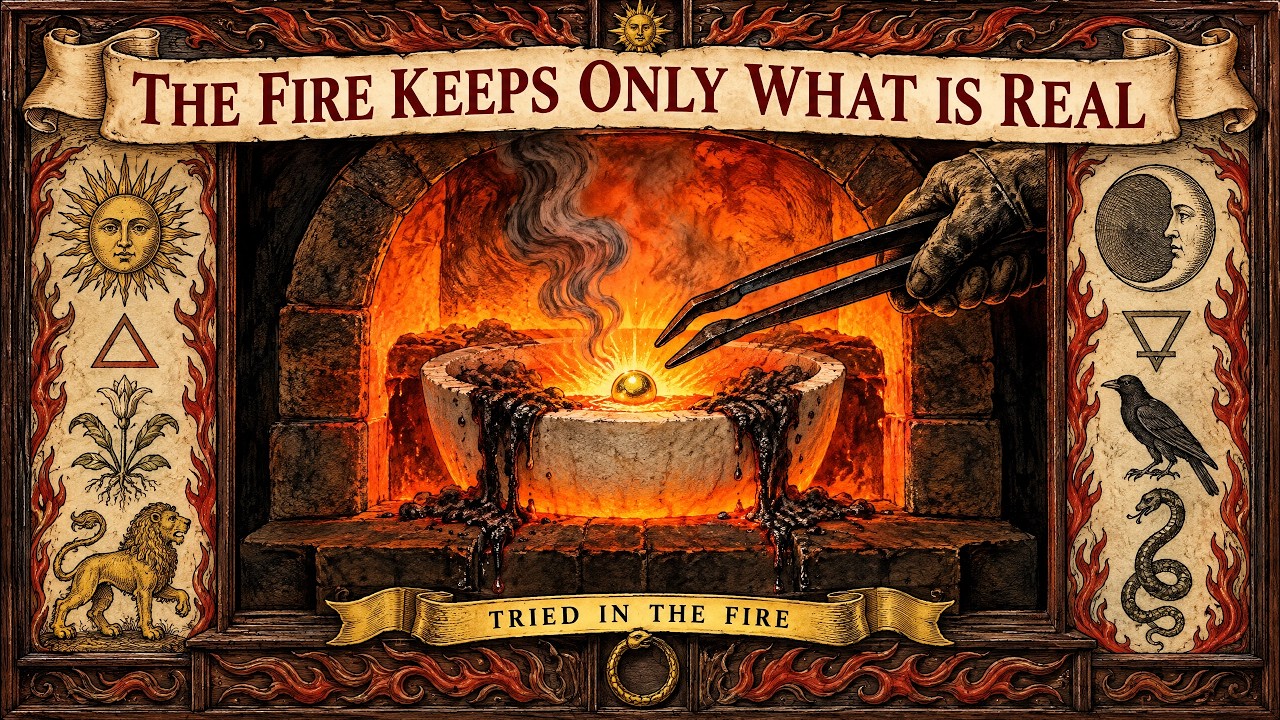
Coagulatio — Why Most Inner Work Never Survives a Normal Tuesday
There is a question that decides whether any of this was real, and it is not a spiritual question.
What is different in your week?
Not in your understanding. Not in your sense of yourself, or in the way you describe what happened to you. In the actual, boring, material structure of your days. What you do on Tuesday morning. What is written in your calendar. Where your money goes. What time you go to bed. Who you called back, and who you stopped calling.
If the honest answer is nothing — if your understanding has been transformed and your week is identical — then whatever happened over the last two years was an experience rather than a transformation. It may have been a profound experience. It may have been the most important thing that ever happened to you. But an experience and a transformation are different things, and the difference between them is the subject of this episode.
The alchemists had an operation for exactly this, and they placed it at the end of the sequence. Not in the middle. Not at the beginning, where most self-improvement starts. At the end.
They called it coagulatio. The fixing. The making-solid.
The Volatile and the Fixed
Let us start with what it actually was in the laboratory, because the procedure is more precise than the word suggests.
Coagulatio is the operation by which something volatile becomes fixed. A substance that was vapour, or dissolved in a liquid, or in some other mobile and unstable condition, takes on body. It becomes a solid — something that can be handled, weighed, stored, carried from one place to another, and used.
And underneath that operation sits a distinction that runs through the entire corpus, from the Greek texts to the latest Latin ones. Volatile and fixed.
The volatile is what rises, what escapes, what cannot be held. Put it in the fire and it leaves.
The fixed is what remains when heat is applied. Put it in the fire and it is still there afterwards.
That is the actual technical definition, and it is worth holding onto, because it is the one that matters psychologically. The fixed is not what is firm, or what is certain, or what is strongly believed. The fixed is what survives fire.
There is a real metallurgical practice behind this that the alchemists knew well, and it is far older than alchemy. Assaying. The testing of a metal by fire to find out what it actually is.
In cupellation, which goes back to antiquity, a sample of metal is heated in a porous vessel under a strong draught of air. The base metals oxidise and are absorbed into the vessel or carried off. What is left behind at the end is the noble metal — the gold and the silver — because those are the metals that the fire cannot take.
That is where the old phrase comes from, about gold being tried in the fire. It is not a figure of speech originally. It is a laboratory procedure. You find out what something is by heating it and seeing what remains.
Lead at the Beginning and Lead at the End
Edward Edinger, in his account of the alchemical operations in Anatomy of the Psyche, treats coagulatio as one of the seven fundamental ones, and he associates it consistently with earth and with body — with the coming-into-matter of something that was previously only potential. Earth is the heaviest element, the slowest, the one that stays where it is put. It is also, in the old planetary scheme, associated with Saturn and with lead: the metal of weight, limitation, and time.
And that association is worth pausing on, because it closes a circle that this series opened twenty episodes ago.
Saturn was the planet of the nigredo. When we looked at the black sun, we saw that the whole first stage sat under Saturn — melancholy, lead, obstruction, the slow and heavy and cold. Lead was the base metal the entire opus set out to transform.
And here, at the end, the tradition returns to Saturn. To weight, to limitation, to time.
That is not a contradiction. It is the same planet in a different relation. At the beginning, Saturn's weight was something that happened to you — the heaviness of a life that had stopped working, pressing down from outside. At the end, weight is something you have chosen to carry. Limitation is no longer imprisonment; it is the shape you have agreed to take. Time is no longer what is running out; it is the medium in which a commitment proves itself.
Lead at the beginning and lead at the end. The difference is that the second time, you are the one who decided where to put it down.
The Operation Nobody Finds Interesting
So the whole opus, compressed into one sentence, runs like this. Something is dissolved. Something is purified. Something is understood. And then something has to become solid enough to live in.
That last step is the one that gets skipped, almost universally, and the reason is simple. It is the only one of the operations that is not interesting.
The collapse is dramatic. The silence is mysterious. The flood of meaning is spectacular. The insight is exciting. Coagulatio is a calendar entry kept for the fourteenth week in a row.
Jung was blunt about this, and the sentence is worth knowing exactly. In Memories, Dreams, Reflections, describing the years of his own confrontation with the unconscious, he says that it is a grave mistake to think it is enough to gain some understanding of the images, and that insight into them must be converted into an ethical obligation. Not into a feeling. Not into a deeper understanding. Into an obligation — something that binds conduct and that you can fail.
That is coagulatio, stated by the man who spent his life on the rest of this material. Everything you understood has to become something you do, and the doing has to be something you can fail at.
What It Actually Is
Now to be concrete about what coagulatio actually is, because vagueness at this point defeats the entire purpose of the operation.
It is a habit that survives a bad week. Not a habit you keep when things are going well — any habit survives a good week. One that is still there after the week when everything went wrong.
It is a boundary that holds when the person testing it is someone you love and they are upset with you. Boundaries with strangers are easy. The fixed version holds under the specific pressure that used to dissolve it.
It is money going somewhere different from where it went before. This is one of the most reliable indicators there is, precisely because money is unsentimental. People can tell themselves anything about their values. Their bank statements are harder to argue with.
It is a commitment with an actual cost attached. One that has a date on it, that a third party could verify, and that you would have to explain if you broke it.
And it is the body. Sleep. Movement. What you eat and drink, and how much. The alchemists associated this operation with earth and with the physical, and there is no way to run a coagulatio that leaves the body entirely out of it. A transformation that has changed your inner life and left your sleep, your posture and your nervous system exactly where they were has not finished coming into matter.
None of that is exalted. All of it is checkable.
And that checkability is the whole point. Everything before this stage was assessed, in the end, by how it felt. The blackening felt like collapse. The whitening felt like silence. The yellowing felt like the return of wanting. Coagulatio is the first operation in the entire sequence that can be evaluated by someone who has no idea what you are thinking.
Four Domains and One Case
It might help to look at it across four domains, because people tend to coagulate in one and not the others.
Time. What is in the calendar, and what has been removed from it. Transformation that does not reach the calendar remains an opinion about how you would like to live.
Money. Where it goes. What you have stopped buying. What you have started paying for that you used to tell yourself you could not justify.
Body. Sleep, food, movement, rest. Not as a project of self-improvement, but as the physical register of whatever has changed.
And relationships. Who you see, how often, and what happens in the room. Whether the conversation you used to avoid now takes place.
Most people who have done serious inner work have coagulated in one of these and not the other three. The person whose relationships have changed completely and whose body is still running on four hours of sleep. The person whose calendar is beautifully reorganised and who has not had the difficult conversation in nine years.
A useful exercise is simply to ask which of the four is still volatile.
To make that concrete, take a single case, because the abstraction hides how ordinary this actually looks.
Imagine someone who has spent two years in this process. The collapse came after a career that had organised their whole identity ended badly. They went through the darkness, the long flat silence, the slow return of wanting. They understand now, clearly, that they spent fifteen years working to be indispensable because indispensability was the only form of safety they had ever been offered. They can trace it to a specific household and a specific parent. The insight is real.
Now look at their week.
In time: they still answer work messages at eleven at night, because they always have, and the understanding has not reached the phone. In money: nothing has changed, because nothing about this seemed to involve money. In body: they sleep five and a half hours, the same as before. In relationships: they have had one honest conversation with their partner about what happened, eighteen months ago, and not since.
Everything has been understood. Nothing has been fixed.
Coagulatio for this person does not mean a new life. It means the phone goes into another room at nine o'clock, four nights a week, and that this is still true in March. It means one further conversation, scheduled, rather than waited for. It means a bedtime that is defended rather than aspired to.
Small, external, checkable, and dull. That is what the end of a two-year transformation looks like when it is actually completing — and it is precisely because it is so unimpressive that so few people do it.
The Kybalion
The seven Hermetic principles read closely, set beside the older sources, and applied.
Get this guide · $7Why It Comes Last
Now — why does this operation come last? This is more interesting than it sounds, and getting it wrong is one of the main reasons so much self-improvement produces nothing.
You cannot fix material that has not been dissolved.
If you take a person who has done none of the preceding work and ask them to install new habits — to meditate, to exercise, to set boundaries, to keep a journal — what usually happens is that the existing structure absorbs the new habit and converts it into another expression of itself.
A perfectionist begins meditating, and within a month the meditation has become another arena for perfectionism — tracked, scored, failed at, punished. A person whose whole life is organised around approval begins exercising, and the exercise becomes another way of earning approval. A person who avoids their own feelings starts keeping a journal, and the journal becomes a very articulate way of avoiding them in writing.
The habit was installed. The structure that was installing it did not change. So the new behaviour is fixed into exactly the old shape.
That is why decades of resolutions produce nothing. Not because the person lacks discipline. Because the material was never loosened. You cannot coagulate what is already set — you can only add more of it.
Which also means something important if you are earlier in this process. If you are in the blackening, or the silence, the instruction to build structure is premature, and forcing it is the error examined in the second episode of this series. There is an order. Coagulatio being last is not an accident and it is not a formality.
But there is a symmetrical error, and this one is for people who have done the work.
Dissolution becomes comfortable.
After two or three years of loosening, questioning, examining and dismantling, the unfixed state acquires a certain appeal. Nothing is committed. Everything is in process. The person can describe their own becoming with great sophistication, and the description is accurate, and it is also a very elegant way of never having to become anything in particular.
We looked at this person in the episode on solve et coagula — the perpetual dissolver. Here is where that pattern meets its test. Because coagulatio is the operation that asks them to stop.
And the tradition's verdict is blunt. A work that does not coagulate has produced nothing. The vessel contains a solution, and a solution is not a stone. It does not matter how pure the solution is.
What It Is Not
Before going further, it is worth saying clearly what coagulatio is not, because the culture has a very loud version of it that is almost the opposite.
It is not productivity.
The modern vocabulary of habit and routine is overwhelmingly a vocabulary of output — doing more, optimising, extracting the maximum from each hour. Coagulatio has nothing to do with output. Some of the most important fixations in this stage are subtractions: work no longer done after a certain hour, obligations no longer accepted, a pace that is deliberately slower.
It is not discipline as an identity.
There is a figure everyone recognises — the person whose rigour has become who they are, who is proud of the cold shower and the five a.m. alarm and the unbroken streak. That is not fixation. It is very often the fortress wearing athletic clothes, and its tell is the same as the fortress's: it cannot tolerate a missed day without something that looks a great deal like shame.
And it is not self-improvement in the usual sense, where the self is a project to be upgraded toward some better specification. The structure that coagulates at the end of this process is not an improvement on the old self. It is the shape the new material takes when it settles. You are not building toward an ideal. You are giving form to something that has already changed, so that it does not dissolve back into what it was.
The difference is easy to feel. Self-improvement is driven by dissatisfaction with what you are. Coagulatio is driven by the need to hold on to what you have become.
Fixed Is Not Rigid
Now the distinction this episode exists for, because it is the one people consistently get wrong.
Fixed is not the same as rigid.
We looked at the fortress in that same episode — the person whose structure was built early, under pressure, and never loosened. Stable, reliable, and unchanged in twenty-five years. It would be easy to read coagulatio as producing that person. It does not, and the difference is precise.
Rigidity is a structure that cannot be dissolved. It survives heat by refusing contact with it. It avoids the conversations, the situations and the people that would test it. Its stability is real, and it is purchased by keeping the fire away.
Fixation is a structure that has already been through dissolution and re-formed. And because it has already been through the fire once, it holds under heat rather than avoiding it.
The test is exposure.
A rigid arrangement needs conditions to be right. It does well when the week is predictable, when the people around it behave, when nothing unexpected arrives. Take the conditions away and it either cracks or it retreats.
A fixed one does not need the conditions. It is still there afterwards. That is the cupellation test again — heat it, and see what remains.
Here is what that looks like in a single situation.
Two people have both decided they will no longer drop everything whenever a particular family member calls in a crisis.
The first has made the decision rigidly. They have simply stopped answering. They do not go to the family gatherings where the subject might come up. They have arranged their life so that the test never arrives — and if it did arrive, unannounced, at a funeral or a hospital, there is a good chance the whole arrangement would collapse in an afternoon.
The second has made the decision fixed. They still answer. They still go. They sit in the room when the crisis is described, they feel the full familiar pull to fix it, they say they cannot do that this time, and they stay in the room afterwards. The boundary is not protected by distance. It is protected by having already been through the fire.
From outside, in a calm month, the two look identical. In the fire, they are completely different substances.
And there is a second difference, the one the alchemists cared about most.
The stone is fixed and it acts. It is projected onto base metal and changes it. Rigidity does not act on anything. It maintains itself, and the whole of its energy goes into the maintaining.
So the question is never only whether your new structure is firm. It is whether it survives contact with the world, and whether it does something there.
Three Practices
How do you actually run a coagulatio? Three practices, and they are deliberately unromantic.
The first. Make it small enough to hold.
The commitment that comes out of a genuine transformation is usually enormous. I will completely change how I work. I will never again let someone treat me that way. I will rebuild my health from the ground up.
Enormous commitments do not fix. They are volatile — they evaporate under the first real heat. And when they evaporate, they take the person's confidence with them, which makes the next attempt harder.
The alchemists worked with small quantities and repeated the operation many times. Do the same. One thing. One hour a week, protected. One conversation you now have instead of avoiding. One boundary, with one person. Small enough that a bad month does not destroy it.
The second. Make it external.
Something with a date, a person, or a payment attached. Write it down. Tell one person. Put it in the calendar where you will see it. Pay for the thing in advance if that is what it takes.
This is not because internal commitment is insincere. It is because internal commitments are made of exactly the same material that is currently being reorganised, and material under reorganisation is a poor container for anything. The external structure is the vessel. It holds the shape while the interior catches up.
And the third. Expect it to fail several times.
This is where most people abandon the operation entirely, and it is worth understanding why.
The structure is built. It holds for three weeks, or six. Then a hard period arrives — an illness, a crisis at work, a death, a terrible month — and the structure collapses. And the collapse is read as evidence that the transformation was never real.
It is not evidence of that. Coagulatio is iterative, like every other operation in this tradition. The substance is fixed, partially. Then it dissolves again under heat. Then it is fixed again, a little more firmly, and dissolves again a little less. The alchemists repeated their operations dozens of times because a single pass was never expected to be sufficient.
The Real Measure
So what you are looking for over the course of a year is not an unbroken record. It is something else, and it is the real measurement of this stage.
The interval between collapse and resumption.
The first time the structure fails, it may take you six months to come back to it. The second time, six weeks. Then a fortnight. Then four days. Then you miss a week, notice, and simply resume without any drama about it.
That shortening interval is the operation working. It looks nothing like the clean, linear progress people expect, and almost nobody measures it — which is why almost everybody concludes that it is not happening.
Write the dates down. It is the single most encouraging thing you can do in this stage, because the pattern is invisible from inside and obvious on paper.
And when it does collapse — which it will — there is a way of coming back that matters.
Do not judge it. The judgement is itself a dissolution; it spends energy that should be going into resumption, and it reinforces the story that you are someone who fails at this.
Resume smaller. If the structure was an hour a day and it collapsed, come back at twenty minutes. The aim is to re-establish fixity, not to recover the old ambition.
And do not wait for the right moment. The right moment is the habit of the volatile. The fixed resumes on an ordinary Tuesday, without a decision.
A Stone
One last thing, about the image the alchemists chose for the product of all this.
They called it a stone.
They could have chosen anything. A flame. A star. A crown. A sun. All of those images appear elsewhere in the same manuscripts, for lesser things. For the end of the Work, they chose the dullest object available.
A stone is unremarkable to look at. It has no light of its own. It is heavy. It is plain. It does not draw attention. And its entire value lies in what it does when it comes into contact with other material.
That is the tradition telling you what the end of this process looks like from the outside, and it is telling you honestly.
Not radiance. Weight. Not a feeling. A Tuesday that is different from the Tuesdays before, for reasons that are invisible to anyone who does not know where to look — and that would survive being put in the fire.
The next episode takes the stone itself. What it was always a name for, and why the alchemical texts refused — deliberately, consistently, and for fifteen hundred years — to say it plainly.
This is Episode 22 of THE GREAT WORK and the fourth essay of the fourth stage. The card for this operation is Coagulatio. Not sure which stage you are in? Find your stage.
Sources
- Edward F. Edinger, Anatomy of the Psyche: Alchemical Symbolism in Psychotherapy (1985)
- C.G. Jung, Memories, Dreams, Reflections (1962)
- C.G. Jung, Mysterium Coniunctionis, Collected Works vol. 14
- C.G. Jung, Psychology and Alchemy, Collected Works vol. 12
This essay is educational and historical. It describes how alchemical and psychological traditions have interpreted human experience. It is not medical or psychological advice, not a diagnosis, and not a substitute for care from a qualified mental health professional. If you are not sleeping, if you believe you have been given a special mission, if people close to you have expressed concern, or if you are hearing or seeing things others do not, please contact a licensed practitioner or a crisis line in your country today.
Go Deeper
Watch the complete teaching with visual symbolism and guided reflection on our YouTube channel.
Watch on YouTube Explore Ebooks