The Philosopher's Stone — Why Every Alchemist Refused to Say What It Was
For roughly fifteen hundred years, an enormous body of literature was written about an object that its authors refused to describe.
The philosopher's stone. The lapis. The end of the Great Work.
Thousands of texts. Hundreds of named operators, across Alexandria, the Islamic world, and Latin Europe. Illustrated manuscripts made with extraordinary care and at enormous expense. Laboratories, furnaces, fortunes spent, lives spent. And running through all of it, from the earliest Greek fragments to the last printed treatises of the eighteenth century, a consistent and deliberate refusal to say plainly what the thing actually is.
That refusal is not evasion, and it is not incompetence, and this episode is about why.
We have spent twenty-two episodes on the operations. This one is about what they were for.
A Thousand Names
Let us start with what the texts do say, because they are not silent. They are contradictory — and the contradictions are systematic enough that they cannot be accidental.
The stone is described as the most precious thing in existence. And it is described as something despised, thrown away, trodden underfoot.
It is said to be extraordinarily difficult to make, requiring years of labour and a lifetime of preparation. And it is said to be available to anyone, rich or poor, and to be found everywhere.
It is the end of the Work, the final product. And it is the prima materia — the raw material you started with.
It is one single thing. And it has, the texts insist, a thousand names.
That last one is literally true. The alchemical lexicons — there is a famous one by Martin Ruland, printed in 1612 — list dozens and dozens of names for the prima materia and for the stone. Jung, in Psychology and Alchemy, reproduces long lists of them. Water, salt, the dragon, the virgin's milk, the orphan, the green lion, the toad, the bride, the sea, the spittle of the moon. The same object, named over and over in different registers, as if no single name could be allowed to settle on it.
Read all of this as failure of clarity and the corpus is nonsense — the confused notes of people who did not know what they were doing.
Read it as deliberate, and a shape begins to appear.
The Stone and the First Matter
Take the strangest contradiction first, because it unlocks the others. The stone and the first matter are the same substance.
The alchemists say this again and again. What you are trying to produce is what you began with. The gold was in the material from the start.
We touched this when we looked at the White Queen, and it is the reason the prima materia is always described as common, cheap and worthless. The texts say it is found in the dungheap. They borrow a line from the Psalms — the stone which the builders rejected has become the cornerstone — and they apply it to their own material over and over. The thing everyone threw away is the thing the whole edifice depends on.
So the entire opus does not create anything. That is the first and most important thing to understand about the stone.
It makes available something that was present from the beginning and was unusable.
The first thing the stone is a name for is not an acquisition. It is an access.
And that changes the emotional shape of the whole process. Nothing is being added to you. Something already in you is being freed from what was binding it — which is what every operation in this series has been: a loosening, a washing, a separating, a fixing, of material that was always there.
What the Stone Does
Now to the property the texts emphasise most, which is the one modern readers almost always skip.
The stone acts on base metal.
Its definition is functional. It is not valuable because of what it is in itself. It is valuable because of what it does to unpromising material that it comes into contact with. Lead into gold. The ordinary, the heavy, the worthless, transformed by contact.
The technical name for this act is projection. A small quantity of the finished stone is thrown onto molten base metal, and the metal is transmuted.
And here is the detail that matters. The quantities in the texts are absurdly disproportionate. A small amount of the stone is said to transmute many times its own weight of metal — some texts give ratios of one part to hundreds, or thousands, or more. The stone is sometimes called a tincture, a dye, because like a dye a tiny amount of it colours an enormous volume.
And people claimed to have seen it happen.
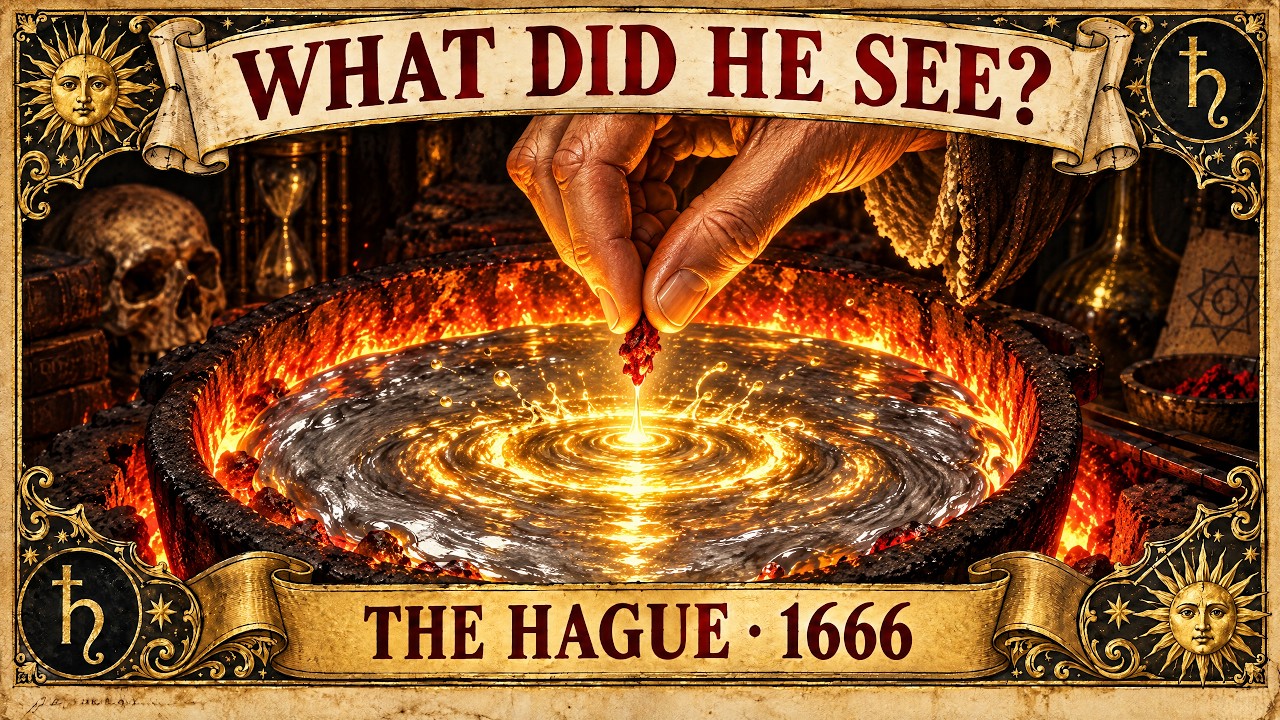
The Hague, December 1666
The most famous account comes from The Hague in December 1666. A physician named Johann Friedrich Schweitzer — he wrote under the Latin name Helvetius, and he was physician to the Prince of Orange — published a description of a visit from a stranger who showed him a few small pieces of a yellowish substance and claimed it was the stone. The stranger left without giving him much, but Helvetius kept a crumb, and some weeks later, in front of his wife and son, he says he threw it onto molten lead and the lead turned to gold. He had it tested by an assayer in the city. He published the whole account the following year in a short book called Vitulus Aureus — The Golden Calf.
It caused a sensation. Spinoza, who was living nearby, mentions in one of his letters that he went to see the silversmith who had assayed the gold, to ask about it himself.
I am not offering that as evidence that lead can be turned into gold. It cannot, by any chemical means available in 1666. I am offering it because it shows what the stone meant to people at the time: not a symbol and not a state of mind, but a real, small, unremarkable-looking substance that did something extraordinary on contact. That is the shape of the idea, and it matters that it was believed literally.
Whatever the alchemists believed about the chemistry, the psychological shape of that claim is exact.
A very small change in the quality of a person can transform a very large amount of ordinary experience. Not because the person does more. Because something in the way they meet the material has changed, and that change touches everything they come into contact with.
We said when we opened this stage that the product of the Work is an agent, not a state. Here is the sharper version of that.
The Base Metal
What, in an actual life, is the base metal?
It is everything that has no obvious value. The material that most of a life is made of.
Take three cases, because this stays abstract otherwise.
The first is the job that is merely a job. Not a vocation, not a calling — the work you do because it pays, and will keep doing, and that no amount of reframing will turn into your purpose. Most people spend most of their waking adult life on something like this.
The second is the parent who is not going to change. The relationship that will be roughly what it is until one of you dies. The same conversation, the same small injuries, the same evasions, at every holiday for the next twenty years.
And the third is the limitation. The illness that is not going away. The body that does less than it used to. The circumstance — money, geography, obligation — that is simply fixed, and that you did not choose.
Base metal. Heavy, dull, unpromising, and not going to be exchanged for anything better.
The claim the tradition makes about the stone — the actual claim, stated in functional terms — is that a person who has completed the Work can bring something to that material which changes what it is.
Not by reframing it. Not by deciding it is secretly wonderful. Not by finding the silver lining or the lesson. By something harder to name: a quality of attention that can be fully present to unremarkable material, and that finds the material yields.
The merely-a-job becomes a place where you are actually present eight hours a day, instead of a place where you are absent and waiting to leave. That does not make it meaningful in the grand sense. It makes it inhabited.
The parent who will not change becomes someone you can be with without needing them to be different — and, very often, the relationship changes anyway, not because they changed but because the pressure you were putting on it has gone.
Picture it concretely. The same holiday table it has been for twenty years. The same remark arrives, the one about your choices, delivered in the same tone. For two decades that remark has produced the same sequence in you: the heat, the defence, the argument you have had forty times, or the silence that costs you the rest of the evening.
This time it arrives and you notice it arrive. You feel the familiar pull. And you do not need it to be different. You do not need your parent to understand, or to apologise, or to stop. You say something light, or nothing, and you stay at the table, and you are actually there for the rest of the meal.
Nothing about your parent has changed. Nothing about the remark has changed. And the evening is a different substance.
The limitation stops being the obstacle between you and your life and becomes one of the conditions your life is made of.
None of these is a transformation of the material itself. The job is the same job. The parent is the same parent. The illness is the same illness. What has changed is what happens at the point of contact.
That is transmutation described without mysticism. And it is what the entire opus was manufacturing.
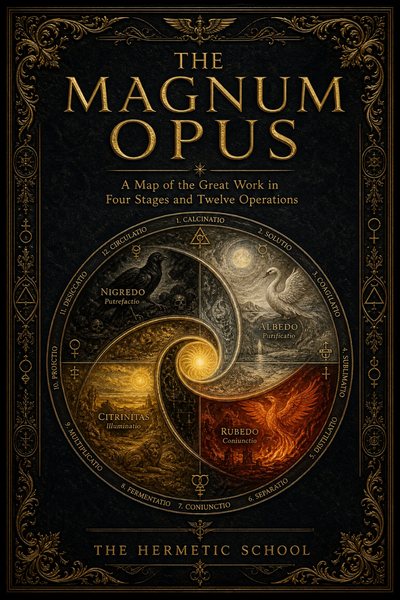
The Magnum Opus
The complete map of the Great Work: four stages and twelve operations, with the psychology of each.
Get this guide · $7What It Is Not
Now it matters to say what it is not, because the counterfeit is everywhere.
It is not positivity. The tradition has no interest in persuading you that difficult things are good. The lead is lead. A great deal of contemporary spirituality consists of insisting that your difficulties are secretly gifts, and the alchemists would not have recognised that. They did not think lead was gold in disguise. They thought lead could become something else through a very long operation, and they never pretended it was not lead first.
It is not acceptance in the passive sense either — the resigned settling into what cannot be changed. The stone acts. Projection is an active verb. The person who has it does something to the material, rather than simply tolerating it.
It is not escape. A great deal of what is sold as spiritual attainment is really a way of rising above the base metal — of becoming someone who is no longer touched by the dull job or the difficult parent because they have transcended such things. That is the arrested sublimatio we looked at in the sixteenth episode. The stone does not lift you away from lead. It is thrown down into it.
And it is not a technique. There is no practice you can apply to your boring job tomorrow morning that will transmute it. The quality of attention that does this is the product of everything that came before — the collapse, the silence, the separation, the long fixing. It cannot be skipped to, any more than the stone can be made without the opus.
The Stone and the Self
Now Jung's reading, which is the boldest thing in his alchemical work.
In Psychology and Alchemy there is a section titled, plainly, the lapis-Christ parallel. In it Jung draws a sustained comparison between the philosopher's stone and the figure of Christ — and he is careful to point out that he did not invent this comparison. The alchemists made it themselves, repeatedly, in their own words, and some of them were quite explicit about it.
The parallels are striking once they are laid out. The stone, like the figure, is rejected by the builders. It is despised and lowly. It undergoes death and burial. It rises. And it redeems base matter — it is the means by which the corrupt and heavy is made incorruptible.
Jung's interpretation of that parallel is careful, and it is not a theological claim. He was not arguing that the stone was Christ or that alchemy was secretly Christian doctrine. He argued that the alchemists were, without fully knowing it, working out in matter something that the religious tradition of their culture had located entirely outside the individual — in history, in a single figure, in the Church.
And the significance of the corpus, for him, was precisely that it is a record of the same process, arrived at independently, and located inside the person rather than outside them. Redemption not as something that happened once to someone else, but as something that has to happen in each life, to that life's own base metal.
For Jung, the lapis is the Self. Not the ego enlarged and not a possession — the organising centre of the psyche, larger than the conscious personality, which the ego comes into relationship with. And, crucially, the Self was there before the work began. Which is exactly what the texts mean when they say the stone and the first matter are one.
That is the second thing the stone is a name for. Not an object. A relationship — with something in you that was always there and was never yours to own.
A Note on the Historians
A note of honesty is needed here, as it is on how we read the sources.
Not everyone accepts this reading, and the strongest objection comes from historians of science. Lawrence Principe and William Newman — who wrote a study of seventeenth-century chemistry pointedly titled Alchemy Tried in the Fire — have argued, with a great deal of evidence, that most alchemists meant the stone quite literally. They believed it was a real physical substance. They were trying to make it in furnaces. Some of their recipes, reproduced in modern laboratories, produce the results the texts describe.
That is a serious argument and it should be taken seriously. The alchemists were not, for the most part, psychologists in disguise.
My own view, which you are free to reject, is that both things are true. They were doing real chemistry, in earnest, with real materials. And because their knowledge of that chemistry was so incomplete, the description of what they were seeing filled up with something else — with the shape of what was happening to them while they watched. That was Jung's claim too. The projection happened precisely because the chemistry was real and the understanding was not sufficient to contain it.
Why They Never Wrote It Down
Which brings us back to the refusal. Why would people who believed in a real stone refuse so consistently to say what it was?
There are two reasons, and both are sound.
The first is practical secrecy, and it is real. Alchemists had patrons who wanted gold and rivals who wanted their methods. They lived under authorities who had opinions about people claiming to transmute metals or to redeem matter. A good deal of the obscurity in the corpus is protective, and some of it is simply commercial.
But the second reason is the one that matters for us, and the texts state it directly, again and again.
The thing cannot be transmitted in a statement.
We established this when we looked at the difference between understanding and sight. A proposition can be handed over. A perception cannot. If I tell you the door is on your left, you now know a fact. If you have never seen a door, the fact is useless to you.
And if the stone is a capacity — a quality of attention that took years of dissolution and washing and separation and fixing to make possible — then writing it down plainly would produce exactly nothing in the reader. Nothing except the illusion of having received it.
That illusion is worse than silence. Because a person who believes they have been given the conclusion stops doing the work. They have the answer. Why would they go through the blackening for something they already have in a sentence?
And the authors built that conviction into the way they wrote.
There was a recognised technique, sometimes called the dispersion of knowledge. You put the first part of an operation in one chapter, the second part three chapters later, and the third in a different book entirely. A reader who wanted the procedure had to assemble it — had to read slowly, repeatedly, comparing, returning, for years. The obscurity was not a barrier in front of the work. It was the beginning of the work.
Many texts say directly that the reader must have a master, that the essential thing passes only from person to person, mouth to ear. Others say the reader must be prepared to understand it, and that until then no amount of reading will help. Both are ways of saying the same thing: what is written can point, and cannot deliver.
So the corpus does something else. It describes the operations in great detail and the product not at all. It gives you the procedure and withholds the result — on the grounds that the procedure is transmissible and the result is not.
Which means, uncomfortably, that this whole series has only been able to give you half of the thing. And that this is not a failure of the series. It is the structure of the material. Every honest account of it has the same shape: the way in, described carefully, and the destination left blank.
The Medicine
There is one more property of the stone that I want to mention before we close, because it changes the moral shape of everything.
The stone is a medicine.
Throughout the literature it is called the medicina, the universal medicine, the elixir. It heals. And it heals other people — that is part of its definition, not a side effect of it.
There is a historical turning point here that is worth knowing.
In the early sixteenth century, the Swiss physician and alchemist Paracelsus — one of the most combative and influential figures in the whole tradition — made an argument that redirected alchemy for the next two hundred years. Many people, he said, think the purpose of alchemy is to make gold and silver. That was not his purpose. His purpose was to find out what virtue and power lay in substances for the healing of the sick.
It was a deliberate demotion of gold. The point of the art, for Paracelsus, was not to enrich the operator but to cure other people. And the line of practice that followed from him — the chemical medicine of the next century and a half — is one of the real ancestors of modern pharmacology.
Psychologically, the shift he made is the shift this stage asks for. From what the Work will give me, to what the Work can do for someone else.
We said in the episode on the rubedo that the product of the Work is mostly good for others. Here is where that comes from. The stone is not a private possession that makes its owner content. It is a substance whose whole nature is to act outward — on base metal, on the sick, on whatever it touches.
If the end of this process has left you calmer and more contained and of no particular use to anyone, the tradition would say you have made silver. Valuable, and not the stone.
They Called It a Stone
One last observation, about the image itself.
They called it a stone.
Not a light. Not a flame, not a crown, not a star, not a sun — all of which were available, all of which appear elsewhere in the same manuscripts for lesser things. For the end of the greatest transformation they could imagine, they chose a stone.
Heavy. Plain. Dull. Something you could carry in a pocket without anyone noticing, and that you might well step over in a road without a second look.
The tradition had fifteen hundred years to choose a better image and never did.
I think that is worth taking seriously as a description of the outcome. That the end of the deepest transformation available to a human being looks, from the outside, like nothing at all. That it is carried by people you would not pick out of a room. And that its only sign is what happens to ordinary things when they come into contact with it.
The final episode does what the tradition did at the end of every stage: it sets out the marks. Nine signs that a cycle of the Work has completed — and, as always, what those signs are not.
This is Episode 23 of THE GREAT WORK and the fifth essay of the fourth stage, the second-to-last of the series. Not sure which stage you are in? Find your stage.
Sources
- Johann Friedrich Helvetius, Vitulus Aureus (Amsterdam, 1667)
- Baruch Spinoza, Letter 40 to Jarig Jelles (25 March 1667)
- Martin Ruland, Lexicon Alchemiae (Frankfurt, 1612)
- Psalm 118:22
- C.G. Jung, Psychology and Alchemy, Collected Works vol. 12
- C.G. Jung, Alchemical Studies, Collected Works vol. 13
- William R. Newman & Lawrence M. Principe, Alchemy Tried in the Fire (2002)
- Lawrence M. Principe, The Secrets of Alchemy (2013)
- Edward F. Edinger, Anatomy of the Psyche (1985)
- IMAGES — All artwork is in the public domain or CC0 (Wikimedia Commons, The Metropolitan Museum of Art Open Access): Splendor Solis, Atalanta Fugiens, Rosarium Philosophorum, Musaeum Hermeticum, Aurora Consurgens, Mutus Liber, and paintings by Rembrandt, David Teniers the Younger, Jan Steen, Gabriël Metsu, Pieter Bruegel the Elder, Jacob van Ruisdael and Pieter Saenredam.
This essay is educational and historical. It describes how alchemical and psychological traditions have interpreted human experience. It is not medical or psychological advice, not a diagnosis, and not a substitute for care from a qualified mental health professional. If you are not sleeping, if you believe you have been given a special mission, if people close to you have expressed concern, or if you are hearing or seeing things others do not, please contact a licensed practitioner or a crisis line in your country today.
Go Deeper
Watch the complete teaching with visual symbolism and guided reflection on our YouTube channel.
Watch on YouTube Explore Ebooks