
9 Signs You Have Completed a Cycle of the Work
A cycle of inner work ends when something you once understood becomes something you can live. The recognition is usually quieter than the crisis that began it. It appears in an ordinary week, in a disagreement, in what you no longer need to rehearse.
In 1677, Pierre Savouret published the Mutus Liber at La Rochelle. Its fifteen engraved plates, including the title page, carry much of the argument through images rather than explanatory prose. The Wellcome Collection preserves copies and records the author under the name Altus. Repeated operations make repetition part of the reader's encounter with the book.
That is an apt place to end THE GREAT WORK. This companion essay follows the final episode's nine signs and four look-alikes. They are a modern psychological reading of alchemical images, not a diagnostic instrument or an ancient checklist that guarantees completion.
A Cycle, with More Work Beyond It
The distinction between a cycle and a final arrival matters. A difficulty can cease to organise your life without removing every difficulty that will follow. You can become more honest about ambition and still have work to do about love. You can settle one grief and encounter another.
In the vocabulary of this series, rubedo names a return to involvement. An insight acquires consequences: time is committed, a conversation happens, a responsibility is accepted. The colour is useful as an image. It does not establish a measurable stage of psychological development.
The following signs ask whether change has acquired that kind of substance. Consider them over months, alongside the experience of people who know you. A compelling afternoon is too small a sample.
1. The Story Becomes More Stable
During a difficult passage, your explanation of it may change repeatedly. You try family history, spiritual language, another person's interpretation, a new account of your own motives. Some revision is necessary. Eventually, however, the account may become simpler and less urgent.
You can describe what happened without having to make the listener recognise its importance. This does not require a perfect memory or a final explanation. New evidence can still change your understanding. The difference is that the story no longer has to rescue your identity every time you tell it.
2. You Need Less Rehearsal
An understanding can occupy the mind long before it changes a habit. You repeat it in conversation, search for it in books, and remind yourself to believe it. Rehearsal may support learning; its absence is not automatically a virtue.
The question is whether some of that effort has become unnecessary. A boundary you once had to justify internally is now ordinary. You can leave the matter alone long enough to attend to something else. The earlier essay on the yellow dawn explores this movement from fluent explanation toward a more settled perception.
3. You Notice the Pattern While It Happens
You recognise the familiar argument halfway through a sentence. You notice that a colleague's success has become a verdict on your worth. You see the impulse to make a promise you cannot keep before the promise has left your mouth.
Recognition does not guarantee control. Sometimes you continue, then repair the damage afterward. What has changed is the timing: the pattern is becoming visible close enough to the event for a different response to become possible. Look for actual examples rather than a general impression of being more aware.
4. Something in Your Week Is Different
This is the practical anchor of the list. A change has reached your calendar, spending, sleep, work, or relationships. Someone who knows nothing about your inner vocabulary could still point to what you now do differently.
You set aside time for the work you kept postponing. You stop agreeing to an arrangement that repeatedly injures a relationship. You ask for help. The change may be modest, but it survives an inconvenient day. That is the question raised by coagulatio: what has become real enough to carry weight?
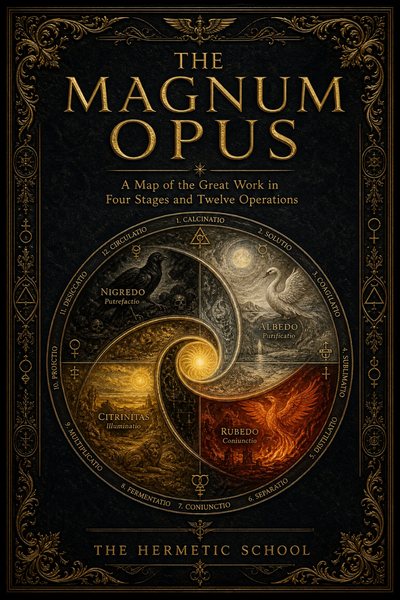
The Magnum Opus
The complete map of the Great Work: four stages and twelve operations, with the psychology of each.
Get this guide · $75. An Old Reaction Has Less Reach
A criticism can still hurt without taking over the following three days. A familiar message arrives and you recover your attention sooner. Often you notice this only in retrospect, when an ordinary week turns out to have contained something that once would have dominated it.
Reduced reaction alone proves little. Exhaustion, avoidance, changed circumstances, and good support can all affect how you feel. Ask what accompanied the quieter response: greater flexibility and engagement, or a withdrawal from everything that matters?
6. You Can Hold an Unresolved Contradiction
You can love a parent and acknowledge a wound. You can want meaningful work and recognise the pleasure you take in being admired. Neither fact has to erase the other.
In this series, coniunctio provides a symbolic language for that difficulty. Holding a contradiction does not mean tolerating abuse, refusing a decision, or treating every position as equally true. It means allowing relevant facts to remain visible while you choose what to do.
7. You Can Be Wrong and Remain Present
An error becomes something to correct. You can say that you misunderstood, listen to the consequence, and revise the account. Being corrected can still be embarrassing. It need not threaten the whole structure of who you are.
This is a useful check against inflation, Jung's term for an ego that overidentifies with something larger than itself. Watch what happens when a cherished interpretation meets a plain objection. Can it be examined, or does disagreement automatically become evidence that the other person lacks understanding?
8. You Can Return to Ordinary Company
You can spend time with people who do not share your interests without quietly ranking them below you. You do not have to turn dinner into a teaching opportunity, or conceal every interest in order to belong.
Returning does not require becoming indiscriminately available. Boundaries and compatible company still matter. The question is whether your study has increased your capacity for relationship. The earlier essay on the return places that capacity at the centre of the work.
9. Desire Returns with Room for Loss
You want to make something, love someone, learn a craft, or contribute to a place. The wanting has consequences. You are willing to spend time and accept uncertainty.
At the same time, the desired outcome does not have to certify your existence. You could lose it, grieve it, and continue. This is an interpretive ideal rather than a test everyone must pass. Illness, bereavement, disability, and material pressure change the conditions in which desire can be expressed.
Four Conditions That Can Resemble Completion
Resignation
You stop arguing because you have stopped expecting anything. Quietness has arrived with bitterness or indifference. Treat that as a reason to investigate what you need, including rest and support, rather than evidence of spiritual failure.
Inflation
An encounter with a powerful idea becomes a special identity. Every objection can be explained away. The useful question is concrete: when did you last change your mind in response to someone else's evidence?
Premature Peace
You have a polished explanation of acceptance, but a particular fact or conversation must remain outside it. A calm that depends on never approaching an unresolved problem deserves a closer look. This does not make calm, meditation, or deliberate practice suspect in themselves.
The Passage of Time
Some disputes lose heat as circumstances change. That can be welcome. It does not, by itself, tell you whether a pattern has been understood or a different way of living has become possible. Age is neither a certificate of completion nor an obstacle to it.
A Review You Can Actually Use
Choose one pattern you have worked with for some time. Write three dated examples from the past month: one moment when it caught you, one when you noticed it earlier, and one observable change in what you did. Include the consequence for another person where you can.
Then write what remains difficult. A useful account can contain progress and unfinished work together. Return to it in a month. You are looking for a more accurate relationship to your life, not a score to defend.
The final episode closes a series. It leaves the ordinary work open: notice, act, repair, and look again. A completed turn gives you something to stand on when the next question arrives.
Frequently Asked Questions
Can you complete the Great Work permanently?
This series treats completion as the closing of a cycle. A pattern can change substantially while other difficulties and future cycles remain. It does not promise permanent enlightenment.
What is the most practical sign of integration?
Look for observable changes in ordinary life: a different response, a kept boundary, a repaired relationship or a changed use of time. Interpret them in context and over time.
Are these nine signs a psychological assessment?
No. They are interpretive prompts from the final episode of THE GREAT WORK, read through alchemical imagery and Jungian ideas. They are not a validated scale or a diagnosis.
What can resemble the end of a cycle?
The episode examines resignation, inflation, premature peace and the passage of time. None can be diagnosed from a checklist; the point is to examine what accompanies your sense of change.
Sources
- Altus, Mutus Liber (La Rochelle: Pierre Savouret, 1677), Wellcome Collection catalogue and copies
- C.G. Jung, Two Essays on Analytical Psychology, Collected Works vol. 7, discussion of the mana-personality
- The Hermetic School, THE GREAT WORK, Episode 24: 9 Signs You Have Truly Completed a Cycle (2026)
This essay is educational and historical. It describes how alchemical and psychological traditions have interpreted human experience. It is not medical or psychological advice, not a diagnosis, and not a substitute for care from a qualified mental health professional. If you are not sleeping, if you believe you have been given a special mission, if people close to you have expressed concern, or if you are hearing or seeing things others do not, please contact a licensed practitioner or a crisis line in your country today.
Go Deeper
Watch the complete teaching with visual symbolism and guided reflection on our YouTube channel.
Watch on YouTube Explore Ebooks