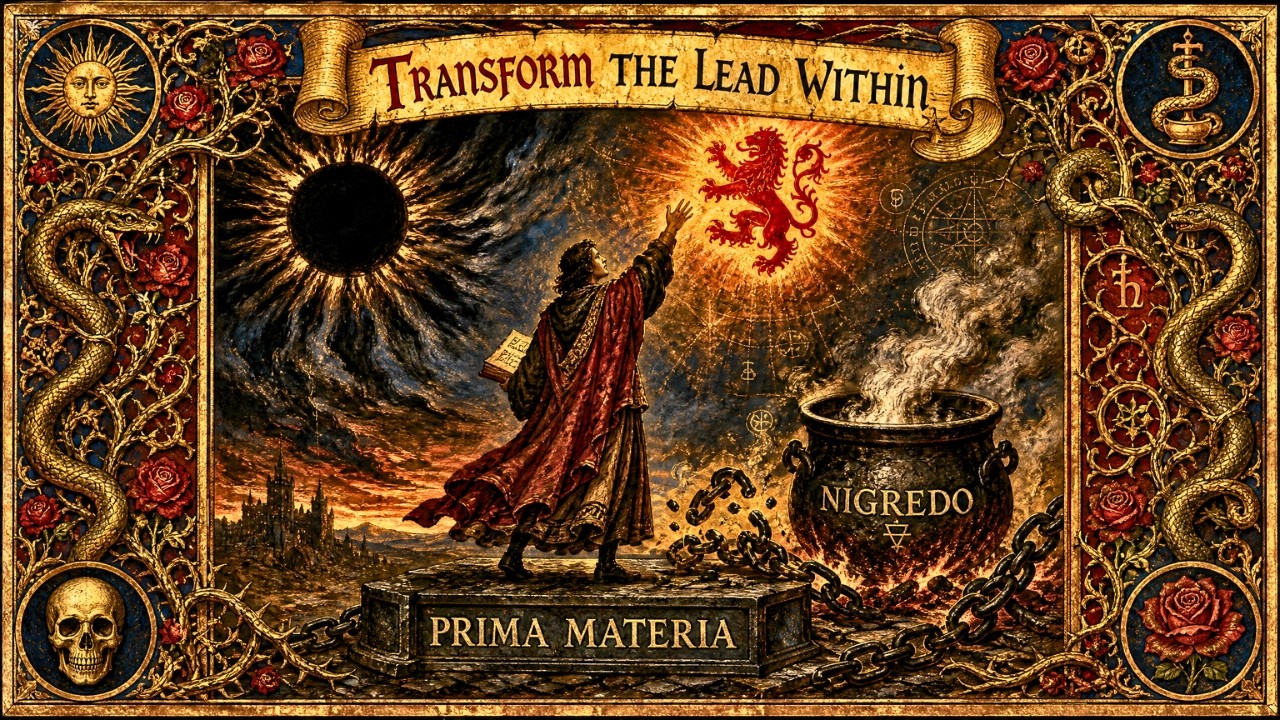
The Rarest Personality Type Carl Jung Called 'The Alchemist' — 7 Signs You Are One
There is a psychological orientation so rare that Jung himself struggled to find adequate language for it. Throughout the Collected Works, scattered across decades of clinical observations, alchemical commentary, and private correspondence, he kept circling back to a single archetype that defied conventional typological classification. This was not the introvert, the intuitive, or the feeling type. It was something more fundamental — a disposition that experiences psychological suffering not as a problem to be medicated away, but as the prima materia itself: the raw lead that the Great Work demands.
Jung called this orientation the Alchemist. Not the historical figure hunched over crucibles and retorts, but a living psychological archetype — a pattern of consciousness that appears in perhaps one in a hundred individuals, people who are constitutionally incapable of accepting the surface of reality as the whole story. If you have spent your life haunted by a persistent, wordless conviction that something essential lies hidden beneath the visible world, you may carry this archetype. What follows are the seven unmistakable signs.
The privilege of a lifetime is to become who you truly are. But first, you must survive the relentless compulsion to become it.
The Compulsion to Transform Suffering
The first and most foundational sign of the Alchemist personality is an instinctual, pre-rational relationship with pain. Where the conventional psyche recoils from suffering — seeking escape through distraction, medication, or denial — the Alchemist moves toward it. Not out of masochism, but from a deep, bodily knowledge that the wound contains information. Every crisis, every heartbreak, every period of existential despair is unconsciously processed as alchemical material waiting to be worked.
This is the same principle that governs the four stages of the Magnum Opus: nigredo, albedo, citrinitas, rubedo. The Alchemist personality does not merely study these stages intellectually. They live them, cyclically, as the fundamental rhythm of their psychological existence. A failed relationship is not just heartbreak — it is a nigredo, a dissolution of a false structure that must decompose before something genuine can crystallize. A period of creative drought is not merely frustration — it is the albedo's silence, the purifying emptiness that precedes the return of authentic vision.
Jung observed this pattern repeatedly in patients who resisted the therapeutic goal of simply "feeling better." These individuals were not seeking comfort. They were seeking transformation. The distinction is crucial: comfort stabilizes the existing personality structure, while transformation dismantles it entirely and rebuilds from the ground up. The Alchemist accepts nothing less than the latter.
A Diagnostic Eye That Never Rests
The second sign is exhausting to live with: a relentless, involuntary capacity to see through surfaces. The Alchemist perceives the hidden structure beneath every social interaction, every institutional facade, every personal narrative. They see the shadow behind the smile, the compensation behind the confidence, the wound behind the aggression. This is not cynicism — it is a form of psychological X-ray vision that operates continuously, whether the Alchemist wants it to or not.
In Jungian terms, this corresponds to a naturally activated transcendent function — the psychic faculty that mediates between conscious and unconscious content. Most individuals must develop this function laboriously through years of analysis or contemplative practice. The Alchemist is born with it already operational, and the result is a life spent feeling profoundly alienated from a world that appears to operate on a script that everyone else has agreed to follow without question.
This diagnostic capacity explains why the Alchemist often experiences social gatherings as draining rather than energizing. It is not mere introversion. It is the cognitive burden of processing multiple layers of reality simultaneously — the spoken words, the unspoken motivations, the collective shadow dynamics playing out beneath the surface conversation. This is the same mechanism explored in the Hermetic law of the silent observer: the practice of watching without reacting, seeing without intervening.
Fluency in the Symbolic Language
The third sign is unmistakable: the Alchemist thinks in symbols. Where the conventional mind processes experience through linear, discursive logic, the Alchemist's cognition operates primarily through the language of images, metaphors, and archetypal patterns. Dreams are not random neural noise but urgent communications from the unconscious. Myths are not primitive entertainment but precise maps of psychological territory. Synchronicities are not coincidences but meaningful eruptions of the unus mundus — the unified field that Jung and the physicist Wolfgang Pauli theorized as the substrate connecting psyche and matter.
This symbolic fluency is why the Alchemist is often drawn to Hermeticism, Gnosticism, Kabbalah, and depth psychology long before encountering them formally. The encounter feels less like learning and more like remembering. When the Alchemist first reads the Emerald Tablet or the Corpus Hermeticum, the experience is visceral recognition — the shock of finding an external text that articulates an internal reality they have always known but never had words for. The same recognition occurs with Imaginatio — the alchemical understanding that the mind does not merely observe reality but actively participates in its construction.
Jung & The Occult
Where depth psychology meets esoteric wisdom, and where Jung deliberately stopped.
About the bookPhysical Resistance to the Superficial
The fourth sign manifests in the body. The Alchemist experiences a near-physical revulsion when forced to engage with superficiality for extended periods. Small talk does not merely bore them — it produces a somatic response: restlessness, irritability, a tightening in the chest, an overwhelming urge to leave the room. This is not social anxiety. It is the body's protest against a form of interaction that the Alchemist's entire psychic apparatus recognizes as a waste of the soul's finite energy.
This physical resistance extends beyond social interaction. The Alchemist cannot sustain interest in work that lacks depth or meaning, regardless of its financial rewards. They cannot maintain relationships built primarily on convenience or social obligation. They cannot consume media designed to anaesthetize rather than awaken. Every aspect of their existence is governed by an internal compass that relentlessly orients toward substance, depth, and authentic engagement with the mystery of consciousness.
The danger of this sign is isolation. When the superficial world constitutes ninety percent of available social reality, the Alchemist can easily become a hermit — not by philosophical choice, but by exhaustion. This is the paradox examined in why the most individuated people end up almost alone: the deeper you go, the fewer companions can follow.
Darkness as Forge, Not Affliction
The fifth sign is the most counterintuitive: the Alchemist's darkest periods are invariably followed by their most significant breakthroughs. This is not a cliché about silver linings. It is a structural feature of the Alchemist's psyche — a built-in transmutation mechanism that converts psychological darkness into expanded consciousness with a reliability that borders on the mechanical.
When the Alchemist enters a period of depression, existential crisis, or complete psychic collapse, they are entering the Putrefactio — the stage of rotting, where outdated psychological structures decompose to release the energy trapped within them. Where the conventional response to such collapse is panic and pharmaceutical intervention, the Alchemist — even while suffering intensely — carries a dim but persistent awareness that the darkness is doing something. That the pain has a direction.
This is not the same as romanticizing suffering. The Alchemist does not enjoy the nigredo. They simply recognize it as non-negotiable. The Black Sun must set before the philosopher's stone can crystallize. The lead must be acknowledged as lead before it can become gold. The Alchemist personality knows this in their marrow, even when their conscious mind is screaming for relief.
The Instinct for Solve et Coagula
The sixth sign is a natural orientation toward the alchemical rhythm of solve et coagula — dissolve and coagulate. The Alchemist's life follows a distinctive pattern: periods of radical dissolution (breaking apart relationships, careers, belief systems, entire identities) followed by periods of deliberate reconstitution at a higher level of integration. This is not instability. It is the fundamental operating system of the individuating psyche.
Most people build a life once and then spend the remaining decades defending it against change. The Alchemist builds, dismantles, and rebuilds — not compulsively, but because each iteration brings them closer to the authentic core that Jung called the Self. Each Separatio — each surgical removal of what was never truly theirs — reveals a layer of the personality that is more genuine, more resilient, and more aligned with the soul's actual trajectory.
The people around the Alchemist find this process bewildering and often threatening. Why would someone voluntarily abandon a stable career? Why would someone end a functional relationship because it lacks "depth"? Why would someone deliberately invite the chaos of transformation when a perfectly acceptable life is available? These questions reveal the fundamental divide between the Alchemist and the rest of humanity. For the Alchemist, "perfectly acceptable" is a prison sentence.
The Inability to Follow Standard Paths
The seventh and final sign is perhaps the most socially visible: the Alchemist is constitutionally incapable of following a pre-scripted life trajectory. The standard sequence — education, career, marriage, accumulation, retirement — feels not merely unappealing but fundamentally wrong, as though following it would constitute a betrayal of something sacred. This is not youthful rebellion or counterculture posturing. It is a deep, persistent, lifelong orientation that intensifies with age rather than mellowing.
Jung recognized that the Alchemist's inability to conform is itself the most reliable indicator of the archetype's presence. The individual who can comfortably inhabit a conventional life without inner conflict is simply not oriented toward the Great Work. The Alchemist's discomfort is not a symptom to be treated — it is the call of the individuation process, the Self summoning the ego toward a transformation that the ego, quite understandably, dreads. The same dynamic is explored in the alchemical death of the false self: every standard path maintained at the expense of the authentic self is a form of slow psychological suicide.
The Alchemist does not choose the Work. The Work chooses the Alchemist. The only decision is whether to resist the call or surrender to the transformation.
The Laboratory Awaits
If you recognized yourself in these seven signs, understand this clearly: recognition is not completion. Identifying the archetype is merely the first step — the calcinatio, the initial burning away of ignorance about your own nature. The actual Work — the disciplined, systematic, often agonizing process of transforming the raw material of your psyche into something resembling wholeness — lies entirely ahead of you.
The Alchemist personality is both a gift and a burden. It grants you access to dimensions of experience that most people will never perceive. It also condemns you to a life that will never be comfortable, never be simple, and never be fully understood by those who do not share the orientation. You will spend long periods feeling profoundly alone — not because you lack the capacity for connection, but because the depth at which you operate makes shallow connection intolerable.
But you will also experience moments of such searing insight, such devastating beauty, such absolute clarity about the hidden architecture of consciousness, that the isolation becomes not just bearable but necessary. The laboratory of the soul requires solitude. The Great Work demands everything. And the Alchemist — the rarest of Jung's types — would not have it any other way.
Works Named in This Essay
- Corpus Hermeticum, trans. G.R.S. Mead, in Thrice-Greatest Hermes (1906).
- The Emerald Tablet (Tabula Smaragdina), in the Latin tradition from the twelfth century; English translation by Isaac Newton (c. 1680).
This essay is educational and historical. It describes how alchemical and psychological traditions have interpreted human experience. It is not medical or psychological advice, not a diagnosis, and not a substitute for care from a qualified mental health professional. If you are not sleeping, if you believe you have been given a special mission, if people close to you have expressed concern, or if you are hearing or seeing things others do not, please contact a licensed practitioner or a crisis line in your country today.
Go Deeper
Watch the complete teaching with visual symbolism and guided reflection on our YouTube channel.
Watch on YouTube Explore Ebooks